The Jakarta Post
Please Update your browser
Your browser is out of date, and may not be compatible with our website. A list of the most popular web browsers can be found below.
Just click on the icons to get to the download page.


Popular Reads
Top Results
No results found. Please check your search term and try again
Can't find what you're looking for?
View all search results
Popular Reads
Top Results
No results found. Please check your search term and try again
Can't find what you're looking for?
View all search resultsAnalysis: PLN leadership shift signals solar ambitions, challenges remain
Change text size
Gift Premium Articles
to Anyone
Share the best of The Jakarta Post with friends, family, or colleagues. As a subscriber, you can gift 3 to 5 articles each month that anyone can read—no subscription needed!
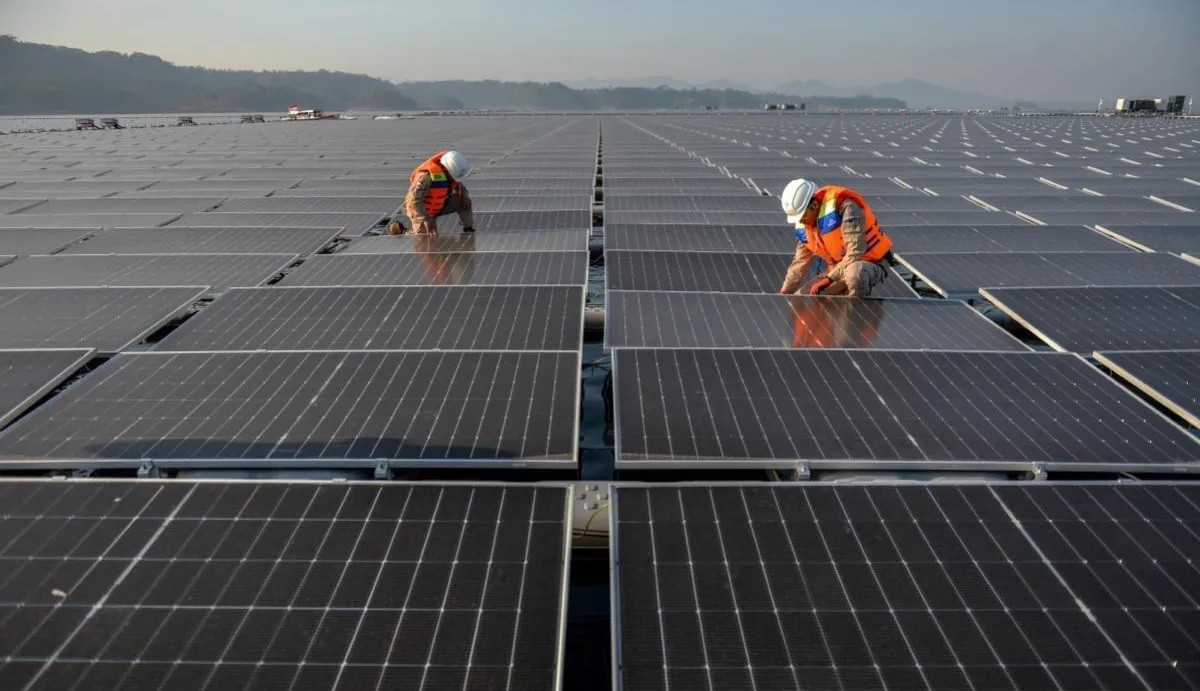 Final tweaks: Technicians check panels on Sept. 29, 2023, at the Cirata floating solar photovoltaic plant, located at the Cirata Reservoir in Purwakarta, West Java. (Antara/Raisan Al Farisi)
T
he appointment of Suroso Isnandar as president director of state-owned electricity company PT PLN comes as the government steps up efforts to deliver its ambitious 100 gigawatt-peak (GWp) solar power program. Having previously overseen renewable energy projects at PLN, Suroso is well positioned to lead the initiative. However, delivering the program within its three-year timeline will be challenging, given Indonesia’s structural constraints on integrating variable renewable energy (NRE) into its electricity grid.
President Prabowo has tasked PLN and the newly established Coordinating Ministry for Downstreaming and Energy Transition with accelerating the 100 GWp solar power program, one of his national priority work programs (PKPN). Launched in Bali on Aug. 25 the program aims to add more solar capacity in three years than Indonesia’s entire installed power generation capacity of approximately 88 GW at the time.
The first phase targets 17 GWp, beginning with 14 projects totaling 5,216 megawatt-peak (MWp) at various stages, including construction, groundbreaking, inauguration and tendering. The program encompasses ground-mounted, rooftop and floating solar power plants, reflecting the government’s push to expand NRE and strengthen energy security.
Despite an estimated solar power potential of 3,294 GWp, Indonesia has utilized only around 1.5 GW. Solar power paired with battery energy storage systems (BESS) is estimated to cost US$0.08–$0.20 per kilowatt-hour (kWh), substantially less than the $0.55–$0.65 cost of diesel-generated electricity. Replacing 13 GW of diesel capacity could save Rp 73.9 trillion annually.
However, achieving the 100 GWp target within three years presents formidable challenges. These include land suitability, limited institutional capacity to implement projects across approximately 80,000 villages and the proposed involvement of Red and White Cooperatives in managing the program. Meanwhile, PLN’s coal-heavy grid and long-term power purchase agreements (PPAs) with power producers constrain its flexibility to accommodate variable NRE generation.
These constraints are compounded by uncertainty over whether electricity demand can keep pace with the planned capacity expansion. PLN’s 2025–2034 Electricity Supply Business Plan (RUPTL) targets an additional 205 terawatt-hours (TWh) in electricity sales over the period, implying average annual growth of approximately 21 TWh.

Sales are projected to rise from 306 TWh at the end of 2024 to 511 TWh in 2034. The projections rely on demand from industrial and special economic zones, tourism destinations, fisheries centers, and electric vehicles (EVs), supporting the government’s target of 8 percent economic growth by 2029. However, the RUPTL predates the 100 GWp solar initiative and already envisages an ambitious addition of 42.6 GW of new and renewable energy (NRE) capacity.