The Jakarta Post
Please Update your browser
Your browser is out of date, and may not be compatible with our website. A list of the most popular web browsers can be found below.
Just click on the icons to get to the download page.


Popular Reads
Top Results
No results found. Please check your search term and try again
Can't find what you're looking for?
View all search results
Popular Reads
Top Results
No results found. Please check your search term and try again
Can't find what you're looking for?
View all search resultsJust another FTA
Unless Indonesia tackles its worsening corruption and regulatory chaos at home, joining the high-standard CPTPP will deliver mere diplomatic prestige rather than real economic gains.
Change text size
Gift Premium Articles
to Anyone
Share the best of The Jakarta Post with friends, family, or colleagues. As a subscriber, you can gift 3 to 5 articles each month that anyone can read—no subscription needed!
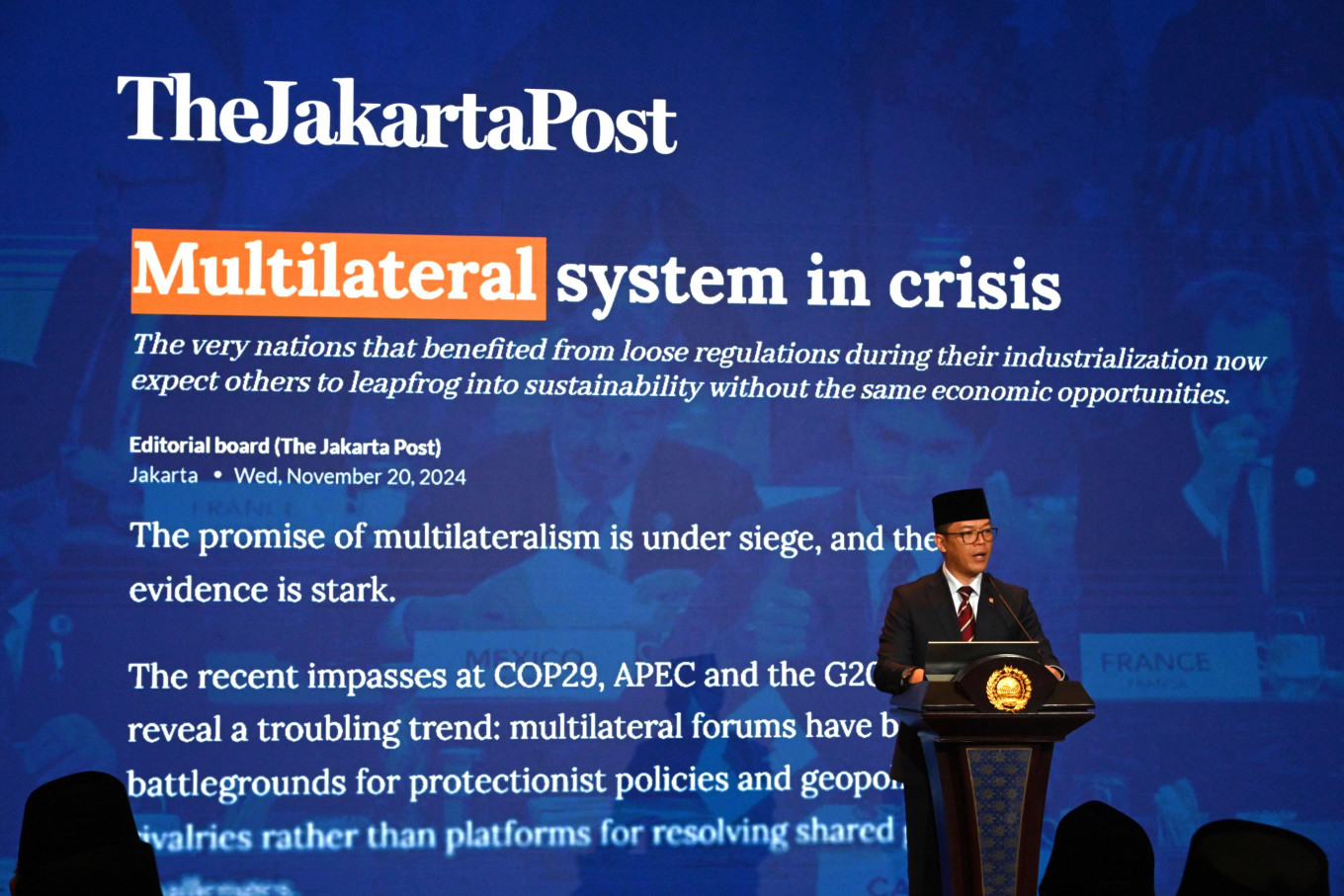 Then-foreign minister Sugiono speaks during the Foreign Minister's Annual Press Statement (PPTM) at the Foreign Ministry in Jakarta, on Jan. 10, 2025. The Foreign Ministry is committed to continuing to strengthen Indonesia's position on the global stage by becoming a member of BRICS and in the process of accession to be included in the membership of the Organisation for Economic Co-operation and Development (OECD) which affirms its active role in various world economic forums such as the G20, APEC, IPEF, MIKTA and CPTPP. (Courtesy of Foreign Ministry/Courtesy of Foreign Ministry)
L
eaders of the 12-member Comprehensive and Progressive Agreement for Trans-Pacific Partnership (CPTPP) are expected to approve Indonesia's accession at their Nov. 23–27 summit in Vietnam. Yet a central question remains: What exclusive benefits can Indonesia secure from this bloc that existing trade arrangements cannot already provide?
President Prabowo Subianto requires a comprehensive briefing on free trade agreements (FTAs) ahead of an intensive diplomatic sprint. In mid-November, he will attend the ASEAN Summit in Manila (Nov. 16–18), followed immediately by the Asia-Pacific Economic Cooperation (APEC) leaders' meeting in Shenzhen, China (Nov. 18–19). In December, he heads to Florida in the United States for the Group of 20 Summit at Trump National Doral Miami (Dec. 14–15).
Across Manila, Shenzhen and Miami, President Prabowo will have prime opportunities to promote his administration’s economic agenda. However, high-level diplomatic talks simply address broad principles. Real economic dividends materialize only when the private sector follows through.

Coordinating Economy Minister Airlangga Hartarto asserts that Indonesia will attain full CPTPP membership by 2027. Skeptics abound, given the CPTPP's reputation as one of the world's most rigorous, high-standard trade pacts.
Without exceptional concessions, meeting these stringent standards within three years will prove next to impossible. Jakarta would have to overhaul domestic regulations and enforce strict inter-agency coordination across market access, investment rules, digital trade and government procurement.
Strategically, the economic magnet of the CPTPP is fading. The Japan- and Australia-led grouping lost significant weight when President Donald Trump withdrew the US in 2017. China’s accession bid has languished since 2021, and South Korea has shown little interest. Given that the bloc has denied entry to the world's second-largest economy, it is difficult to escape the impression that the CPTPP functions primarily as a geopolitical counterweight to Beijing.

Furthermore, Indonesia already maintains bilateral or ASEAN-level trade deals with 10 of the 12 CPTPP signatories. Jakarta is also an anchor of the Regional Comprehensive Economic Partnership (RCEP), the world’s largest, legally binding trade bloc initiated by ASEAN alongside China, Japan, South Korea, Australia and New Zealand. While perhaps less exacting than the CPTPP, the RCEP is far better calibrated to the realities of emerging economies like Indonesia.




Your Opinion Matters
Share your experiences, suggestions, and any issues you've encountered on The Jakarta Post. We're here to listen.
Enter at least 30 characters
0
/ 30
Thank you
Thank you for sharing your thoughts. We appreciate your feedback.








