The Jakarta Post
Please Update your browser
Your browser is out of date, and may not be compatible with our website. A list of the most popular web browsers can be found below.
Just click on the icons to get to the download page.


Popular Reads
Top Results
No results found. Please check your search term and try again
Can't find what you're looking for?
View all search results
Popular Reads
Top Results
No results found. Please check your search term and try again
Can't find what you're looking for?
View all search resultsThe Z in resistance
From One Piece flags to Hunger Games salutes, Indonesia’s Gen Z is ditching tired tropes and rewriting the playbook of street resistance in a language entirely their own.
Change text size
Gift Premium Articles
to Anyone
Share the best of The Jakarta Post with friends, family, or colleagues. As a subscriber, you can gift 3 to 5 articles each month that anyone can read—no subscription needed!
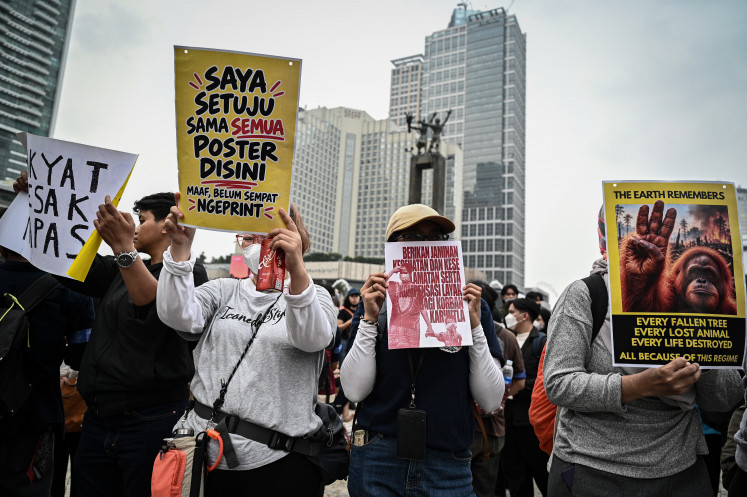
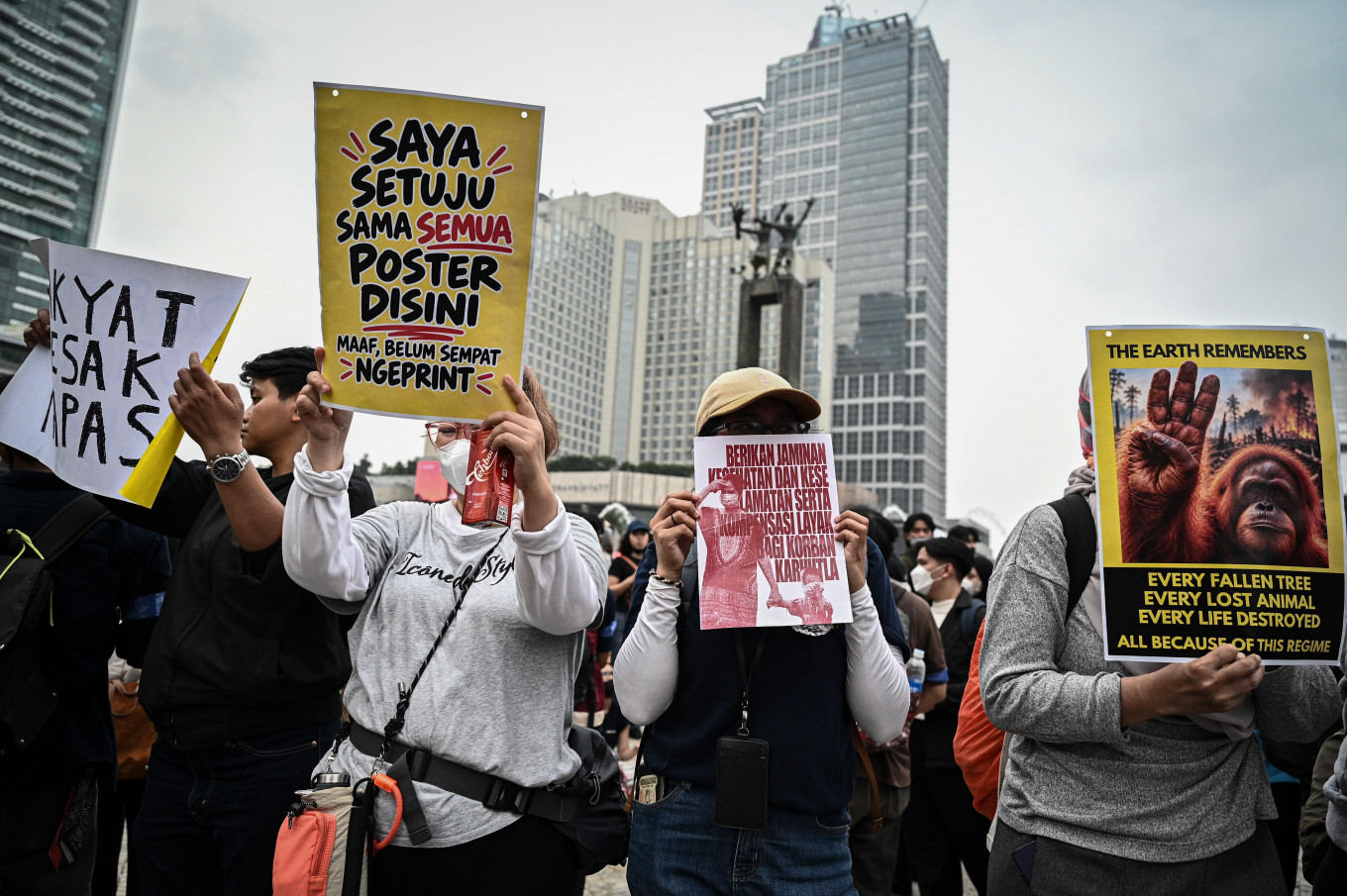 Students stage a protest against economic hardship, graft and the government's handling of devastating wildfires causing toxic haze that has sickened thousands on Hotel Indonesia traffic circle n in Jakarta on Oct. 28, 2026. (Antara/Fauzan)
W
henever political or economic uncertainty hits, in democracies and dictatorships alike, social media echoes with the same question: Where are the students? After all, when a government steps out of line, university campuses are usually the first to erupt.
Over the past few weeks, they answered. Frustrated that their grievances keep falling on deaf ears, students returned to the streets to protest President Prabowo Subianto’s administration. They took aim at the recurring forest and peatland fires tearing through Kalimantan, Sumatra and Papua and sickening the populations, while calling out the government’s fixation on pet projects. With disaster in the provinces remaining unaddressed, protestors asked why hundreds of trillions of rupiah are still being poured into free meal schemes and village cooperatives.
Taking to the streets on Youth Pledge Day, Oct. 28, the demonstration served as a sobering reminder that young Indonesians have never stayed on the sidelines. Whenever state accountability erodes or democracy takes a beating, they are right there next to labor unions and civil society groups, staring down increasingly fortified police and military lines.
That legacy runs deep. In 1928, young visionaries declared the Youth Pledge, forging the very idea of an Indonesian nation. Seven decades later, student activists broke the spine of the New Order regime in 1998 to usher in the Reform Era. Now, a new cohort is stepping up: Generation Z, roughly those born between the late 1990s and early 2010s.
Having grown up alongside smartphones and algorithms, Gen Z is too often dismissed through tired workplace tropes and memes about short attention spans, a shallow caricature that infuriates a demographic left to clean up a world set on fire by their elders. Yet that digital fluency gives them an edge. They approach political dissent on their own terms, weaving pop-culture references and viral imagery across borders in ways older generations never could.
We saw this during the 2025 protests, when demonstrators hoisted the Straw Hat Pirates’ Jolly Roger from One Piece, a manga classic that practically raised millions of Indonesian kids. The flag, synonymous with rebellion against corrupt world rulers, quickly migrated to demonstrations from Nepal and the Philippines all the way to France, embraced by activists of every age as a modern emblem of defiance.

A similar spark lit up the recent Youth Pledge rallies. Across the country, students flashed the three-finger salute from The Hunger Games, tapping into the story of teenagers taking on an authoritarian Capitol. While pro-democracy movements in Thailand, Myanmar and Hong Kong had already made the gesture famous across Asia, it hit home just as hard for Indonesian Gen Zs who grew up watching the films in theaters.