The Jakarta Post
Please Update your browser
Your browser is out of date, and may not be compatible with our website. A list of the most popular web browsers can be found below.
Just click on the icons to get to the download page.


Popular Reads
Top Results
No results found. Please check your search term and try again
Can't find what you're looking for?
View all search results
Popular Reads
Top Results
No results found. Please check your search term and try again
Can't find what you're looking for?
View all search resultsNatuna waters put ASEAN's maritime unity to the test
To protect its own waters from Beijing's creeping maritime pressure, Indonesia must trade cautious bilateralism for region-wide solidarity at the upcoming ASEAN Summit in Manila.
Change text size
Gift Premium Articles
to Anyone
Share the best of The Jakarta Post with friends, family, or colleagues. As a subscriber, you can gift 3 to 5 articles each month that anyone can read—no subscription needed!
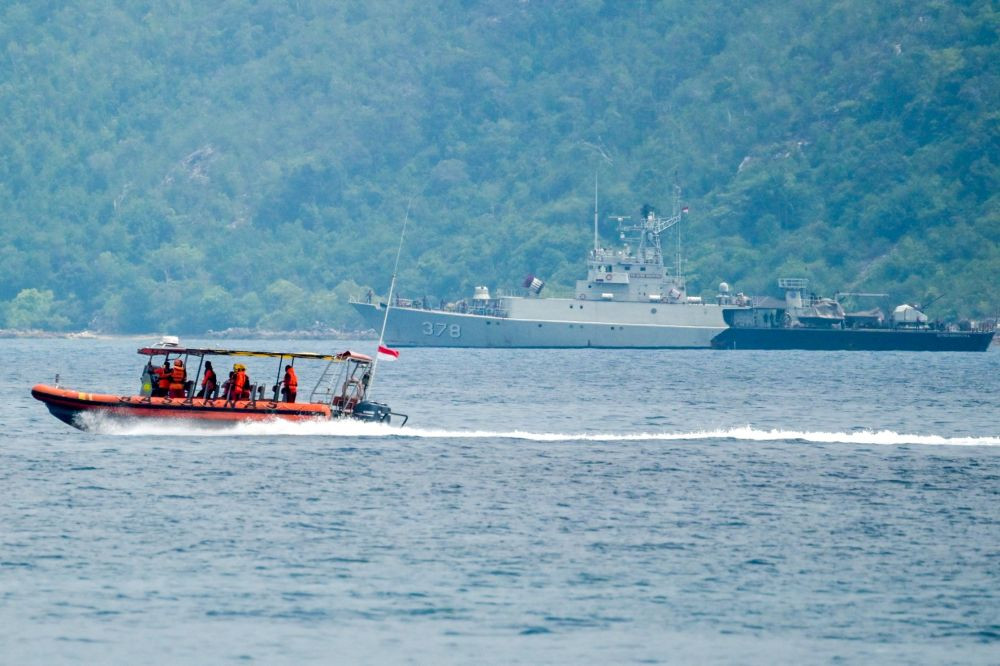 Maritime solidarity: Navy corvette KRI Sutedi Senoputra sails during the final day of the ASEAN Natuna Solidarity Exercise 2023 in the waters off Lagong island in Riau Islands on Sept. 23, 2023. (AFP/Bay Ismoyo)
W
hen Southeast Asian leaders convene in Manila on Nov. 16-18 for the 49th ASEAN Summit, the South China Sea will once again dominate the agenda. Much of the focus will inevitably center on the host nation, the Philippines, whose coast guard has repeatedly engaged in high-stakes standoffs with Chinese vessels at Second Thomas Shoal and Scarborough Shoal.
Yet evidence indicates that Chinese maritime incursions around Indonesia’s Natuna Islands have persisted into 2026, though recent episodes have garnered scant public attention. This continuing friction highlights a vital reality: Maritime unity within ASEAN is equally critical for Jakarta.
Indonesia has long maintained that it is not a claimant state in the South China Sea dispute, asserting that no overlapping territorial claims exist between Jakarta and Beijing. Under the 1982 United Nations Convention on the Law of the Sea (UNCLOS), the North Natuna Sea falls squarely within Indonesia’s exclusive economic zone (EEZ).
Nevertheless, China Coast Guard (CCG) cutters and maritime research vessels have systematically operated for years within the portion of Indonesia’s EEZ intercepted by Beijing’s unilateral "nine-dash line”.
In October 2024, just one day after President Prabowo Subianto assumed office, CCG 5402 disrupted a seismic survey vessel operating on behalf of state-owned energy company Pertamina. Indonesian maritime patrols expelled the ship twice within a single week. In mid-2025, the Indonesia Ocean Justice Initiative documented recurring unauthorized operations by Chinese research ship Nan Feng alongside CCG escorts.
Beijing routinely dismisses criticism of these incursions, characterizing them as standard law enforcement patrols in waters within its sovereign jurisdiction.

These developments form part of a sustained coercive pattern familiar across Southeast Asia.