The Jakarta Post
Please Update your browser
Your browser is out of date, and may not be compatible with our website. A list of the most popular web browsers can be found below.
Just click on the icons to get to the download page.


Popular Reads
Top Results
No results found. Please check your search term and try again
Can't find what you're looking for?
View all search results
Popular Reads
Top Results
No results found. Please check your search term and try again
Can't find what you're looking for?
View all search resultsIndustry 5.0: The future of manufacturing in 2035
Advancement in technologies will remain significant, but the trend of "human touch" will also be in demand in Factory of 2035.
Change text size
Gift Premium Articles
to Anyone
Share the best of The Jakarta Post with friends, family, or colleagues. As a subscriber, you can gift 3 to 5 articles each month that anyone can read—no subscription needed!
 Set as preferred source
T
he factory of 2035 will look vastly different than the factory of today. Ever since the first Industrial Revolution when mechanization, water, and steam power started to automate work previously carried out manually, more work has been taken on by machines.
Each technological advancement – from computers and robotics to the Internet – has brought about additional automation. Advancement in technologies will remain significant, but the trend of "human touch" will also be in demand in Factory of 2035.
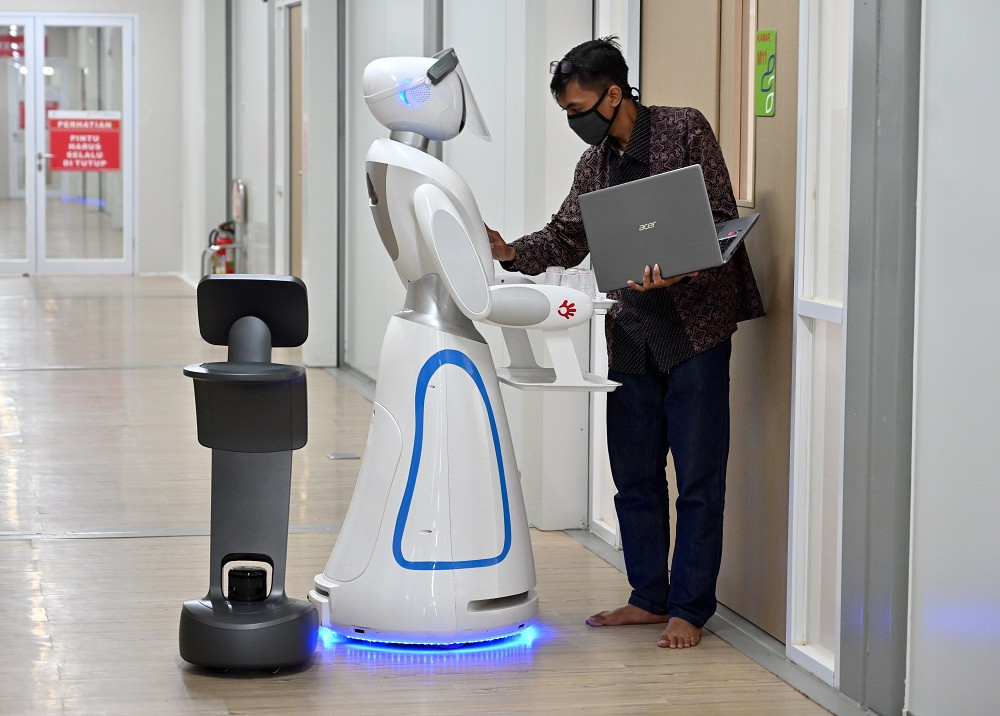
Today, internet-enabled "Industry 4.0” – including the robots that form a growing part of its connected technologies – has given rise to new fears that technology is replacing human workers. Representing Industry 4.0 as they do, robots are also bearing the brunt of the latest “technology is replacing us” myths. People have misconceptions that automation technologies and robots threaten people’s livelihoods. Automation does not replace jobs, in fact, it creates new jobs.
According to a recent Harvard Business Review article on automated tasks, 20 percent and 80 percent of a given job can involve automatable tasks, but no jobs are 100 percent automatable. This means that even with all the advancements, robots will not replace humans entirely. The fact is that robots help to increase productivity and companies are in the position to employ more people. Hence, robots will create jobs instead of eliminating them.
The promise of the latest industrial revolution, Industry 4.0, is not just complete factory automation. Manufacturers move towards "light out factory" setups where they can produce goods people demand quickly, with consistently high quality, at unprecedented low cost, and with little human intervention. However, when the “lights out factory” has started to gain traction in actual manufacturing setups, different global consumer trend has emerged – the return of human touch in Industry 5.0.
Mass demand for the human touch, or what is often described as “mass personalization,” will never be met by large scale lights-out type manufacturing nor by traditional craftspeople working in their own small shops. Today, people want to experience the human touch in mass-manufactured goods. The type of factory needed to produce such goods at a scale and cost that makes production economically feasible will depend on technology.
It is not the technology operating without human involvement in a lights-out factory. It will be the technology that collaborates with workers and, where the human touch is involved, serves as a tool that enables the workers to contribute the value they add to the product.