TheJakartaPost
Please Update your browser
Your browser is out of date, and may not be compatible with our website. A list of the most popular web browsers can be found below.
Just click on the icons to get to the download page.


Popular Reads
Top Results
No results found. Please check your search term and try again
Can't find what you're looking for?
View all search results
Popular Reads
Top Results
No results found. Please check your search term and try again
Can't find what you're looking for?
View all search resultsPositive trend in Indonesia’s foreign reserves
The government’s external debt still dominates Indonesia’s FX reserves and adequate reserves management becomes crucial.
Change text size
Gift Premium Articles
to Anyone
Share the best of The Jakarta Post with friends, family, or colleagues. As a subscriber, you can gift 3 to 5 articles each month that anyone can read—no subscription needed!
 Set as preferred source
D
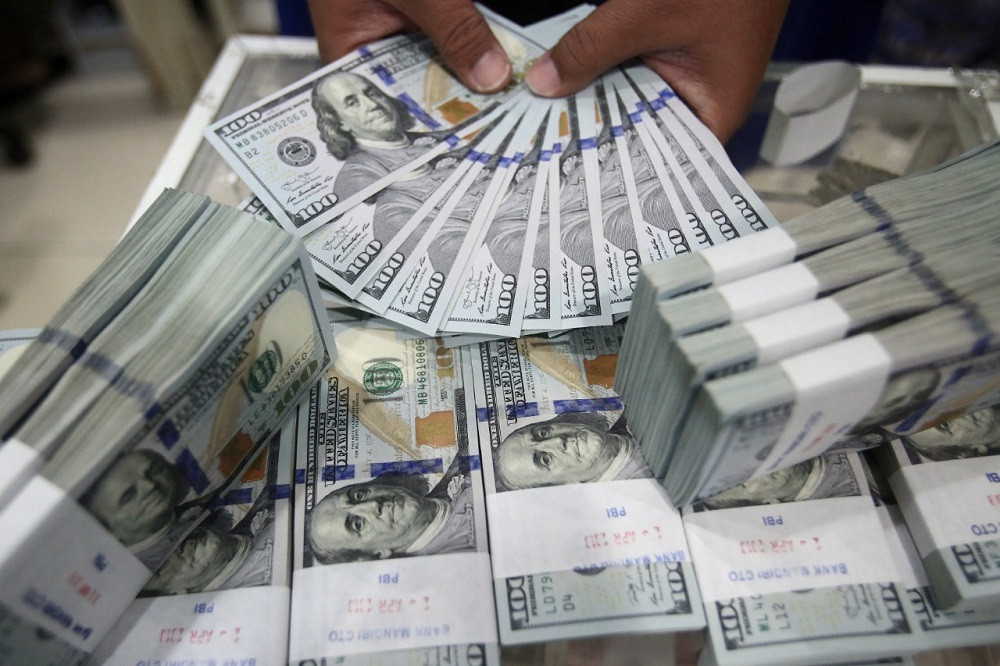
espite multiple pressures on the macroeconomic environment due to the COVID pandemic -19, Bank Indonesia (BI) has for the past four successive months boosted the level of Indonesia’s foreign reserves to US$138.8 billion as of late February, enough for financing 10 months of imports and the government’s external debt. This level is higher than the international benchmark of three months of imports.
Reserve adequacy is consequential for the robustness of a domestic economy. One of the international reserves’ roles is to temporarily finance the balance of payment deficits. A growth trend in a country’s reserves shows it has a stronger buffer to maintain a sustainable external balance. Today, Indonesia manages a surplus trend of its trade balance, but maintaining greater reserves would improve domestic resiliency in anticipating sudden macroeconomic shifts.
Amid the ongoing pandemic, the robustness of international reserves is also important to sustain confidence in both the domestic currency and the economic standpoint. In the event of market shocks, reserves could contribute to moderating exchange rate volatility.
But in Indonesia’s case, the needs for spot market intervention are relatively reduced as BI directs currency stabilization via domestic non-deliverable forward (DNDF), a derivative of foreign exchange (FX). By doing so, BI effectively routes US dollar demand to longer maturities. This helps BI manage an optimum number of FX reserves.
BI as the monetary authority is given the mandate to manage Indonesia’s official foreign reserves, according to Article 13 of the BI Law. Not only that, it is important to maintain its adequacy and attain an optimal value of FX reserves because of the escalated challenges of macro dynamics. As a result, the government’s external debt still dominates Indonesia’s FX reserves and adequate reserves management becomes crucial.
But the number speaks for itself. Central Banking Publications has recognized BI as reserves manager of the year. The achievement was not a walk in the park. Top-notch reserves management requires a fluency in complex and diverse global financial markets and the resilient institutional arrangement of FX reserves.
On a side note, the economics of financial assets always involve the cost of holding ones (such as the cost of funds). As the reserves increase, there is also an escalated interest for BI to acquire higher return differentials and correspondingly preserve them. This adds another rationale as to why it is necessary to strengthen the diversification of BI’s reserves portfolio. In addition to compensating the alpha risk in finance (i.e., the risk vis-à-vis individual stock performance), there should be sufficient room to gain more returns.