The Jakarta Post
Please Update your browser
Your browser is out of date, and may not be compatible with our website. A list of the most popular web browsers can be found below.
Just click on the icons to get to the download page.


Popular Reads
Top Results
No results found. Please check your search term and try again
Can't find what you're looking for?
View all search results
Popular Reads
Top Results
No results found. Please check your search term and try again
Can't find what you're looking for?
View all search resultsWhat’s wrong with ASEAN responses to the Myanmar crisis?
ASEAN faces various pressures manifested in rooted civil society-based movements to improve its human rights record.
Change text size
Gift Premium Articles
to Anyone
Share the best of The Jakarta Post with friends, family, or colleagues. As a subscriber, you can gift 3 to 5 articles each month that anyone can read—no subscription needed!
 Set as preferred source
"Normative and ideational concerns have always informed the study of international politics and are a consistent thread running through the life of International Organization," argued the norm experts Kathryn Sikkink and Martha Finnemore in 1998 when discussing global norm dynamics and political change.
Their statement fits as an opening to look at ASEAN, founded in a post-Cold War context to keep the balance of power in the region, a correct maneuver according to the realist view.
However, under the severity of the gross state-sponsored human rights violations in Myanmar, one cannot but raise the obvious question: what sort of norms and whose norms run in the veins of ASEAN?
Myanmar's military, the Tatmadaw, is closely tied to politics, which means that the principle of civilian supremacy over the military in government politics, as is customary in democracies, has no root, if not in fact non-existent, in Myanmar. Furthermore, the culture of military domination in many aspects of the Myanmar state's political life is institutional.
In Eric Nordlinger's terminology, the Myanmar military is a praetorian guard intensely involved in government politics. The Feb. 1 coup has created social fragmentation at the grassroots level of Myanmar society. Led by the commander of the armed forces, Gen. Min Aung Hlaing, the hostile takeover is grounded on assumed fraud during the November 2020 election, which Aung San Suu Kyi’s National League of Democracy (NLD) Party won. Myanmar's General Election Commission emphasized however there was no evidence of fraud.
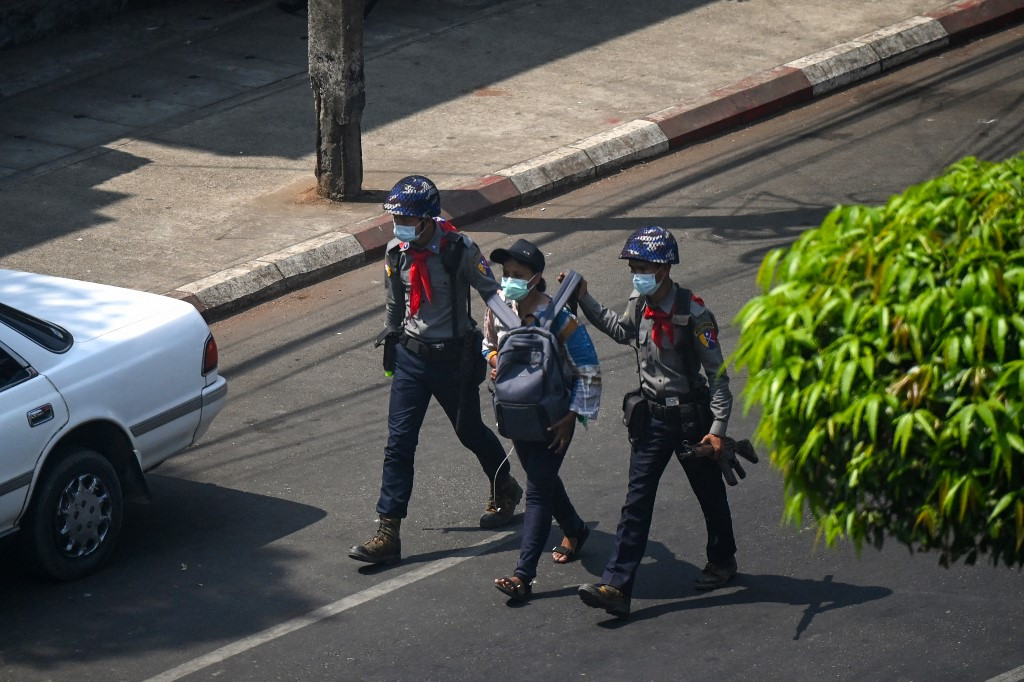
Since then, we have witnessed a domestic political escalation which has led to the arrest of Suu Kyi and President Win Myint. Later Suu Kyi was charged with illegal possession of communication equipment in the form of walkie-talkies used by her security staff, among other accusations. President Myint was charged with violating the COVID-19 protocol when campaigning in November 2020.
Considering that around 50 percent of Myanmar's 54 million population have Facebook accounts, the junta eventually blocked social media channels "to maintain stability". However, street politics resist the repression loudly and are gaining support worldwide.