The Jakarta Post
Please Update your browser
Your browser is out of date, and may not be compatible with our website. A list of the most popular web browsers can be found below.
Just click on the icons to get to the download page.


Popular Reads
Top Results
No results found. Please check your search term and try again
Can't find what you're looking for?
View all search results
Popular Reads
Top Results
No results found. Please check your search term and try again
Can't find what you're looking for?
View all search resultsElectric vehicles offer chance to clean up our cities
E-mobility initiatives should focus on large fleets of high mileage commercial vehicles, including buses, taxis, and delivery trucks.
Change text size
Gift Premium Articles
to Anyone
Share the best of The Jakarta Post with friends, family, or colleagues. As a subscriber, you can gift 3 to 5 articles each month that anyone can read—no subscription needed!
 Set as preferred source
T
he coronavirus disease (COVID-19) pandemic has reshaped urban transport across Asia and the Pacific. In the wake of the virus, many Asian cities banned or severely restricted public transport usage, forcing travelers to switch to alternative non-motorized or private forms of transport. Shops closed down for months, resulting in a massive increase in e-commerce and growth in light good vehicles to make deliveries.
As cities start to open up, the time is ripe for a modernization program focusing on clean public transport and light duty delivery vehicles. Failure to do so will result in a bigger pollution and congestion mess than before the pandemic.
Asia’s motor vehicle fleets have been doubling in size every 5-7 years. Aside from congestion problems, which can cost an economy around 2 percent-5 percent of gross domestic product (GDP) annually, motor vehicles are responsible for up to 80 percent of air pollution in urban Asia.
Further, vehicular emissions contributed to 23 percent of greenhouse gas (GHG) emissions in 2009, compared to 41 percent from the energy sector. If nothing changes, this figure is expected to surge to 46 percent in 2035, and it could even hit 80 percent by 2050, according to Asian Development Bank estimates.
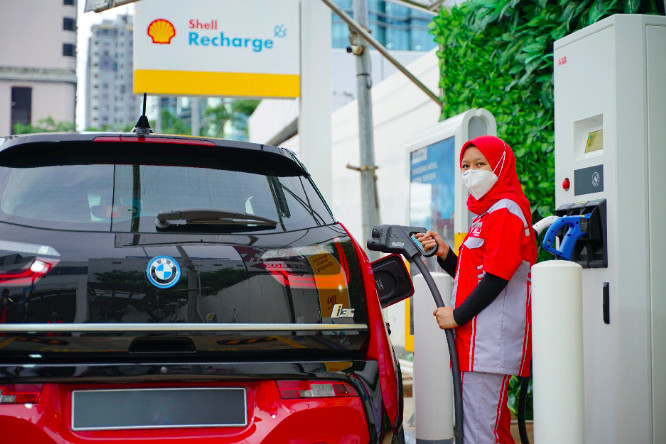
To address this, switching from combustion engine vehicles to electric vehicles (EVs) has emerged as a promising approach for Asian megacities.
In its recent publication “E-Mobility Options for ADB Developing Member Countries,” ADB underlined options to fully harness the EV momentum. The report notes significant progress in the People’s Republic of China (PRC) in the last decade, affirming that the viability of electric transport is no longer in doubt for Asia. More importantly, it recommends a three-pronged strategy to pursue e-mobility.
First, e-mobility initiatives should focus on large fleets of high mileage commercial vehicles, including buses, taxis, and delivery trucks. Priority should be given where EV investments yield the highest economic and environmental returns. Large fleets of high-mileage vehicles that operate in cities allow quicker repayment of higher upfront fixed-costs.