TheJakartaPost
Please Update your browser
Your browser is out of date, and may not be compatible with our website. A list of the most popular web browsers can be found below.
Just click on the icons to get to the download page.


Popular Reads
Top Results
No results found. Please check your search term and try again
Can't find what you're looking for?
View all search results
Popular Reads
Top Results
No results found. Please check your search term and try again
Can't find what you're looking for?
View all search resultsFiscal dominance to avert greater macro problems
It is essential to realize that more restrictions on mobilization of the economy would put the acceleration of the supply economy as well as consumption on hold.
Change text size
Gift Premium Articles
to Anyone
Share the best of The Jakarta Post with friends, family, or colleagues. As a subscriber, you can gift 3 to 5 articles each month that anyone can read—no subscription needed!
 Set as preferred source
T
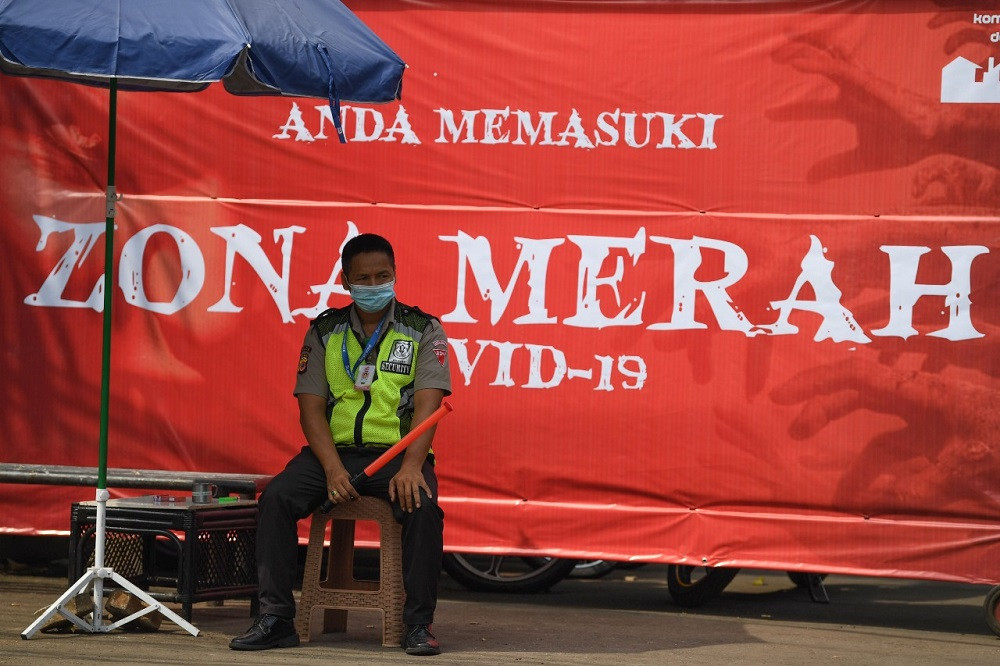
he government has resorted to stricter mobility curbs, which will last until July 25. For the second time since the COVID-19 pandemic struck in March last year, such an intervention is inevitable to stop the exponential virus transmission. At the same time, we should examine and mitigate the impact of the emergency public activity restrictions (PPKM Darurat) on the economic and financial sectors as the trade-off.
The struggling economy will encounter challenges similar to previous problems. The real economy faces “dual problems” from the supply and demand sides. Of course, the consequences might be minimized for essential goods and services by implementing a safe harbor for them. But we should not overlook the rest of the economy.
Some market experts have expressed that the financial sector is somewhat “immune” from the changing-mobility policies. But it is not necessarily the case. More constrained businesses would likely be transmitted to the financial markets, thanks to the intertwined relations among sectors in the macro economy.
For a solution, let us start by examining the current macro condition. The latest data on gross domestic product (GDP) growth in the first quarter (Q1) of 2021 is negative 0.74 percent year-on-year. Even though GDP is still contracting, it is quickly recovering, at least for the time being until we see what effect the PPKM Darurat have on the economy. It is evident that the contraction is getting smaller over time.
The government and authorities are optimistic, even if they revised the outcome projection to between 4.1 and 5.1 percent. The optimistic view is supported by some reliable data and dynamics. In the external sector, Indonesia has a better position on net international investment (25.3 percent of GDP per Q1 2021), reserves adequacy (US$137.1 billion as of June 2021) and trade balance surplus ($2.36 billion as of May 2021).
The advanced economies in the western world are showing a strong recovery, which is mainly due to their outstanding vaccination performance.
On the downside, we must be careful about the adverse impact on emerging markets, including Indonesia. Capital would rationally take off to safer havens once it is readily available (i.e., the rise of interest rates in advanced countries). Nevertheless, the EU region faces similar problems as ours, namely fast spread of the virus due to Euro 2020 euphoria.