The Jakarta Post
Please Update your browser
Your browser is out of date, and may not be compatible with our website. A list of the most popular web browsers can be found below.
Just click on the icons to get to the download page.


Popular Reads
Top Results
No results found. Please check your search term and try again
Can't find what you're looking for?
View all search results
Popular Reads
Top Results
No results found. Please check your search term and try again
Can't find what you're looking for?
View all search resultsIndonesia as a greener battery producer for electric vehicles
Despite its abundant resources, the nickel industry should have paid more attention to sustainability issues if Indonesia wants to lead global EV production.
Change text size
Gift Premium Articles
to Anyone
Share the best of The Jakarta Post with friends, family, or colleagues. As a subscriber, you can gift 3 to 5 articles each month that anyone can read—no subscription needed!
 Set as preferred source
T
he transportation sector is one of the most significant contributors to global greenhouse gas (GHG) emissions. This sector remains the biggest emitter and air polluter in Southeast Asia, contributing to 25 percent of total GHG emissions. Meanwhile, following the Paris Agreement in 2015, ASEAN member states have committed to reducing global GHG emissions as soon as possible and reaching climate neutrality by mid-century.
To do so, the International Energy Agency (IEA) recommends that at least 60 percent of the global road fleet run on electric vehicles (EV) by 2030. As of 2019, one-fifth of the world's road vehicles are in ASEAN, according to our estimate.
EVs are similar in many aspects to conventional transportation that is powered by internal combustion engines, but they are much more energy-efficient and emit zero emissions. The latter proposition, though, needs to be further examined. Indonesia, which has a 60 percent share of total road vehicles in ASEAN, will be the perfect case.
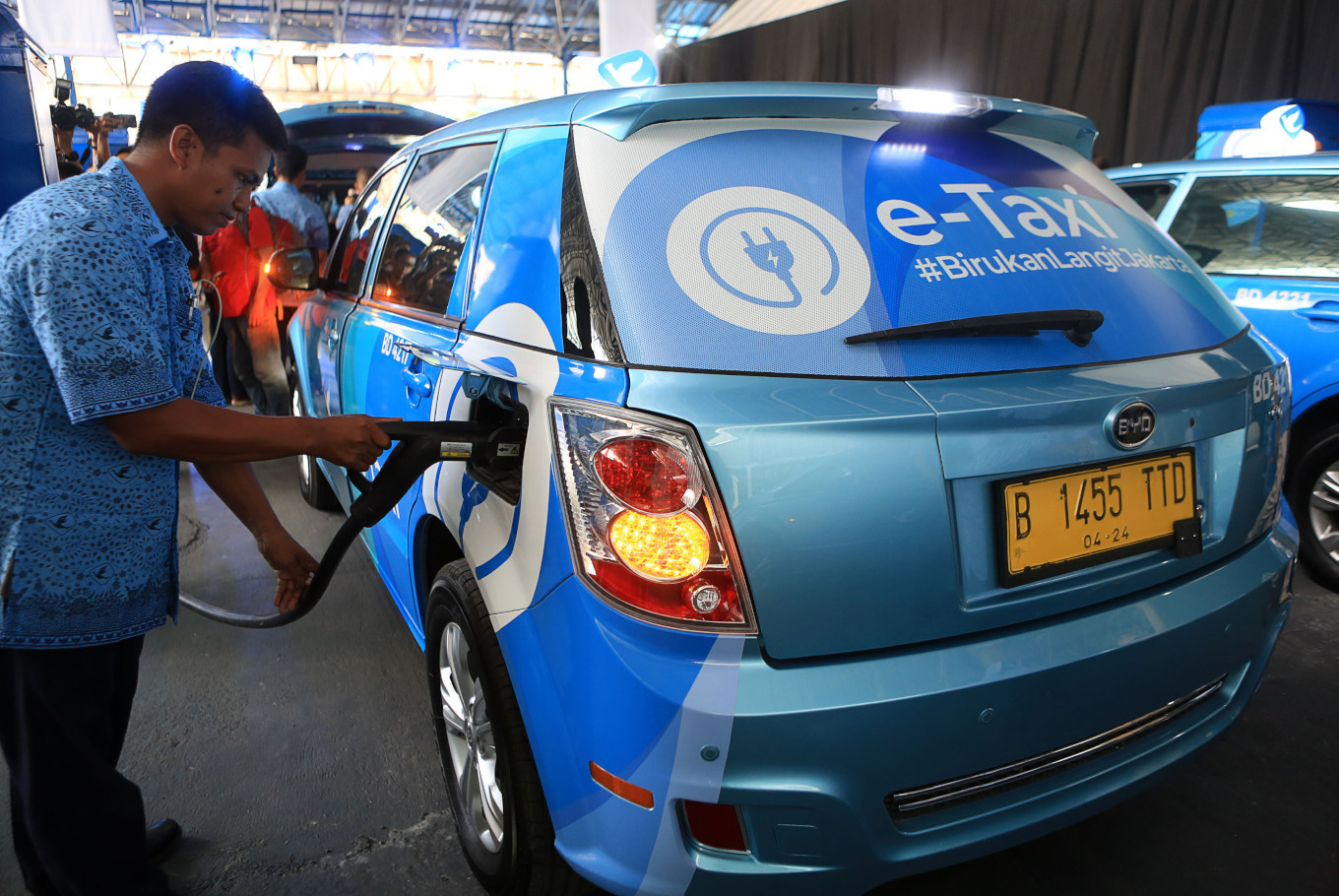
In 2019, President Joko "Jokowi" Widodo issued Presidential Decree No. 55/2019 as the framework for accelerating battery-powered EV deployment. Following this, the Energy and Mineral Resources Ministry launched a road map of EV infrastructure development. The road map includes various supporting factors for the EV ecosystem such as the number of charging stations, electrification of government vehicles and e-mobility. Further, Industry Ministerial Regulation No. 27/2020 stipulates the minimum domestic content of EVs manufactured in Indonesia. This regulation provides a strong foundation for the national industry to become the leading manufacturer of EVs and their components.
The policies above indicate that Indonesia believes in the significant potential of EVs in reducing carbon emissions. The EV industry itself, however, should not forget to foresee the sustainability aspects of electric mobility. From that perspective, the “zero-emissions” tag of EVs should also consider the carbon emissions from the whole lifecycle of EVs, including electricity generation, the manufacturing of components and management of components in their end-of-life.
Starting from electricity generation, Indonesia has set a target of increasing the share of renewable energy in its energy system, including electricity generation, albeit with apparent challenges in implementation. It is reassuring that several studies that made a comprehensive comparison between various mobility options through well-to-wheel assessment found that EVs are still competitive. Meaning that in terms of overall emission, EVs are still better than the conventional option, even in regions with a large coal share in electricity generation.
With the outlook of the Indonesian EV market being seemingly positive, the government must ensure a continuous supply of raw materials of EV lithium-ion batteries – nickel, cobalt and copper. According to the Investment Ministry, Indonesia has 30 percent of the world’s nickel reserves of 21 million tons, mainly located on the islands of Sulawesi and Halmahera. Securing supply is an essential strategy to mitigate supply shortage problems, which might lead to uncontrollable price hikes.