The Jakarta Post
Please Update your browser
Your browser is out of date, and may not be compatible with our website. A list of the most popular web browsers can be found below.
Just click on the icons to get to the download page.


Popular Reads
Top Results
No results found. Please check your search term and try again
Can't find what you're looking for?
View all search results
Popular Reads
Top Results
No results found. Please check your search term and try again
Can't find what you're looking for?
View all search resultsWorkers deserve higher pay
The Manpower Ministry and the National Wage Council must decide on the level of the rise in the nationwide minimum wage median for 2023 before the end of the third week so that provincial administrations can immediately begin local tripartite consultations for the new minimum wage.
Change text size
Gift Premium Articles
to Anyone
Share the best of The Jakarta Post with friends, family, or colleagues. As a subscriber, you can gift 3 to 5 articles each month that anyone can read—no subscription needed!
 Set as preferred source
T
he tripartite National Wage Council and the government are facing a dilemma in determining the minimum wage for 2023 in view of the predicted gloomy outlook of the global economy, even the big risk of recession in several advanced countries, which certainly will also impact Indonesia.
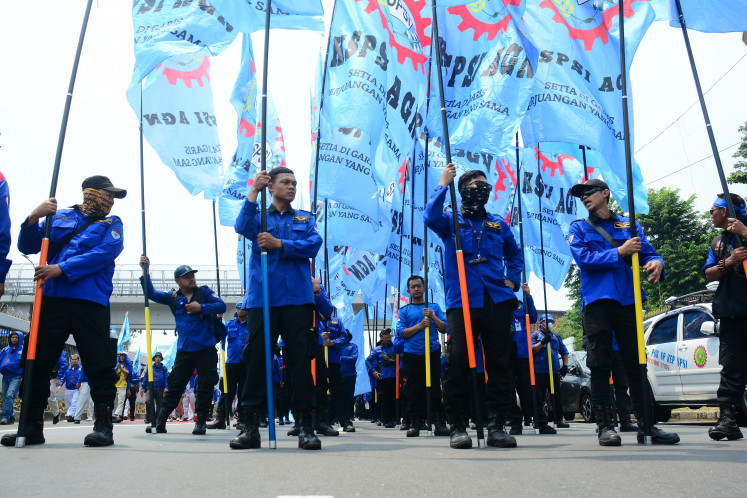
But most international and national analysts and even multilateral development banks have predicted that Indonesia will continue to be a beacon and the most robust economy amid the doom scenario with annual growth of at least 5 percent. No wonder trade union federations have demanded a minimum increase of 13 percent in the minimum wage.
To a certain extent such a demand seems justified as there was virtually no wage rise in 2020, a year that saw an economic contraction of 2 percent, and 2021, which booked growth of only 3.7 percent, much lower than the previous annual expansion of 5 percent. The demand also seems reasonable in view of cumulative inflation from 2020 to 2022 of about 8 percent.
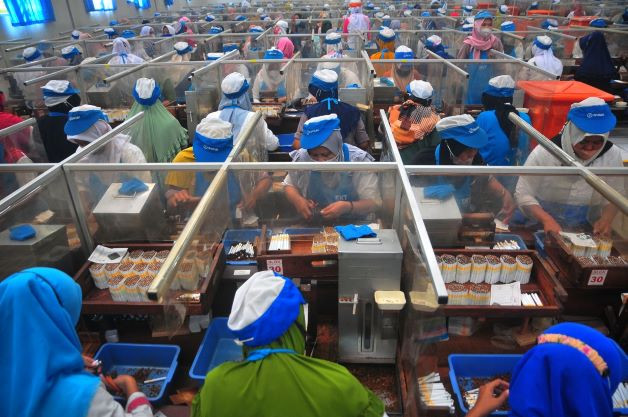
On the other hand, most companies are greatly worried about the wage-increase demand. Even though the brunt of the global economic slowdown has not adversely affected the country’s many labor-intensive industries, companies have reported laying off of tens of thousands of workers. Next year could be worse.
Whatever the argument, the Manpower Ministry and the National Wage Council must decide on the level of the rise in the nationwide minimum wage median for 2023 before the end of the third week so that provincial administrations can immediately begin local tripartite consultations for the new minimum wages in their regencies.
The new formula for determining minimum wage based on the 2020 Job Creation Law uses gross domestic product (GDP), inflation, the local people’s purchasing power, labor absorption rate and wage median as the main indicators.
Government Regulation No.36/2021, which implements the provisions of the Job Creation Law on labor policies was internationally praised for making the labor rules more flexible and more conducive for companies to cope with the rapid changes in the job or employment landscape caused by the high-growth of the digital economy.