The Jakarta Post
Please Update your browser
Your browser is out of date, and may not be compatible with our website. A list of the most popular web browsers can be found below.
Just click on the icons to get to the download page.


Popular Reads
Top Results
No results found. Please check your search term and try again
Can't find what you're looking for?
View all search results
Popular Reads
Top Results
No results found. Please check your search term and try again
Can't find what you're looking for?
View all search resultsJokowi-Lee’s achievements
The DCA negotiations had sparked fierce debate in this country, with many, fueled by nationalist sentiment, believing the defense cooperation scheme would constitute a loss of Indonesian sovereignty by allowing Singaporean military to train on Indonesian soil.
Change text size
Gift Premium Articles
to Anyone
Share the best of The Jakarta Post with friends, family, or colleagues. As a subscriber, you can gift 3 to 5 articles each month that anyone can read—no subscription needed!
T
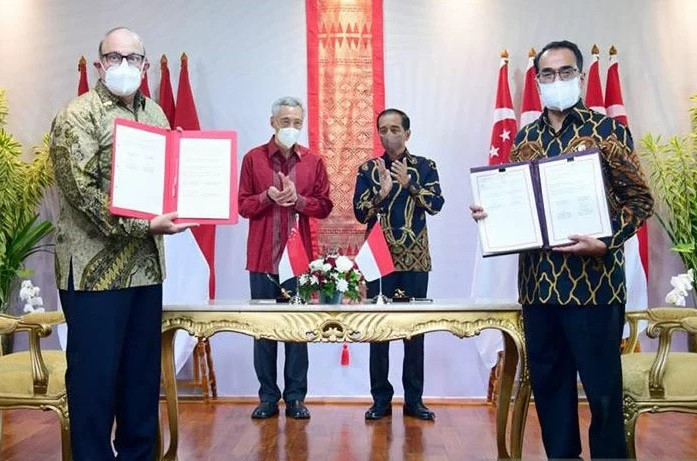
he bilateral summit between President Joko “Jokowi” Widodo and his host Singaporean Prime Minister Lee Hsien Loong last week marked a new and more mature relationship between the two countries, as reflected by their announcement on the ratification of three much-delayed agreements, two of which were politically sensitive for Indonesia.
With the ratification, the two leaders have laid down a strong foundation for future bilateral relations between the two ASEAN neighbors that their successors will nurture.
Unless the ruling People’s Action Party (PAP) suffers a shock defeat or significant decline in votes in the 2025 general elections, it is almost certain Singapore will see a power transfer from Lee to Finance Minister Lawrence Wong, the current deputy prime minister. In Indonesia, a new president will be elected in February 2024 and take office in October.
Following up the signing of the Defense Cooperation Agreement (DCA), the Agreement on the Realignment of the Boundary between the Jakarta Flight Information Region (FIR) and the Singapore FIR and the extradition treaty the two governments signed during the Jokowi-Lee summit in Bintan in January last year, the ratification of the three pacts went through with relative ease. For Indonesia the long-awaited extradition deal will facilitate repatriation of corruption convicts hiding in Singapore. along with their ill-gotten assets.
The DCA negotiations had sparked fierce debate in this country, with many, fueled by nationalist sentiment, believing the defense cooperation scheme would constitute a loss of Indonesian sovereignty by allowing Singaporean military to train on Indonesian soil. This was also the case for the FIR, which had for decades been perceived here as Singapore’s control of certain parts of Indonesian air space.
During the presidency of Susilo Bambang Yudhoyono, the Indonesian and Singaporean governments signed the DCA and the extradition treaty, but all was lost after the House of Representatives refused to ratify the DCA in 2007, citing its perceived breach of Indonesian territorial integrity.
That the House has finally ratified the politically sensitive DCA only underlines the need for give and take in negotiations. In the end, both parties should benefit from the agreement. The House deserves credit for the ratification, in particular because the lawmakers acknowledged the treaties were of great importance for both Indonesia and Singapore.