The Jakarta Post
Please Update your browser
Your browser is out of date, and may not be compatible with our website. A list of the most popular web browsers can be found below.
Just click on the icons to get to the download page.


Popular Reads
Top Results
No results found. Please check your search term and try again
Can't find what you're looking for?
View all search results
Popular Reads
Top Results
No results found. Please check your search term and try again
Can't find what you're looking for?
View all search resultsFaith in Luis Enrique leads PSG to back-to-back Champions League titles
Luis Enrique arrived in Paris in 2023 promising a cultural shift rather than instant glamour, with the Spaniard wanting a team in which collective sacrifice outweighed individual status, where the biggest names defended, pressed and suffered together.
Change text size
Gift Premium Articles
to Anyone
Share the best of The Jakarta Post with friends, family, or colleagues. As a subscriber, you can gift 3 to 5 articles each month that anyone can read—no subscription needed!
 Set as preferred source
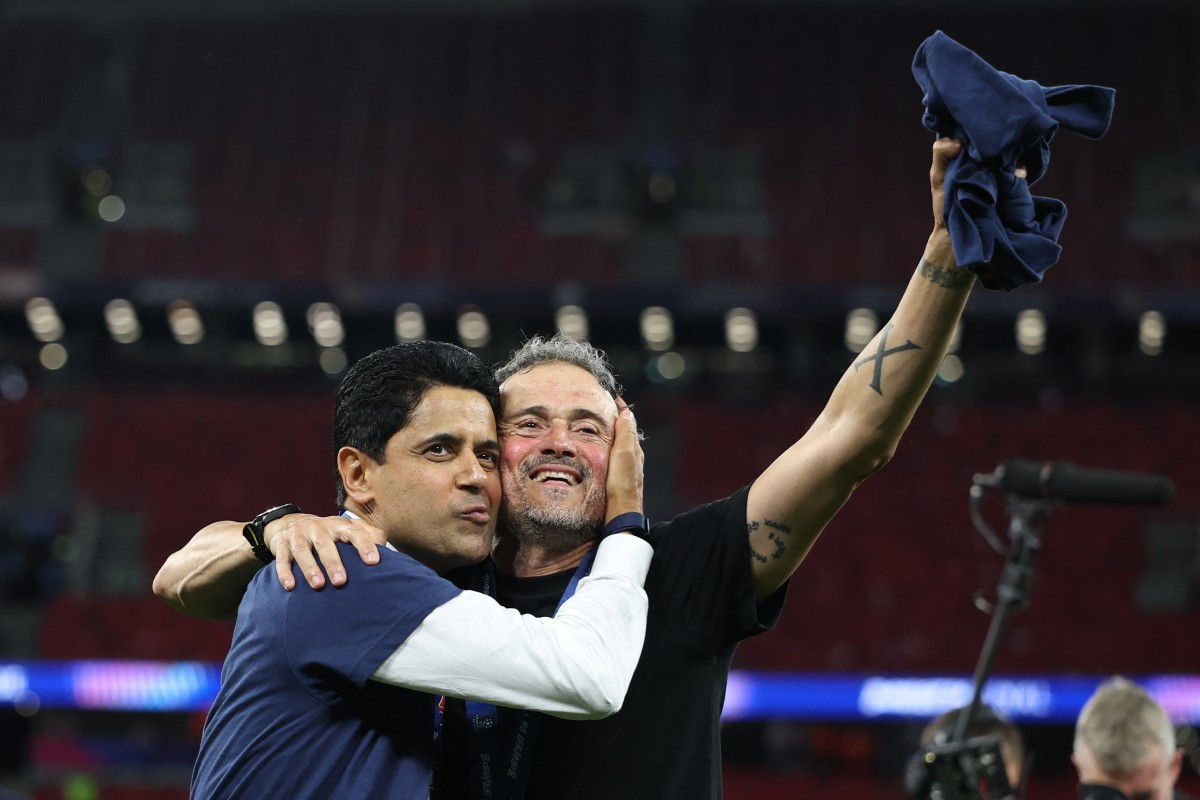 Paris Saint Germain's Qatari president Nasser al-Khelaifi (left) and Paris Saint-Germain's Spanish head coach Luis Enrique celebrate after winning the UEFA Champions League final football match between Paris Saint-Germain (PSG) and Arsenal FC at the Puskas Arena in Budapest on May 30, 2026. (AFP/Franck Fife)
P
aris St Germain’s back-to-back Champions League triumphs have been built on talent, depth and tactical sophistication, but those inside the club point first to something less tangible when explaining their rise to the summit of Europe - belief.
Luis Enrique arrived in Paris in 2023 promising a cultural shift rather than instant glamour, with the Spaniard wanting a team in which collective sacrifice outweighed individual status, where the biggest names defended, pressed and suffered together.
Two Champions League titles later, his players speak about him less as a coach than as an architect and people leader.
“It’s not easy to do it back-to-back, but we did,” defender Achraf Hakimi said after PSG beat Arsenal 4-3 on penalties in Saturday’s final following a 1-1 draw after extra time.
“The coach is the big voice of the club. We follow him, we trust him. Since day one he told us the team is more important than the player. We have created not just a team but a family.”
That idea has become the defining principle of PSG’s modern era.
For years, the French club assembled collections of stars rather than genuine teams, their Champions League failures often framed as psychological collapses under pressure.
Luis Enrique instead built a side around intensity, resilience and blind trust in a collective framework. PSG still dazzled going forward, but the spectacle became secondary to structure and commitment.
The Spaniard has insisted he has little interest in legacy or personal acclaim, brushing aside suggestions that he now belongs among the game’s legendary managers.
“Legend? I’m not interested in that,” he said.
Yet PSG’s players increasingly describe him as the driving force behind a side that now appears capable of extending its dominance.
Vitinha said the squad had endured a draining campaign marked by injuries, physical fatigue and relentless demands after a shortened pre-season, but credited Luis Enrique with keeping the group united through difficult moments.
“There were a lot of ups and downs,” the Portugal midfielder said. “We knew when the season started after little rest and little preparation that there would be physical problems and injuries, but we were bracing for it," he added.
Vitinha echoed forward Ousmane Dembele's praise for the PSG staff for managing the squad perfectly in a season that started after only a short break following the Club World Cup final, which they lost to Chelsea.
"We played several games without key players but even then we managed to improve and win. What the team have been doing, but also those who’ve had fewer minutes, they deserve a lot," Vitinha added.
Luis Enrique has consistently empowered squad players throughout his tenure, refusing to build hierarchies around reputation alone.
After the final, he singled out Warren Zaire-Emery despite the midfielder only appearing in extra time, after the 20-year-old dazzled in midfield and defence at times during the season to cover for the injured Hakimi and Fabian Ruiz.
“We were very unfair to Warren as coaches,” Luis Enrique said. “He deserved to play the final. But in the minutes he played he showed he was someone special,” he added of the youngest player to win two Champions League finals.
That faith in the collective has also allowed PSG to navigate transitions that once threatened to destabilise the club and the departures of superstar forwards in recent years no longer feel existential.
Instead, PSG now operate with unusual clarity.
“We know the path we want to follow,” Luis Enrique said when asked about transfers. “We are working for the future but we are not in a hurry.”
Even the celebrations inside the PSG camp already carried hints of what comes next.
“We have a coach who will push us to go for the third (Champions League),” captain Marquinhos said.
Vitinha echoed the sentiment, light-heartedly describing Luis Enrique as “the culprit” behind the squad’s endless hunger for more trophies.
“This desire to win more, never to stop, Luis Enrique is the culprit,” he said with a smile.