The Jakarta Post
Please Update your browser
Your browser is out of date, and may not be compatible with our website. A list of the most popular web browsers can be found below.
Just click on the icons to get to the download page.


Popular Reads
Top Results
No results found. Please check your search term and try again
Can't find what you're looking for?
View all search results
Popular Reads
Top Results
No results found. Please check your search term and try again
Can't find what you're looking for?
View all search resultsAustralia to boost defense spending citing growing threats
The new commitment follows pressure from US President Donald Trump's administration for Canberra to boost military expenditure as a share of total annual economic output.
Change text size
Gift Premium Articles
to Anyone
Share the best of The Jakarta Post with friends, family, or colleagues. As a subscriber, you can gift 3 to 5 articles each month that anyone can read—no subscription needed!
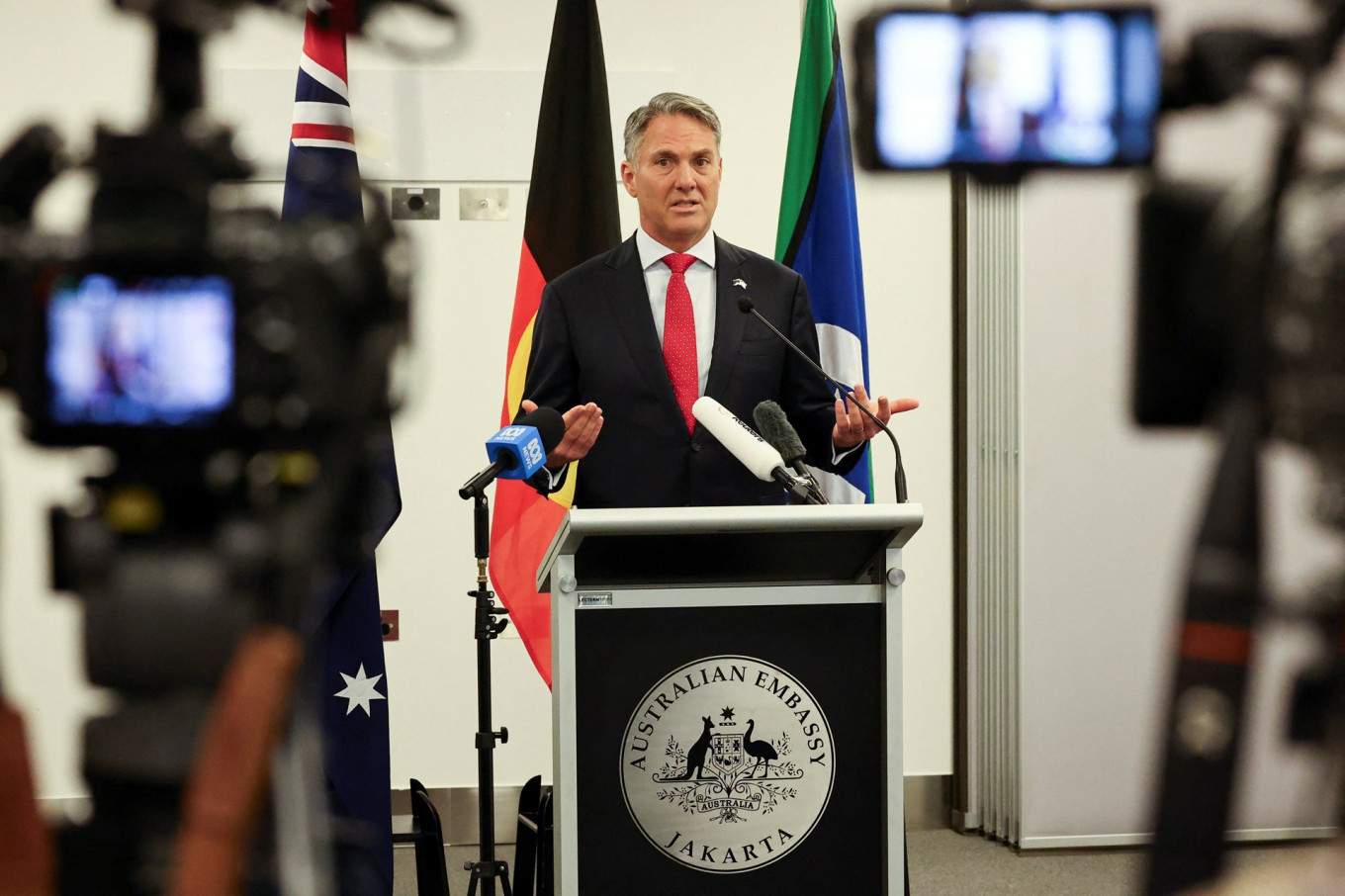 Australian Deputy Prime Minister and Defense Minister Richard Marles speaks during a press conference at the Australian embassy in Jakarta on March 12, 2026. (Reuters/Willy Kurniawan)
A
ustralia will raise defense spending to 3.0 percent of GDP by 2033 as armed conflicts flare worldwide, Defense Minister Richard Marles said Thursday.
The new commitment follows pressure from US President Donald Trump's administration for Canberra to boost military expenditure as a share of total annual economic output.
"International norms that once constrained the use of force and military coercion continue to erode," Marles said in a speech in Canberra, outlining a boost to spending on missile defense, drones and guided weapon stockpiles.
"More countries are engaged in conflict today than at any time since the end of World War II, and this is occurring across every region of the world."
Australia's defense spending had previously been forecast to rise to 2.3 percent of GDP by 2033.
But the country will spend an additional AU$53 billion ($38 billion) over the next decade when compared to its 2024 defense strategy, Marles said.
In the shorter term, spending would climb by an extra AU$14 billion over four years.
To reach the 3.0 percent figure, Australia changed how it calculates the defense budget to match a NATO definition that includes factors such as military pensions and defense intelligence.
Marles said Thursday this allowed better comparisons with other countries and put Australia ahead of comparable European and Asian nations with a defense spend this year of 2.8 percent.
But the new spending still falls short of the 3.5 percent of GDP that US Defense Secretary Pete Hegseth demanded Australia shell out last year.
Wary of China's navy build-up, US ally Australia has reshaped its defense force in recent years to focus on its missile strike capability and deterring an adversary from its northern approaches.
It has also embarked on its largest-ever military spending project to build nuclear-powered submarines next decade under the AUKUS agreement with the United States and the UK.
Marles emphasized Australia would focus in 2026 on building greater military self-reliance but was not jettisoning its US security alliance, which he said remained "fundamental".
"There is no effective balance of power in the Indo-Pacific absent the continued presence of the United States," he said.
Spending to build a missile defense system will accelerate -- up to AU$30 billion over the next decade.
Another AU$36 billion will be spent to build guided missiles locally.
Australia's vast coastline and small population have also spurred a focus on developing large autonomous submarines and fighter jets, dubbed the Ghost Shark and Ghost Bat.
This week, Canberra said it would boost spending on drones by up to AU$5 billion in response to shifts in warfare tactics in the Middle East and Ukraine.
Under the AUKUS agreement, the United States will sell Australia two nuclear-powered submarines from 2032.
Australia and Britain will then build a new class of submarine in the 2040s.
Critics have alleged the deal does not guarantee that Australia will ever receive the submarines.