The Jakarta Post
Please Update your browser
Your browser is out of date, and may not be compatible with our website. A list of the most popular web browsers can be found below.
Just click on the icons to get to the download page.


Popular Reads
Top Results
No results found. Please check your search term and try again
Can't find what you're looking for?
View all search results
Popular Reads
Top Results
No results found. Please check your search term and try again
Can't find what you're looking for?
View all search resultsA closer look at Indonesia's business cycle
All in all, it is quite obvious that Indonesia is facing a “financial cycle drag” — like problem.
Change text size
Gift Premium Articles
to Anyone
Share the best of The Jakarta Post with friends, family, or colleagues. As a subscriber, you can gift 3 to 5 articles each month that anyone can read—no subscription needed!
 Set as preferred source
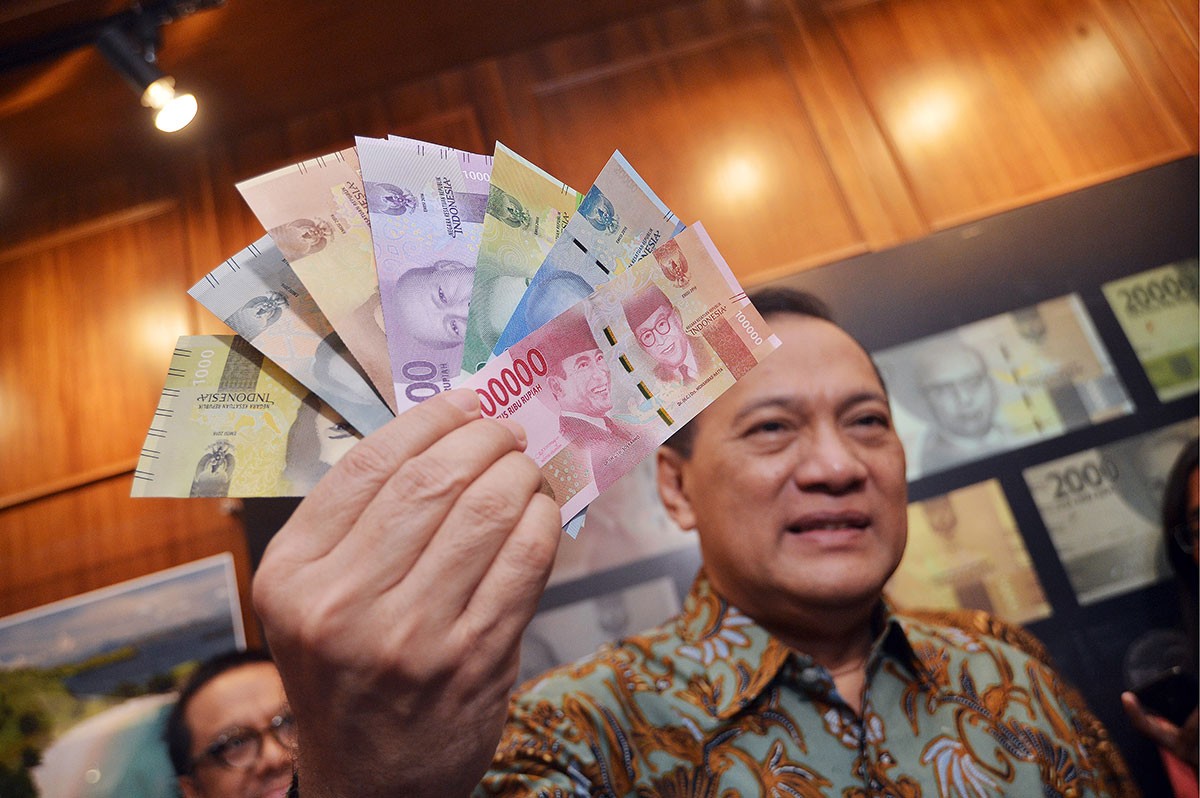 New faces in the wallet: Bank Indonesia Governor Agus Martowardojo shows off new rupiah banknotes after their launch. (Antara/Yudhi Mahatma)
I
n macroeconomic textbooks, in the business cycle hypothesis, the expansionpeak phase swiftly emerges after the recession-trough phase. Using this framework, we can consider the year 2015 as the bottom of Indonesia’s economic cycle. Ever since that year, the economy has been growing at around 5 percent again. In the first quarter this year, the economy expanded by 5.01 percent year-on-year.
That said, some issues are still causing concern. First, the business cycle is still over-reliant on the cycle of global commodity prices.
This over-dependency problem, the so-called Dutch Disease, has caused a deep monetary policy trilemma where Bank Indonesia (BI) to some degree has lost its policy sovereignty for the sake of free capital flows and a stable rupiah.
The consequence of prioritizing these two rather than the commodity dependency issue is a non-optimum level of interest rates, which accompanies economic growth, also at a non-optimum pace. It can be seen that Indonesia’s economy is unlikely to peak at the same level again after every crisis recurs.
Many recent studies have discussed the importance of structural reform through infrastructure investment and industrialization to relax the constraints in reaching its optimum potential. Yet, only a few focus on the financial sector development to ensure that optimum allocations of funds occur.
According to Levine in 1997, the financial sector has significant roles in intermediating and accumulating capital. An efficient financial sector tends to prolong the period of expansion and shorten the period of recession.
For the most recent study this year, Borio used the “financial cycle drag ” hypothesis to blame weak financial development as the source of economic predicaments.