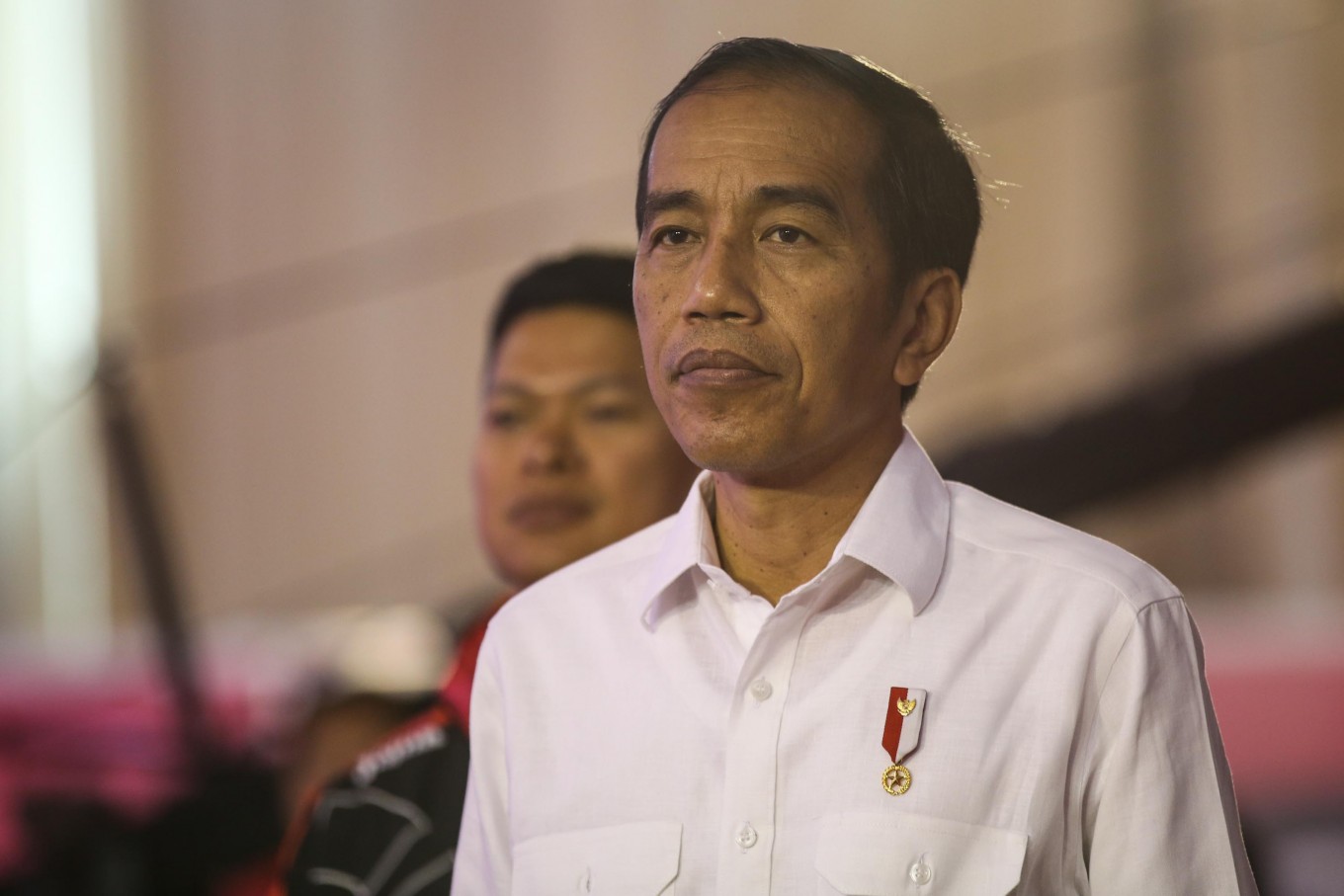
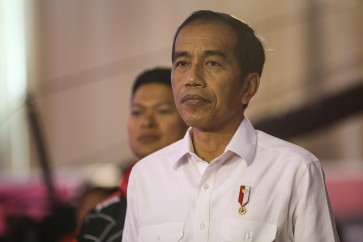
President Joko "Jokowi" Widodo (INAPGOC/Garry Lotulung)
A rare statement came from a coal-based energy businessman during the opening of the Indonesia Clean Energy Forum on Nov. 15, who said that securing investment for coal power plants was getting harder. Some of his international funders had even stopped investing in coal power plants.
On the other hand, he said, transitioning to renewable energy was not that easy, as many regulatory issues hampered the development of renewable energy. He concluded that while coal-based energy was headed toward extinction, renewable energy did not have the support it needed to survive.
A month earlier, President Joko “Jokowi” Widodo’s opening speech on Oct. 12 for the International Monetary Fund and World Bank Group Annual Meetings in Bali referred to a report from the Intergovernmental Panel for Climate Change (IPCC) regarding the 1.5-degree Celsius warming threshold. The President said that investment in renewable energy that was 400 times greater than current investments was needed to reduce carbon emissions and mitigate climate change.
To emphasize this notion, the National Development Planning Board (Bappenas) launched a low-carbon development plan during the same IMF-WB event as part of the government’s 2020 to 2024 National Long-term Development Plan (RPJMN).
It must be noted that the IPCC report also mentions the need to phase out the use of coal to fire power plants.
As reported, the IPCC has sent the message that even if countries fulfilled their Paris Agreement commitment to voluntarily reduce emissions under the Nationally Determined Contribution (NDC), the rise in the earth’s mean temperature would still exceed the 1.5-degree Celsius limit. This is why the Paris Agreement emphasized the need to formulate and submit a more ambitious NDC by 2020.
An ambitious NDC means that the member countries of the United Nations Framework Convention on Climate Change (UNFCCC) need to formulate a collective carbon emission reduction target (CERT), taking into consideration the different responsibilities and capacities of each country (CBDR-RC principles). Such differences include industrialization intensity, political will, population, economic capability and historical emission responsibility. The collective CERT must also achieve the 1.5-degree Celsius warming limit by 2030.
However, a fair way to determine the emission quota for each country is yet to be formulated. Does the UNFCCC have a top-down mechanism to ensure that each country’s commitment to proportionally reduce its emissions can work under the CBDR-RC principles?
Since climate change — which is mainly caused by fossil fuels — is catastrophic for humanity, a fossil fuel non-proliferation treaty similar to the 1968 nuclear non-proliferation treaty might be necessary as Andrew Simms and Peter Newell wrote in The Guardian last month.
Fifty years ago, countries felt the urgency to limit nuclear weapons to prevent worldwide disaster.
The IPCC report makes the same urgent case for climate change, backed by strong scientific arguments. Jokowi reiterated this urgency to an international audience in his Game of Thrones-themed IMF-WB opening speech.
During any UN assembly, including the COP24 now underway in Katowice, Poland, heads of state will be given the chance to voice their aspirations for their countries. Driven by the urgency surrounding climate change and countries’ commitment to reduce emissions more ambitiously, G77 developing countries may decide to send their heads of state to the COP24 and demand the 10 largest emission contributors, including Indonesia, to commit to setting a more ambitious CERT. The heads of the 38 small island developing states could also voice the same demand.
Given that the 2015 Paris climate summit is the only COP President Jokowi has attended so far, with all due respect, the President must to attend COP24 to reiterate the importance of collaboration in facing climate change as a “collective enemy”.
He also needs to attend the conference fight for Indonesia’s position to ensure that its contribution to emission reduction, which is closely linked to economic growth, does not disrupt national development. The agreement made at COP24 will set the course for the national development plan that will set Indonesia’s NDC 2020.
Indonesia still relies heavily on emission-intensive economic activities and production processes. The Environment and Forestry Ministry’s analysis of greenhouse gas data and the 2014 gross domestic product (GDP) published by Statistics Indonesia show that the country produced 174.53 tCO2e of emission to generate an additional GDP of Rp 1 billion (US$69,970).
Such a ratio is known as emission intensity. That year, Indonesia’s GDP was $890.8 billion, while India and China — recorded much lower emission intensity at 106 tCO2e and 73 tCO2e to respectively generate GDP of $2.04 trillion and $10.48 trillion.
In 2017, the 40 percent addition to India’s electricity capacity came from solar power, increasing its total solar-based electricity capacity to 22,000 megawatts.
Meanwhile, Indonesia’s solar power capacity reached only 94.45 MW this year. The price of solar power in India is 2.46 rupees per kilowatt hour, lower than the price of diesel power generator at 3.20 rupees/kwh.
This has contributed to reducing the emission intensity of India — which is one of the two largest solar power producers in the world, alongside China.
Arguably, the Indonesian government is on the right track in pushing for the integration of low-carbon development in the RPJMN 2020 to 2024. Hence, Indonesia’s long-term development and planning strategy must be grounded in the ambitious NDC 2020 spirit to limit warming to 1.5 degrees by 2030.
There should be dialogue and synergy between the two development planning streams to strengthen and sharpen the 2045 Vision for a Golden Indonesia with low-carbon development.
***
The writer is director of World Resources Institute Indonesia.
Starting from IDR 55,500/month
Disclaimer: The opinions expressed in this article are those of the author and do not reflect the official stance of The Jakarta Post.