The Jakarta Post
Please Update your browser
Your browser is out of date, and may not be compatible with our website. A list of the most popular web browsers can be found below.
Just click on the icons to get to the download page.


Popular Reads
Top Results
No results found. Please check your search term and try again
Can't find what you're looking for?
View all search results
Popular Reads
Top Results
No results found. Please check your search term and try again
Can't find what you're looking for?
View all search resultsPupuk Indonesia explores strategic fertilizer sector partnership in Russia
Change text size
Gift Premium Articles
to Anyone
Share the best of The Jakarta Post with friends, family, or colleagues. As a subscriber, you can gift 3 to 5 articles each month that anyone can read—no subscription needed!
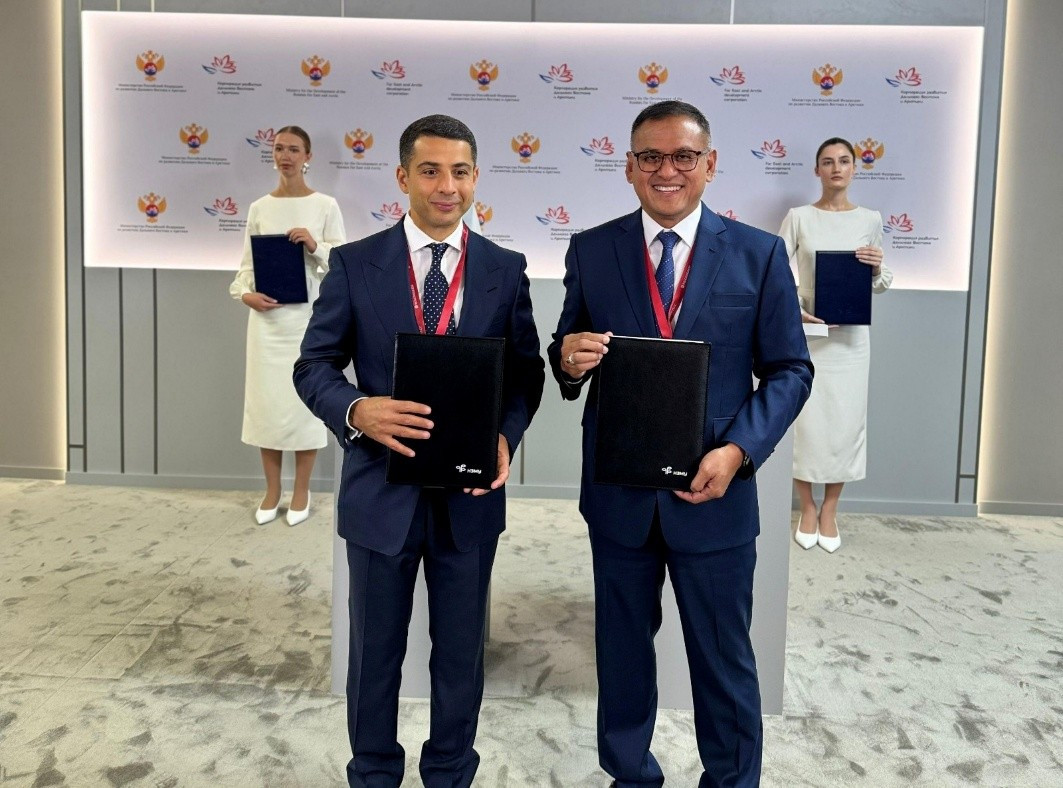 PT Pupuk Indonesia (Persero) president director Rahmad Pribadi (right) and JSC Ruschem general director Davydov Eduard Malikovich pose for a photo op during a signing ceremony on Sept. 3, 2026, in Vladivostok, Russia. (Courtesy of Pupuk Indonesia)
P
T Pupuk Indonesia (Persero) is exploring strategic partnership opportunities regarding the development of the Nakhodka Fertilizer Plant Phase 2 (NFP-2), a global-scale ammonia and urea production facility in Primorsky Krai in the Russian Far East, spearheaded by holding company JSC Ruschem.
Reflecting Pupuk Indonesia's efforts to diversify its raw material sources and expand its positioning regarding global assets and supply chains, the initiative was marked by signing a memorandum of understanding (MoU) on a joint study on Sept. 3, during the 11th Eastern Economic Forum (EEF) in Vladivostok, Russia.
Through this collaboration, the two parties will conduct a feasibility study and due diligence for the potential project. The assessments will cover technical aspects, project economics, security of raw material supply, financing structure, project risks and compliance with applicable laws and regulations, among other things.
Pupuk Indonesia president director Rahmad Pribadi explained that expanding production and sourcing alternatives could enhance resilience of the national fertilizer supply chain. The initiative, he added, also opened up potential access to gas-based ammonia-urea production with competitive feedstock costs that was also environmentally sustainable.
"Exploring this partnership is one of Pupuk Indonesia's long-term strategic options to secure access to raw materials and global production capacity,” Rahmad said.
“This aligns with Danantara's directive for Pupuk Indonesia to play a greater role in strengthening national food security while simultaneously expanding its presence in the global fertilizer industry," he said, referring to the state asset fund.
Investment and Downstream Minister Rosan P. Roeslani, who is also CEO of Danantara, said the exploration was a concrete follow-up to the meeting between President Prabowo Subianto and Russian President Vladimir Putin at the EEF. The new collaboration would create global investment opportunities for Pupuk Indonesia and strengthen both raw material security and the national industry, Rosan remarked.
"Pupuk Indonesia’s performance is steadily improving and becoming more efficient, giving it immense potential to invest in Vladivostok and partner with Russian entities. We hope this serves as a strategic step to strengthen our raw material security and industrial resilience," he said.
Rahmad noted that Pupuk Indonesia’s experience in processing gas for ammonia and urea production was a key asset in evaluating potential collaboration opportunities in Russia. This experience was highly relevant to the Nakhodka project, he said, as it relied on natural gas as feedstock.
The NFP-2 project involves the construction of a world-scale industrial complex for methanol, ammonia and urea in Primorsky Krai. The facility, owned by JSC Ruschem, is designed to have a projected annual production capacity of 1.8 million tonnes of methanol, 2 million tonnes of ammonia and 3.5 million tonnes of urea, with commercial operations targeted to begin around 2030.
The project also holds strategic value due to its location, with Rahmad noting that the port of Vladivostok faced the Pacific Ocean, offering Pupuk Indonesia an opportunity to expand market access in the Asia-Pacific, which had long been a crucial region for the company's trade activities.