The Jakarta Post
Please Update your browser
Your browser is out of date, and may not be compatible with our website. A list of the most popular web browsers can be found below.
Just click on the icons to get to the download page.


Popular Reads
Top Results
No results found. Please check your search term and try again
Can't find what you're looking for?
View all search results
Popular Reads
Top Results
No results found. Please check your search term and try again
Can't find what you're looking for?
View all search resultsHeeding the signal: Indonesia’s rising food insecurity
The share of food-insecure Indonesians rose from 8.7 percent in 2024 to 10.4 percent in 2025, or roughly 29 million people.
Change text size
Gift Premium Articles
to Anyone
Share the best of The Jakarta Post with friends, family, or colleagues. As a subscriber, you can gift 3 to 5 articles each month that anyone can read—no subscription needed!
 Set as preferred source
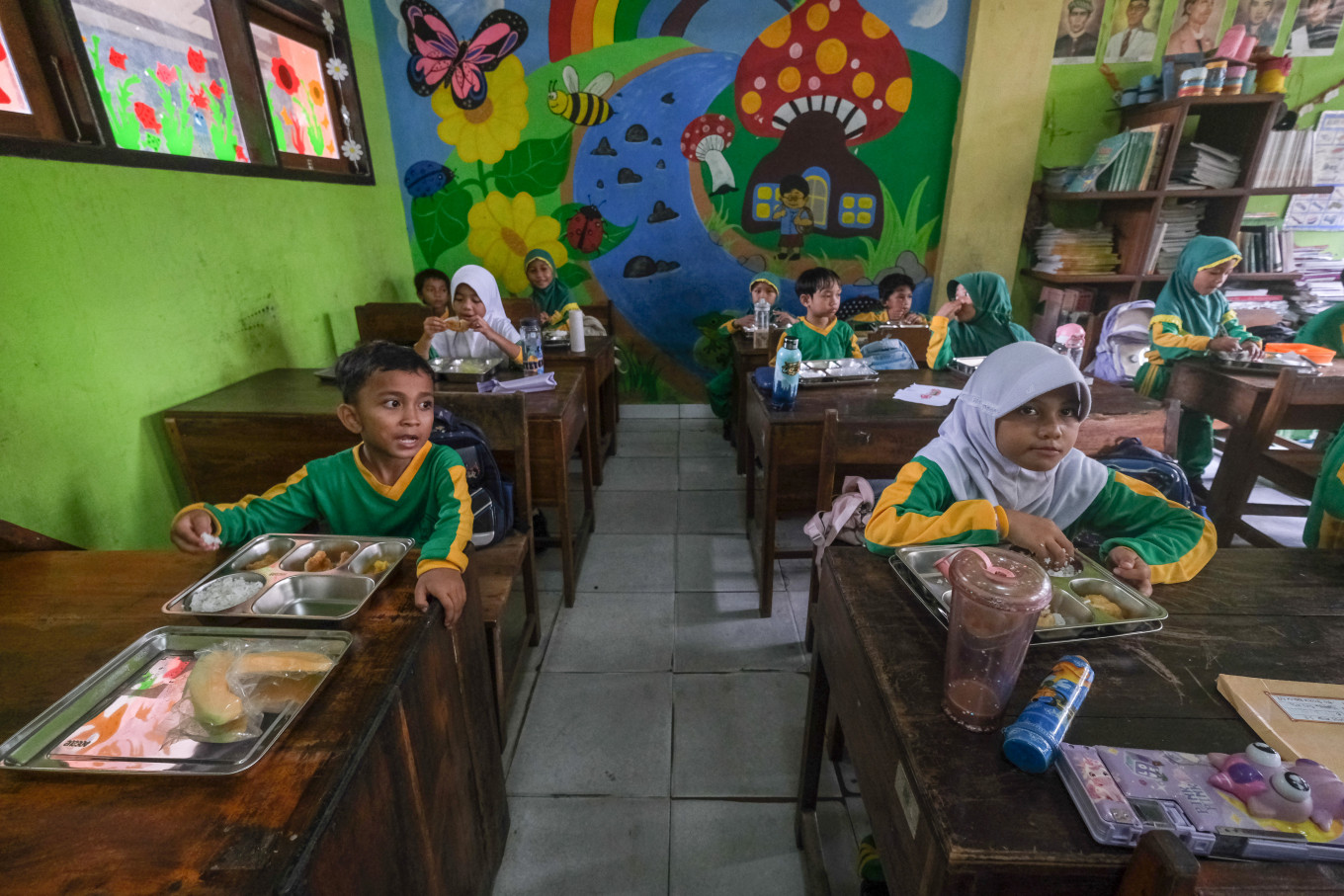 Lunch break: Students eat meals provided under the free nutritious meal program on May 21, 2026, at SD 2 Kendari elementary school in Kendari, Southeast Sulawesi. (Antara/Andry Denisah)
After nearly six years of steady improvement, Indonesia’s food insecurity has started to rise again.
Applying the Food and Agriculture Organization (FAO)’s Food Insecurity Experience Scale, we estimate that the share of food-insecure Indonesians rose from 8.7 percent in 2024 to 10.4 percent in 2025, or roughly 29 million people. However, the entire rise came from the mildest form of insecurity, while moderate and severe insecurity continued to fall to their lowest levels in six years. This is a story of rising worry, not rising hunger.
The pattern reflects pressure on household purchasing power rather than a real shortage of food. Volatile food prices jumped 6.2 percent year-on-year in 2025, up from just 0.1 percent a year earlier. When food prices rise faster than household income, families often cut back on the quality and variety of their food before they cut how often they eat.
This is exactly what the data suggest: more families grew anxious about affording enough food, while the most severe hardship, skipping meals or going a whole day without eating, kept easing. The burden, however, is not shared evenly. Food insecurity rises sharply as incomes fall. Against a national rate of 10.4 percent, it climbs to 15.4 percent among vulnerable households and 25.3 percent among the poorest, who suffer the most.
This shift matters most as a warning sign. Food access is among the main factors linked to child stunting, with food-insecure households more than four times as likely to have a stunted child. Indonesia has brought stunting down sharply, from 27.7 percent in 2019 to 19.8 percent in 2024. As food insecurity rises again, that progress is now at risk, because more hardship in households today can push stunting back up tomorrow.
From broad coverage to sharper impact

This is where food security programs such as the free nutritious meal program become especially relevant. The data also point to where their impact can be better targeted. The 2026 budget aims to reach 82.9 million people, yet only about 12 percent actually face a food deficit, a shortfall in the quality or quantity of their food. That is the very gap the free meals program is meant to help close. Genuine need, meanwhile, is found mostly among the poorest households and in remote, frontier and outermost (3T) regions, where food deficits run about one and a half times the national average.
The good news is that the program is already being directed toward these groups. The government has begun removing meals from schools that can feed their own students and shifting them to those who need them most. The case is strongest in the 3T regions, where need is greatest.
School meals can also support school participation, especially where it starts off low. In Rote Ndao, one of the poorest districts in Nusa Tenggara Timur, around a third of children aged 16 to 18 are not enrolled in senior high school in 2025. With many growing up without further education, the future of the next generation is at stake. Directed well, the free meals program can draw some of the 2.9 million children still out of school back in, becoming an investment in human capital, not just nutrition.
Indonesia can also learn from countries with mature school-meal systems. Their experience suggests such programs work best by combining broad reach with careful targeting. In the United States, nutrition standards matter because funding rewards schools that meet them, while the poorest schools are covered automatically. Japan, often seen as the world’s best example, shows that a central-kitchen model much like Indonesia’s can deliver good meals at scale when trained nutritionists plan and check every menu.
Seen against these examples, Indonesia’s recent move to sharpen the free meals program’s targeting is the right one. Focusing support on the households and regions that really need it matches how mature systems give their strongest support to those who benefit most. Sharper targeting is not giving up on big goals, it is the best way to make a large program actually work.
The signal is clear. Food insecurity is rising again, and if left unchecked, it could set back the progress Indonesia has worked so hard to make against stunting. In that light, the government’s commitment is well-placed and its goal sound, for few investments matter more than the nutrition of its next generation.
Sharper targeting also costs less. For that reason, we estimate the budget needed for the program at around Rp 175 trillion to 209 trillion (US$9.8billion-$11.7 billion), after refocusing it on the districts and cities that face food insecurity. That is about a third less than today, budget that could go to other priorities. The case for improving the program has rarely been stronger, and the timing has rarely been better. When done carefully, a program already this large can become truly transformative, nourishing not only today’s children but also the human capital of tomorrow.
*****
The writer is an analyst at Mandiri Institute.




Your Opinion Matters
Share your experiences, suggestions, and any issues you've encountered on The Jakarta Post. We're here to listen.
Enter at least 30 characters
0
/ 30
Thank you
Thank you for sharing your thoughts. We appreciate your feedback.


