The Jakarta Post
Please Update your browser
Your browser is out of date, and may not be compatible with our website. A list of the most popular web browsers can be found below.
Just click on the icons to get to the download page.


Popular Reads
Top Results
No results found. Please check your search term and try again
Can't find what you're looking for?
View all search results
Popular Reads
Top Results
No results found. Please check your search term and try again
Can't find what you're looking for?
View all search resultsIndonesia 'nowhere' in global AI supply chain, deputy minister says
Official says other countries are weaponizing technology chokepoints as competition shifts to hardware manufacturing and compute infrastructure.
Change text size
Gift Premium Articles
to Anyone
Share the best of The Jakarta Post with friends, family, or colleagues. As a subscriber, you can gift 3 to 5 articles each month that anyone can read—no subscription needed!
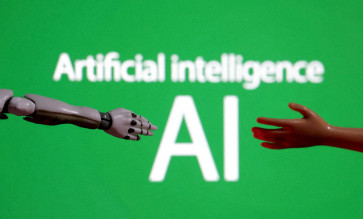
 A miniature robot hand and a toy hand point toward words reading “Artificial intelligence AI“ in this illustration created on Dec. 14, 2023. (Reuters/Dado Ruvic)
I
ndonesia risks being left out of the global artificial intelligence race unless it captures more value in supply chains, Deputy Communications and Digital Minister Nezar Patria has warned.
Speaking at an AI workshop hosted by the Indonesia Fintech Society (IFSoc), Nezar said Indonesia still contributed little beyond hosting factories, despite sitting on vast reserves of critical minerals needed for semiconductors and AI hardware.
"We are nowhere in the global supply chain […] We have the manufacturing plants, but the higher-value components and materials are still imported,” Nezar said on Tuesday, recalling a visit to PT Infineon Technologies Batam, the local subsidiary of German semiconductor manufacturer Infineon Technologies.
Read also: Govt under pressure from US Big Tech as AI rules near launch
While Southeast Asia’s largest economy had spent years promoting downstream processing, much of the materials and components used in semiconductor manufacturing are still imported before being assembled locally, leaving much of the industry's value creation overseas.
Basic but high-value components, such as gold bonding wire used in chip packaging, were still sourced overseas, he pointed out, illustrating how little of the semiconductor value chain the country could control and contribute to.

"Today, geopolitics is about creating technological choke points. The countries that control the supply chains are those that create choke points,” the deputy minister added.