TheJakartaPost
Please Update your browser
Your browser is out of date, and may not be compatible with our website. A list of the most popular web browsers can be found below.
Just click on the icons to get to the download page.


Popular Reads
Top Results
No results found. Please check your search term and try again
Can't find what you're looking for?
View all search results
Popular Reads
Top Results
No results found. Please check your search term and try again
Can't find what you're looking for?
View all search resultsMothers struggle to raise autistic children
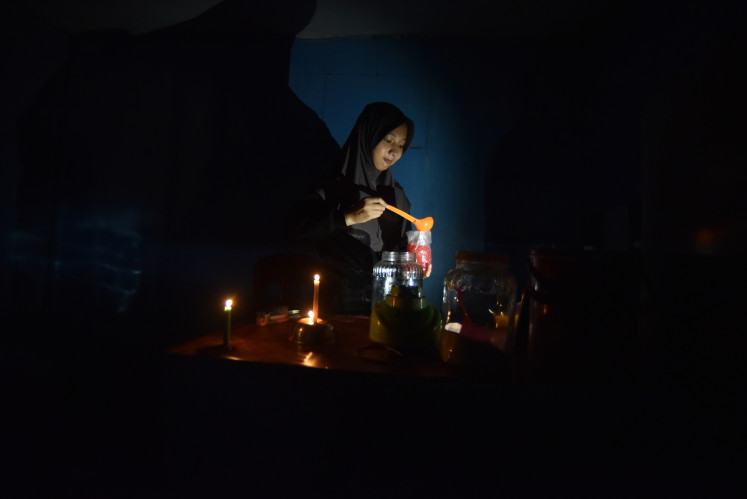
Kun Gantari recalled the moment her second son Furqon was born 10 years ago, and the days she raised her baby
Change text size
Gift Premium Articles
to Anyone
Share the best of The Jakarta Post with friends, family, or colleagues. As a subscriber, you can gift 3 to 5 articles each month that anyone can read—no subscription needed!

Kun Gantari recalled the moment her second son Furqon was born 10 years ago, and the days she raised her baby.
She remembered how responsive Furqon was in his first months.
"He always looked at the camera when someone was about to take a picture of him. I remembered how he responded when I taught him how to clap and wave his hands," the mother of two said.
Furqon was a normal child until he turned eight months old. Then he had a high fever.
"After he recovered from his sickness, I began to feel he was not normal."
She compared Furqon's growth with that of her first child, who was born 22 months before Furqon.
"When my mother came over to the house one day, she wondered why her grandson was no longer friendly with people he met and why he became angry easily."
Her psychologist friend recommended she see a prominent specialist, who ended up diagnosing her 22-month-old son with autism.
One week later, her husband and her found a therapy clinic for autistic children and enrolled their son there.
But after two years of therapy without seeing any improvements in their son's condition, the couple then decided to quit the therapy sessions and hired two therapists instead, to treat their son from home.
"A mother knows what is best for her son, so I decided to take care of him myself with the help of our therapists."
A year later, Furqon's condition improved and he was soon able to communicate.
The couple then decided to send their son to school.
"We tried to enroll him in several playgroups and kindergartens, but none of them were willing to accept our son," she said, holding back her tears.
Luckily, she received a call from Mandiga School - a special school for autistic children - letting her know Furqon could finally join the school.
"I really feel the ups and downs of raising a child that has special needs. I have shed so many tears, but now I feel I have finally born the fruits after years of struggling. And I am very grateful my husband and the whole family always supported us during these hard times."
Ane, Kristopher Agatha's stepmother, also shared bittersweet memories of raising her autistic 12-year-old son.
Kristov, as he is usually called, is her husband's first child, whom she started to raise in March 2007.
"His condition was saddening. He looked healthy from the outside, but his body was full of wounds and allergies. He often bit his own fingers and arms every time he got angry."
Not only would he hurt himself, but he would also attack people around him when relapsing, she said.
She was also sad to find Kristov's nurses, who had been treating her son at the house for seven years, often tied his hands and legs even when he was calm.
Her husband and her enrolled Kristov in a therapy center in North Jakarta and consulted a psychiatrist, however their son was still not showing signs of improvement.
"But we were committed to fighting for our son's condition to improve, no matter what," Ane said.
During the next months, they moved Kristov to another therapy center in South Jakarta, and their son's condition finally improved, although sometimes he is still emotionally unstable.
The couple also enrolled Kristov in therapy sessions for autistic children at school, regular counseling with doctors and psychologists, on top of giving him diet and food supplements.
"Kristov also swims, paints and does athletics. We encourage him to socialize," Ane said.
Natasha Rita Selly, a housewife living in Bekasi, did not need a diagnosis from a specialist to confirm her 7-year-old son Muhammad Malakalhaq suffered from autism.
She and her husband simply looked after their son at home for around two years after Muhammad began to show symptoms of autism.
"When my son was 4 years old, he began to show symptoms of autism. He did not talk and lived in an imaginary world," Natasha said.
"But we were living in a rural area in Pekalongan at that time, so it was hard to find a therapy center. We just treated him as best we could."
After the family moved to Bekasi, Muhammad joined a therapy clinic at Yayasan Cahaya Keluarga Kita in Jatiasih, where his condition improved very fast.
He is now able to read, count and communicate.
While most mothers are devastated when finding out their children are different, Chandra Dewi seemed to be much tougher when she discovered her now 16-year-old son Alit was autistic at the age of 5.
Her son began finding it difficult to communicate when he turned 2 years old.
When she brought her son to a children's clinic, specialists said her son's ability to talk and socialize was simply slow.
"We enrolled him in a standard playgroup and kindergarten. Actually, we didn't really treat him in any special way and just raised him as a normal child. If other children can do many things by themselves, why can't he?"
Alit enjoys learning music, cooking, making handicrafts, computers and reciting the Koran, and is good at those things too, Dewi said. He also improved his socializing skills and adaptation to a new environment.
Now that all these mothers have come to grips with their children's special needs, as well as made many plans for their future, they suggested some tips for the parents of autistic children.
"The most important thing is Alit is able to survive on his own and does not always depend on me," Dewi said.
"I want him to be able to look after himself by using his skills."
"We are now looking for an area in which Furqon excels, so that we can focus on it for his future," said Kun.
Selly suggested mothers bring their children immediately to a specialist for early detection as soon as they notice symptoms of autism.
Dewi, meanwhile, encouraged parents to be more accepting, no matter what the condition of their children was.
"A child is a blessing. God has entrusted us to take care of him, so we have to love him unconditionally although he is nothing like we expected," she said.