TheJakartaPost
Please Update your browser
Your browser is out of date, and may not be compatible with our website. A list of the most popular web browsers can be found below.
Just click on the icons to get to the download page.


Popular Reads
Top Results
No results found. Please check your search term and try again
Can't find what you're looking for?
View all search results
Popular Reads
Top Results
No results found. Please check your search term and try again
Can't find what you're looking for?
View all search resultsRestoring the spirit of Ramadan
All over the world, Muslims are celebrating the arrival of the blessed month of Ramadan 1431 Hijri with joy and happiness
Change text size
Gift Premium Articles
to Anyone
Share the best of The Jakarta Post with friends, family, or colleagues. As a subscriber, you can gift 3 to 5 articles each month that anyone can read—no subscription needed!

A
ll over the world, Muslims are celebrating the arrival of the blessed month of Ramadan 1431 Hijri with joy and happiness. For Indonesian Muslims, however, the picture of this coming Ramadan is quite depressing in the midst of a sharp hike in food prices, gas canister explosions and electricity tariff hikes. Frustrated, many people cannot afford to buy these items to feed their families and children, which most likely will trigger violence and social unrest.
Since the coming of Ramadan is a critical moment of our day-to-day lives where things are getting tough in this country, restoring the spirit of Ramadan is desperately needed with a view to establishing a more humanizing fasting month. Some points are worth considering and putting into practice prior to and during Ramadan.
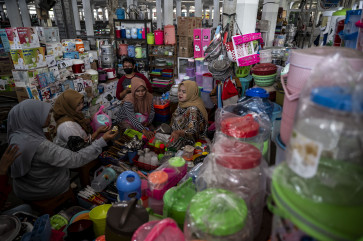
First, Muslims must not put an incorrect emphasis on Ramadan. Indonesian Muslims are unique in their greeting of Ramadan by shopping. There have been questions from non-Muslims as to why Muslims consume and spend more during the month where they are supposed to cut back and be moderate.
How come many Indonesian Muslims overstock on food? It can’t be for survival. Because if it is survival, it would not apply to the many Indonesians who are already struggling with obesity and the various health problems related to it.
Even if it is survival, surely that applies only to food and drink? What reasons, however, exist for those who greet Ramadan by preparing to shop for new clothes, new gadgets, new furniture, even new cars?
Only those who are thinking of doing all those things know the real answers. Hopefully, those who are thinking of doing so realize soon enough that they are actually planning for a loss. The wrong emphasis on Ramadan would risk overshadowing the da’wah (Islamic propagation) with commercialism.
Second, Muslims should adopt a healthy lifestyle during Ramadan. There is a tendency for people to hold excessive and lavish food preparations and buffets during Ramadan and the festive season of Idul Fitri, locally known as Lebaran. It definitely contradicts the Ramadan message encouraging those who are fasting not to live life beyond normal limits.
Frankly speaking, Indonesian Muslims remain ignorant of health and safety issues during Ramadan compared to their brothers and sisters-in-faith fasting abroad. For instance, people are not used to consulting with a doctor about the safety of fasting in some circumstances. It makes sense because some health conditions may be improved during fasting, while others may possibly deteriorate.
During my time in Canberra, I realized medical consultation was absolutely essential for those who are about to fast, particularly during long summer days when it may be required to resist all food and drink for up to 16 hours at a time. This strain may be too much for people with certain health conditions.
Maintaining a healthy lifestyle during Ramadan is frequently misunderstood by many through discontinuing exercise. People are under the misconception that perhaps their bodies cannot withstand physical activities because they are fasting. However, the truth is otherwise. Studies have shown that although people fasting should not perform strenuous exercise. It is recommended that those fasting should engage in some kind of light exercise, such as stretching or walking.
With working hours reduced for government and private sectors, the public should take that opportunity to de-stress the mind especially in the peaceful month of Ramadan and at the same time, not completely neglect exercise normally performed during other months.
Third, Muslims are in dire need of revitalize the role of mosques. For many people across the country, Ramadan has arrived when they are at the age of a decline in health and education, massive unemployment and the rise of business failures. The future seems to be bleak.
In response to huge difficulties, Muslims should make mosques as centers for intellectual discourse and at the same time information centers for non-Muslims to learn about Islam as a faith and as a way of life. While the former functions to have Muslims active in seeking ways out of day-to-day actual problems, the latter is believed to be a bridge of understanding between Muslims and non-Muslims.
Islamic organizations — MUI, Muhammadiyah, NU, or DDII — are expected to pay more attention to organize and coordinate joint counseling centers in thousands of mosques across the nation. Compared to safari Ramadan (Ramadan Safari), disreputably known as means of consolidating party members and supporters by the Golkar Party during Soeharto era, mosque-centered counseling centers will be more inviting, enlightening and cerebral for intellectually and spiritually inquisitive Muslims.
With regard to young Muslims, it is time to see the house of Allah busy with activities not only for prayers but also as consultation centers that will attract our youths to frequent the mosques rather than moving around in the shopping malls. Indonesian Muslims today need new breeds of successful young Muslims who understand deeply the role of the mosque in Islam.
With Ramadan just around the corner, let’s utilize the holy month to obtain good merit and get closer to Allah the Almighty. Ramadan Karim (Ramadan, the noble)! Ramadhan Mubarak (Ramadhan, the blessed)!
The writer is a lecturer at Andalas University, Padang, and a graduate of the University of Canberra, Australia.