The Jakarta Post
Please Update your browser
Your browser is out of date, and may not be compatible with our website. A list of the most popular web browsers can be found below.
Just click on the icons to get to the download page.


Popular Reads
Top Results
No results found. Please check your search term and try again
Can't find what you're looking for?
View all search results
Popular Reads
Top Results
No results found. Please check your search term and try again
Can't find what you're looking for?
View all search resultsThe looming legal tsunami: Unchecked military power in Indonesia
The TNI has transitioned into a "multifunction" role, potentially gaining even more power than it held during its historical "dual function" (dwifungsi) era.
Change text size
Gift Premium Articles
to Anyone
Share the best of The Jakarta Post with friends, family, or colleagues. As a subscriber, you can gift 3 to 5 articles each month that anyone can read—no subscription needed!
 Set as preferred source
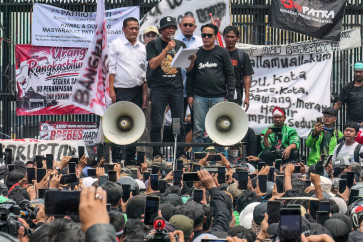
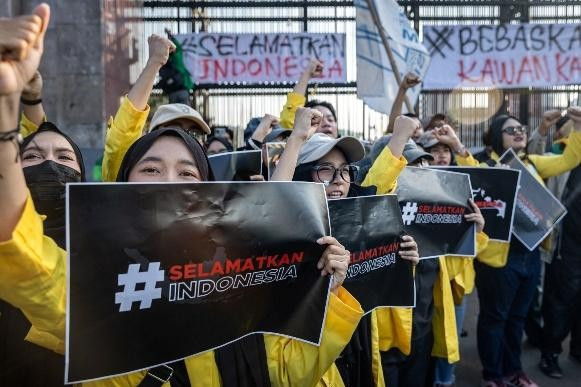 On reminders: Members of the Indonesian Student Executive Board Alliance rally outside the House of Representatives on Sept. 4, 2025 in support of the “17+8 People’s Demands”, a platform of short-term and long-term reform demands raised during the August protests. (AFP/Kristianto Purnomo)
T
he Indonesian law enforcement landscape in 2025 is defined by a security-centric approach, signaling a troubling shift toward militaristic and authoritarian governance that imperils human rights and civilian supremacy.
This administration's approach to legislation has been chaotic, characterized by rapid, opaque revisions of the Law on the Indonesian Military (TNI) and the Code of Criminal Procedure (KUHAP). These processes neglected meaningful public participation and subjectively expanded the powers of security agencies (The TNI and the police) without adequate oversight mechanisms.
Meanwhile, ambitious initiatives such as the national strategic projects (PSN), the food estates and the free nutritious meal program have been implemented with little public engagement, leading to systematic human rights violations that favor oligarchic interests.
Data substantiates the criticism of these strategic projects. From 2023 to 2025, the Indonesia Legal Aid Institute Foundation (YLBHI) documented 216 incidents in areas designated for PSN, while the National Human Rights Commission received 114 complaints related to PSN from 2020 to 2023. The Agrarian Reform Consortium reported that 36 of 79 agrarian conflicts were directly linked to PSN infrastructure.
The eviction of residents in Rempang, Riau Islands, in December 2024 highlights the alarming prioritization of security measures over community rights to facilitate the Rempang Eco City project. This approach is mirrored in land seizures for green industries in North Kalimantan. The Indigenous Maba Sangaji community in East Halmahera faced criminalization while attempting to protect their ancestral lands from nickel mining.
Furthermore, the food estate project in Merauke, South Papua, which aims to utilize 2 million hectares of land under military leadership, has displaced local communities, including the Malind, Maklew, Yei and Khimaima peoples. The military presence and plans for transmigration have created a volatile environment ripe for conflict.

President Prabowo Subianto's flagship free meals program is also plagued by structural flaws, including a lack of legal foundation beyond Presidential Regulation No. 83/2024. Despite an allocation of Rp71 trillion (US$640 million), 30 percent of the education budget, the program has underperformed, with over 9,000 reported cases of food poisoning across 83 districts by Sept. 30.