TheJakartaPost
Please Update your browser
Your browser is out of date, and may not be compatible with our website. A list of the most popular web browsers can be found below.
Just click on the icons to get to the download page.


Popular Reads
Top Results
No results found. Please check your search term and try again
Can't find what you're looking for?
View all search results
Popular Reads
Top Results
No results found. Please check your search term and try again
Can't find what you're looking for?
View all search resultsTime to reset strategic relations between Cambodia and the US
For the US, grater engagement with Cambodia fits well within its Indo-Pacific strategy, at a time when the Southeast Asian mainland has quietly become ground zero of increasing Chinese influence.
Change text size
Gift Premium Articles
to Anyone
Share the best of The Jakarta Post with friends, family, or colleagues. As a subscriber, you can gift 3 to 5 articles each month that anyone can read—no subscription needed!
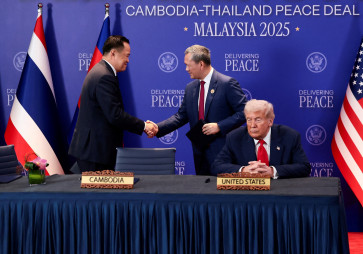
 Thailand's Prime Minister Anutin Charnvirakul (left) and Cambodia’s Prime Minister Hun Manet (center) shake hands next to United States President Donald Trump (right) on Oct. 26, during the signing of a ceasefire deal between Cambodia and Thailand on the sidelines of the 47th ASEAN summit in Kuala Lumpur. (Reuters/Evelyn Hockstein)
T
hai and Cambodian forces have resumed exchanging fire along their shared border, despite Washington’s earlier, unexpected attempt to end the conflict. The intervention by the United States President Donald Trump in October achieved what months of diplomacy from regional partners could not.
Yet, even as the ceasefire collapses, Trump’s initiative is a reminder that, despite years of distant and strained relations, the US remains the indispensable security partner in mainland Southeast Asia.
The episode also exposed a misalignment of strategic relations for both Cambodia and the US. Cambodia cannot afford to depend solely on one partner, and the US cannot afford to neglect one of ASEAN’s most strategically located states. After decades of mistrust and misunderstandings, the moment has arrived for a reset.
US-Cambodian relations have long been defined by suspicion. In Washington, Cambodia is often viewed as a country that has drifted too far toward Beijing. By contrast, in Phnom Penh, the US is seen as an unpredictable partner whose deeper ambitions tied to aid are unclear. The apprehension over the Ream Naval Base, US tariffs, online scam centers and the suspension of military exercises have reinforced these views on both sides.
But the border crisis changed the tone. The US role in halting hostilities was welcomed by the Cambodian public and by officials who, for years, believed Washington had written their country off. Former prime minister Hun Sen’s exchange of letters with Trump signaled a willingness to rebuild trust and confidence, while Hun Sen’s son, a West Point graduate, became the focal point for reconnection.
This new context offers an opportunity to move beyond old narratives of alignment and dependency, toward one based on transparency, mutual respect and shared strategic interests.

Cambodia’s geography gives it outsized importance regionally. It sits at the heart of mainland Southeast Asia, sharing land borders with Thailand, Laos, Vietnam, and the Gulf of Thailand for its sea border. It is at both a continental and maritime crossroads, making it essential to regional trade, energy flows and security.