The Jakarta Post
Please Update your browser
Your browser is out of date, and may not be compatible with our website. A list of the most popular web browsers can be found below.
Just click on the icons to get to the download page.


Popular Reads
Top Results
No results found. Please check your search term and try again
Can't find what you're looking for?
View all search results
Popular Reads
Top Results
No results found. Please check your search term and try again
Can't find what you're looking for?
View all search resultsThe deafening silence on offshore wealth
A decade later, the verdict is damning. The world was warned. Lawmakers blinked. And the system endured.
Change text size
Gift Premium Articles
to Anyone
Share the best of The Jakarta Post with friends, family, or colleagues. As a subscriber, you can gift 3 to 5 articles each month that anyone can read—no subscription needed!
 Set as preferred source
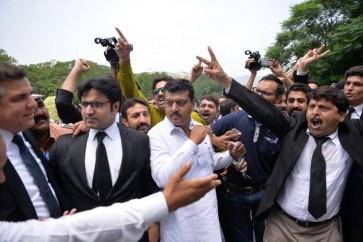
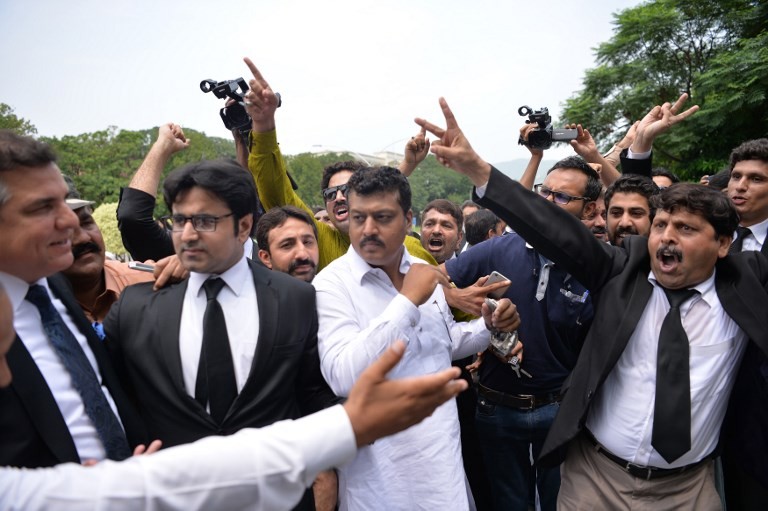 Pakistani lawyers (right) shout slogans next to ruling party leader Daniyal Aziz (left) against then prime minister Nawaz Sharif outside the Supreme Court building during a hearing on the Panama Papers case in Islamabad on July 17, 2017, after the Joint Investigation Team (JIT) presented a final report of the investigation probing allegations of money laundering against Sharif and his family. (AFP/Aamir Qureishi)
W
hen John Doe, the anonymous whistleblower behind the Panama Papers, approached us, he handed us an opportunity. When the resulting investigation into the offshore finance industry was published on April 3, 2016, the world was handed a test. As investigative journalists, we seized the opportunity. Sadly, the world has failed the test.
For decades, Panama, Malta, the British Virgin Islands and the Cook Islands functioned as safe havens for dictators, strongmen, presidents, kings, mafia clans, money launderers and tax cheats. Behind layers of shell companies, erected often by shady law firms, they hid fortunes, influence and crimes. John Doe tore away the veil.
The outrage was immediate and dramatic. Then United States president Barack Obama called for international reforms to address the “huge problem” of tax avoidance. Then British chancellor of the exchequer George Osborne touted a “hammer blow against those who hide their illegal tax evasion in the dark corners of the financial system”.
A slew of investigations were launched. Icelandic prime minister Sigmundur Gunnlaugsson resigned over revelations that he owned an undeclared offshore company. Pakistani prime minister Nawaz Sharif was removed from office and indicted on corruption charges. Governments recovered more than US$1 billion in back taxes and penalties. Britain, France, Germany, Italy and Spain launched an information-sharing initiative to combat tax evasion and avoidance.
For a moment, it looked as if governments were finally ready to confront a problem they had tolerated for decades. But systemic reform never came. Jurisdictions talked tough but quietly protected the status quo. A decade later, the verdict is damning. The world was warned. Lawmakers blinked. And the system endured.
Tackling the kind of financial crimes exposed by the Panama Papers is not some impossible dream. On the contrary, much could be achieved simply by introducing freely accessible public registers of beneficial ownership. If the public knows exactly who owns each firm, shell companies will not be able to shield those who steal, bribe, launder money and evade taxes. The same goes for trusts: with many jurisdictions largely or fully exempting them from public disclosure, these “weapons of mass injustice” can hold wealth indefinitely, while obscuring who truly controls it.

Public ownership registers are widely recognized as one of the most effective tools against corruption. But governments largely refuse to implement them. Where they do exist, they are often deliberately weakened, such as by restricting access to them. In British Overseas Territories and Crown Dependencies, public registers remain unfinished or protected by large barriers to access.