The Jakarta Post
Please Update your browser
Your browser is out of date, and may not be compatible with our website. A list of the most popular web browsers can be found below.
Just click on the icons to get to the download page.


Popular Reads
Top Results
No results found. Please check your search term and try again
Can't find what you're looking for?
View all search results
Popular Reads
Top Results
No results found. Please check your search term and try again
Can't find what you're looking for?
View all search resultsAnalysis: BPJS Kesehatan under strain as claims outpace revenues
Change text size
Gift Premium Articles
to Anyone
Share the best of The Jakarta Post with friends, family, or colleagues. As a subscriber, you can gift 3 to 5 articles each month that anyone can read—no subscription needed!
 Set as preferred source
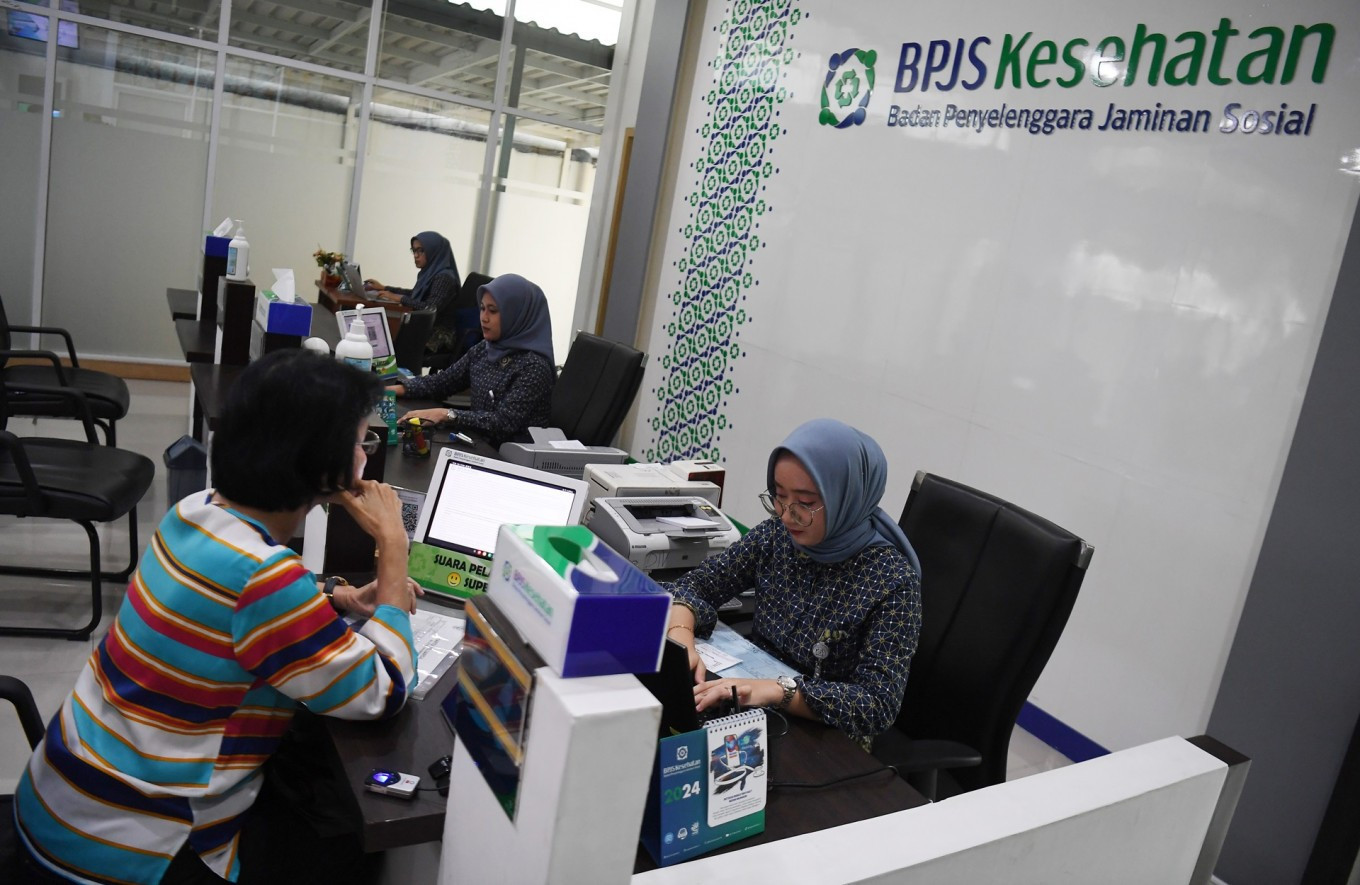 A Health Care and Social Security Agency (BPJS Kesehatan) official helps a customer on May 14, 2024, at the agency's South Jakarta office. (.Antara/Akbar Nugroho Gumay)
I
ndonesia’s universal healthcare program is coming under renewed strain as the Health Care and Social Society Agency (BPJS Kesehatan) revealed that claims have begun to outpace premium revenues. With the claim ratio reaching 111.86 percent as of February 2026, the imbalance signals growing pressure on the financial sustainability of the National Health Insurance (JKN) system.
BPJS Kesehatan president director Prihati Pujowaskito said the imbalance reflects structural weaknesses in JKN’s funding model and could lead to a sustained deficit. As of February 2026, premium revenue reached Rp29.26 trillion (US$1.71 billion), while claims expenses stood at Rp32.73 trillion, resulting in a Rp3.47 trillion shortfall and pushing the claim ratio above 100 percent.
Prihati noted that financial pressure has persisted since JKN’s launch in 2014, with only a brief period of stability between 2019 and 2022, when the claim ratio fell below 100 percent. Since then, the ratio has steadily increased from 104.72 percent in 2023 to 105.78 percent in 2024, 107.69 percent in 2025 and 111.86 percent this year.
A key driver of the program’s strain is declining active membership. As of February 2026, inactive participants reached 58.32 million, comprised of 13.48 million members in arrears and 44.84 million who have deactivated their memberships. This trend is partly driven by non-salaried workers (PBPU), particularly freelancers in the informal sector, opting out of the program. It is also linked to adjustments in local government budgets, which have reduced subsidies for low-income and vulnerable groups (PBI).
The issue of declining government coverage for PBI participants has been one of the key drivers of this trend. According to Social Affairs Minister Saifullah Yusuf, the ministry deactivated around 13.5 million members of the PBI program between April 2025 and January 2026 as part of broader efficiency measures aimed at improving targeting accuracy.
Nevertheless, these measures have had unintended consequences. While the objective of improving targeting is fiscally justified, the large-scale deactivation of subsidized members has not been matched by a corresponding increase in new or returning contributors. Instead, many of those removed from the PBI scheme have transitioned into inactive status, contributing to the growing pool of nonpaying participants and further narrowing the program’s effective contribution base.

As cash inflows from members decline, healthcare costs continue to rise. Total benefit costs increased by 11 percent between 2024 and 2025, while spending on serious illnesses grew by 12 percent over the same period.