The Jakarta Post
Please Update your browser
Your browser is out of date, and may not be compatible with our website. A list of the most popular web browsers can be found below.
Just click on the icons to get to the download page.


Popular Reads
Top Results
No results found. Please check your search term and try again
Can't find what you're looking for?
View all search results
Popular Reads
Top Results
No results found. Please check your search term and try again
Can't find what you're looking for?
View all search resultsBlackout in Sumatra and the threat to Indonesia's energy transition
Indonesia’s power system is still built on a decades-old paradigm, a handful of large power plants strung together by long transmission lines, with limited flexibility and little redundancy.
Change text size
Gift Premium Articles
to Anyone
Share the best of The Jakarta Post with friends, family, or colleagues. As a subscriber, you can gift 3 to 5 articles each month that anyone can read—no subscription needed!
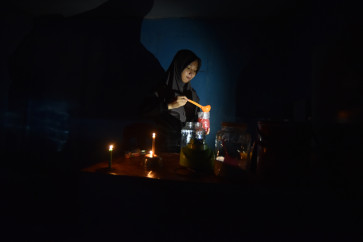
 A vendor prepares drinks for customers on May 23, 2026, during a power outage in Nagari Kasang, Padang Pariaman, West Sumatra. (Antara/Fitra Yogi)
L
ast month’s massive blackout across Sumatra, triggered by a single break in the 275 kilovolt (kV) Muara Bungo–Sungai Rumbai transmission corridor in Jambi, left millions without power for hours.
One lightning strike, one corridor and the whole interconnected cross-provincial grid went down. The big question is why a localized disturbance that should have been contained instead cascaded into a system-wide failure.
The honest answer is Indonesia’s power system is still built on a decades-old paradigm, a handful of large power plants strung together by long transmission lines, with limited flexibility and little redundancy.
When one part of that chain fails, the whole thing goes down fast. What makes this more than a reliability story is the context. Indonesia’s energy transition has been almost entirely fixated on building generation: how many gigawatts of solar, how many geothermal projects, how many coal plants to retire.
The grid, transmission, distribution, protection systems, control architecture, get treated with secondary importance, easy to defer. But this is where the nervous system of the entire power sector lives.
We have been neglecting it for years. A 500 kV transmission backbone for Sumatra was planned over a decade ago, conceived as an electricity superhighway connecting the island’s provinces. Target completion was 2019 but we are well past that, and there is little to show for it. The system still leans heavily on 275 kV networks that were never designed for today’s load, let alone tomorrow’s.

The stakes are now considerably higher. Indonesia is in the middle of an industrial transformation: downstream nickel processing, electric vehicles, hyperscale data centers, new green industrial zones. None of these can tolerate hours without power. A smelter losing power mid-process. A hospital during surgery. A data center serving millions of users. These are the industries Indonesia is actively courting as investors.