The Jakarta Post
Please Update your browser
Your browser is out of date, and may not be compatible with our website. A list of the most popular web browsers can be found below.
Just click on the icons to get to the download page.


Popular Reads
Top Results
No results found. Please check your search term and try again
Can't find what you're looking for?
View all search results
Popular Reads
Top Results
No results found. Please check your search term and try again
Can't find what you're looking for?
View all search resultsAnalysis: BGN reshuffle puts spotlight on problems in free meals program
Change text size
Gift Premium Articles
to Anyone
Share the best of The Jakarta Post with friends, family, or colleagues. As a subscriber, you can gift 3 to 5 articles each month that anyone can read—no subscription needed!
 Set as preferred source
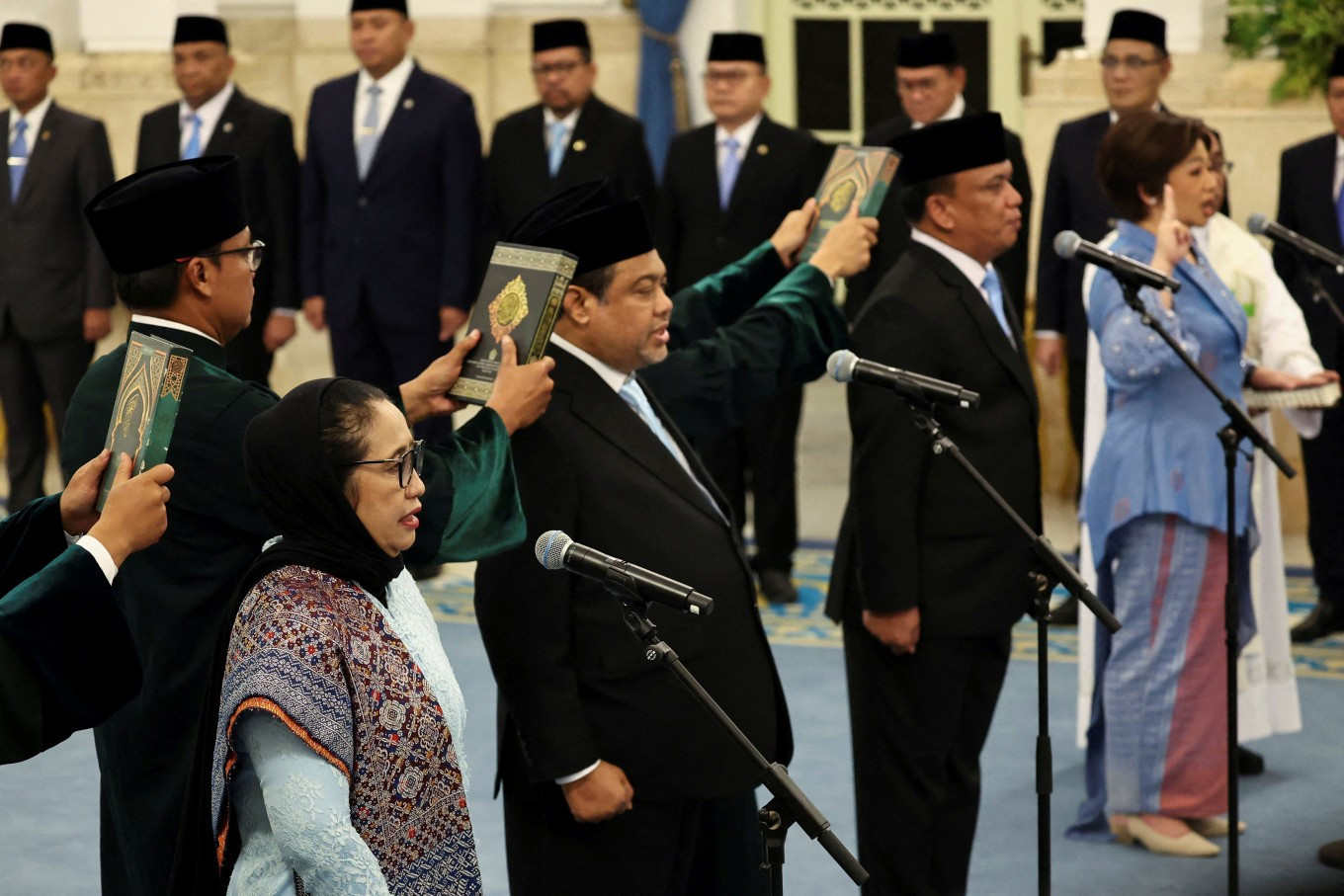 Head of National Nutrition Agency (BGN) Nanik Sudaryati Deyang along with her deputies Maj. Gen. Trenggono and Agustina Arumsari, and Said Iqbal, special presidential advisor for employment, take their oaths during their inauguration on June 8 at the State Palace in Jakarta. (Reuters/Willy Kurniawan)
P
resident Prabowo Subianto officially dismissed National Nutrition Agency (BGN) head Dadan Hindayana and his two deputies through a surprise announcement by the State Secretariat early last week, marking one of the most abrupt leadership changes of his administration. The move was soon followed by the Attorney General's Office (AGO) naming all three officials as corruption suspects in the program.
Dadan was replaced by former deputy Nanik Sudaryati Deyang. Meanwhile, deputy heads Lt. Gen. (ret.) Lodewyk Pusung and Insp. Gen. (ret.) Sony Sonjaya were replaced by Development Finance Comptroller (BPKP) deputy head Agustina Arumsari and Maj. Gen. Trenggono, vice president director of state-owned food company PT Agrinas Pangan Nusantara.
The removal of Dadan and his deputies represents one of the most significant personnel changes since the agency was established. Neither the Palace nor BGN initially provided a detailed explanation for the leadership transition. Shortly after the announcement, however, AGO investigators searched BGN's offices before arresting the three former leaders.
According to the AGO, the three suspects allegedly manipulated the verification process on the BGN partner portal to ensure that foundations selected as partners for the Nutrition Fulfillment Service Units (SPPG) were linked to BGN officials or employees. These foundations reportedly received incentives worth billions of rupiah daily and were allegedly affiliated with, and in some cases owned by, the suspects.
Yet the allegations of financial irregularities represent only one of the challenges facing the government's free meals program. Since its launch in January last year, the initiative has encountered a range of operational and structural problems stretching across the entire supply chain, from land acquisition and facility licensing to procurement, workforce development and food safety oversight.
Labor has emerged as a particularly sensitive issue. While the program is often framed as a food distribution initiative, its core objective is to improve nutritional outcomes among schoolchildren and other beneficiaries. Achieving that goal requires more than simply preparing and delivering meals; it demands personnel capable of managing food safety protocols, handling storage and logistics and ensuring that nutritional standards are consistently met.

Critics have argued that the rapid nationwide rollout of the program has at times outpaced the availability of trained workers and nutrition specialists needed to support such an ambitious undertaking. The consequences have been most visible in a series of food poisoning incidents that have occurred throughout the program's implementation.