The Jakarta Post
Please Update your browser
Your browser is out of date, and may not be compatible with our website. A list of the most popular web browsers can be found below.
Just click on the icons to get to the download page.


Popular Reads
Top Results
No results found. Please check your search term and try again
Can't find what you're looking for?
View all search results
Popular Reads
Top Results
No results found. Please check your search term and try again
Can't find what you're looking for?
View all search resultsReforming the police without reforming police power
By prioritizing organizational strength over independent oversight, the new Police Law delivers mere administrative updates instead of genuine democratic reform.
Change text size
Gift Premium Articles
to Anyone
Share the best of The Jakarta Post with friends, family, or colleagues. As a subscriber, you can gift 3 to 5 articles each month that anyone can read—no subscription needed!
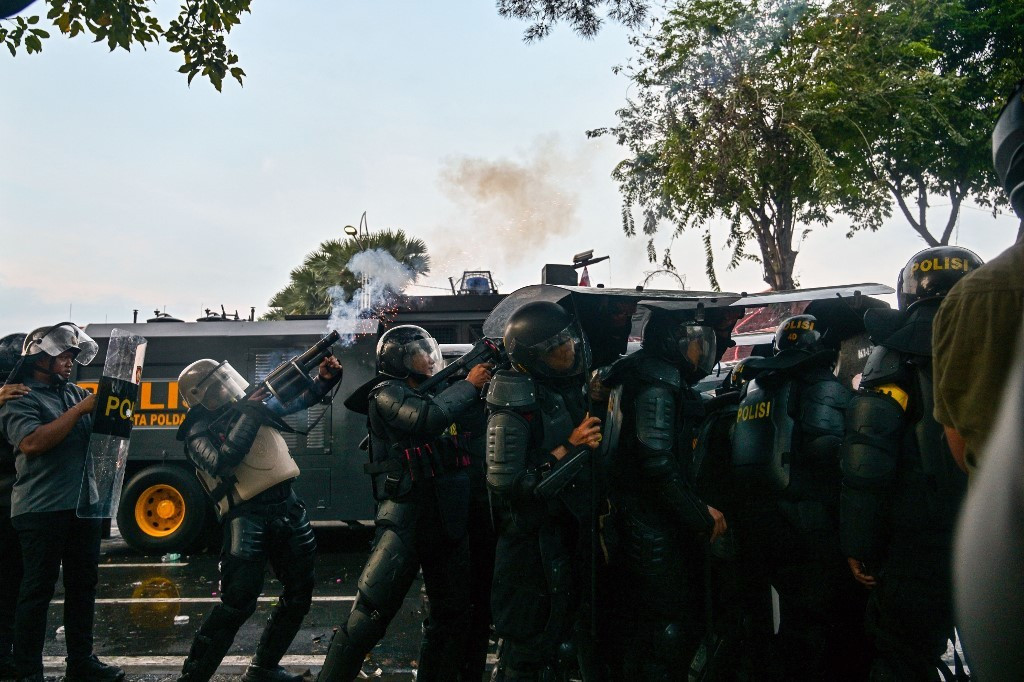 Police fire tear gas to disperse demonstrators during a protest against the Police Mobile Brigade (Brimob) in front of the East Java gubernatorial residence in Surabaya, East Java on Aug. 29, 2025, following the death of 21-year-old motorcycle transportation driver Affan Kurniawan, who was killed after being struck by a police tactical vehicle amid a protest against lavish allowances for lawmakers in Jakarta on Aug. 28. (AFP/Juni Kriswanto)
T
he passage of the revised Police Law this week should have been an opportunity to address one of the most persistent shortcomings of Indonesia’s democratic transition: the lack of meaningful accountability over police power. Instead, the amendment largely reinforces the institution while leaving its most fundamental problems unresolved.
Nearly three decades after the separation of the police from the military, police reform remains one of the unfinished agendas of the Reform Era. The challenge facing Indonesia today is no longer how to build a modern police organization, but how to ensure that police powers are effectively constrained, supervised, and made accountable to the public. The latest amendment, however, reflects a different set of priorities.
Lawmakers have highlighted eight key changes in the revised law, including stronger human rights education, greater transparency, improved personnel management, clearer rules on retirement age and a stronger role for the National Police Commission (Kompolnas). The law also regulates the placement of active police officers in civilian institutions and allows the President to extend the tenure of the National Police chief based on organizational needs. While these changes may improve administrative governance, they do little to address the crisis of public trust that has shadowed the police corps in recent years.
The problem has never been merely organizational; it is fundamentally about accountability. Over the past decade, a series of incidents have exposed structural weaknesses within the institution. The Kanjuruhan stadium disaster demonstrated the deadly consequences of excessive force, while the Ferdy Sambo murder case revealed how institutional solidarity could be used to manipulate legal processes and obstruct justice. Reports of torture to extract confession during interrogation, extortion, corruption, and poor public services continue to surface with disturbing regularity.
These cases are not isolated episodes. They reflect deeper, systemic problems: weak external oversight, a culture of impunity, political proximity to those in power, and the concentration of extensive powers in a single institution.
Yet the revised law pays remarkably little attention to these concerns. There is no requirement to record interrogations to prevent torture and coerced confessions, and no independent mechanism is established to investigate deaths resulting from police actions.

The law contains no meaningful provisions on transparency regarding public complaints, case dismissals, or the use of firearms, nor does it create a complaint mechanism independent of the institution itself. In effect, the amendment devotes considerable attention to strengthening the organization while neglecting safeguards against the abuse of power.