The Jakarta Post
Please Update your browser
Your browser is out of date, and may not be compatible with our website. A list of the most popular web browsers can be found below.
Just click on the icons to get to the download page.


Popular Reads
Top Results
No results found. Please check your search term and try again
Can't find what you're looking for?
View all search results
Popular Reads
Top Results
No results found. Please check your search term and try again
Can't find what you're looking for?
View all search resultsBetter coordination is key to solving the stunting crisis
Indonesia too often loses its recurring war on stunting despite ambitious policy documents, primarily due to a lack of integrated coordination across sectors and stakeholders.
Change text size
Gift Premium Articles
to Anyone
Share the best of The Jakarta Post with friends, family, or colleagues. As a subscriber, you can gift 3 to 5 articles each month that anyone can read—no subscription needed!
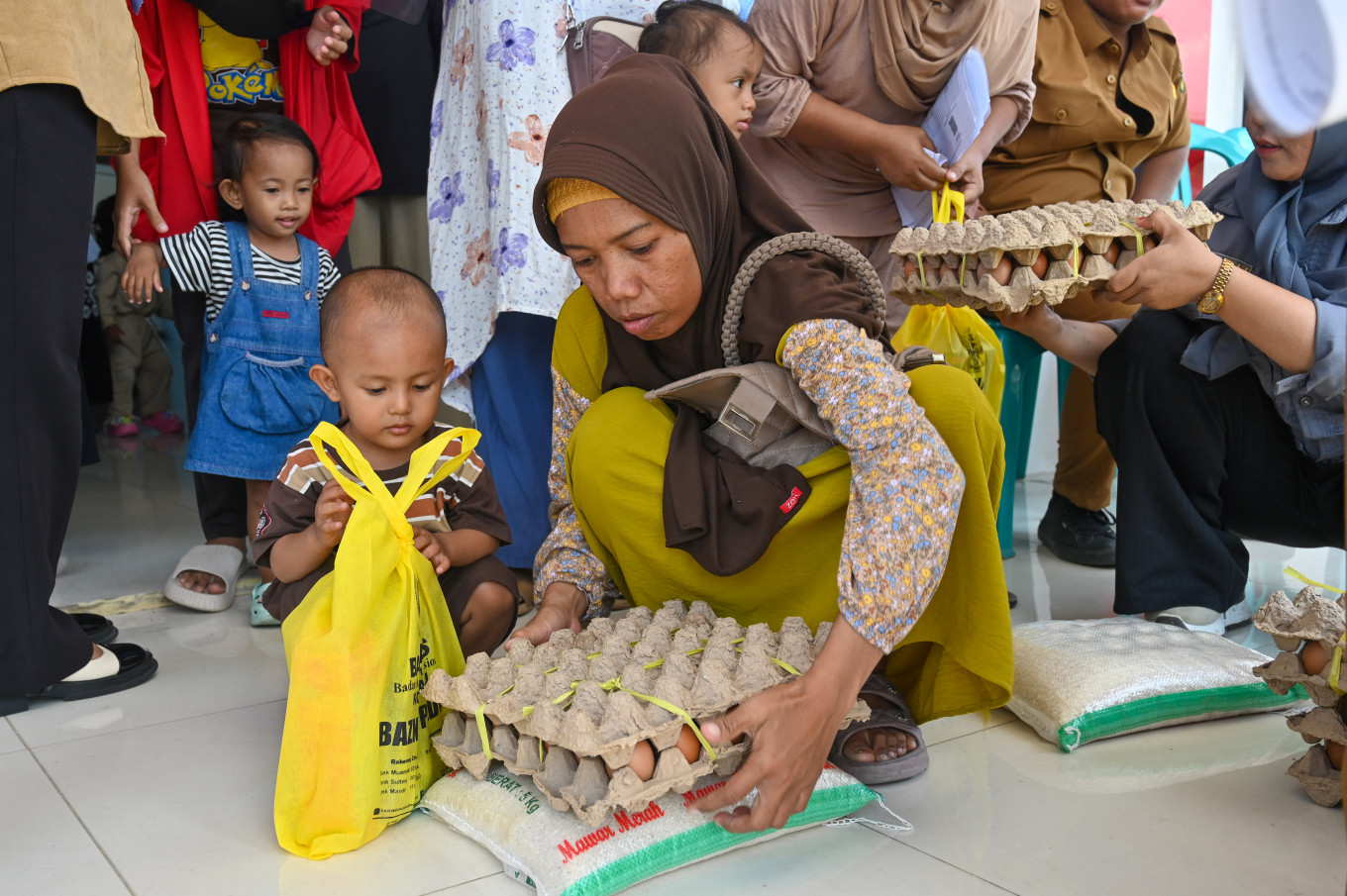 A woman picks up a carton of eggs as a toddler watches on Oct. 14, 2025, during an anti-stunting food distribution activity organized by the municipal administration of Palu, Central Sulawesi. (Antara/Basri Marzuki)
T
he country’s stunting prevalence dropped to 19.8 percent in 2024, down from 21.5 percent the previous year, according to the Indonesian Nutritional Status Survey (SSGI). While this progress is a commendable achievement, it falls short of the 14 percent target mandated for 2024 by Presidential Regulation (Perpres) No. 72/2021 on the acceleration of stunting reduction. This gap serves as a critical reminder that the government must address the underlying governance issues stalling further progress.
A stunting rate of 19.8 percent sounds like a percentage. In reality, it means approximately 4.5 million Indonesian children under 5 are affected. To put that in perspective, that is equivalent to more than one and a half times the population of Surabaya, the second-largest city in the country. It is roughly the size of an entire province. Put another way, if you have five children, statistically, one of them would be stunted.
Imagine if every child in Jakarta was stunted. The public outcry would be immediate. Headlines on this phenomenon would dominate the news. Politicians would be under immense pressure to act.
But most of these 4.5 million children do not live in Jakarta. They live in remote villages, outer islands and underserved communities far from the centers of power and attention. Their struggles are less visible, and our sense of urgency is diminished as a result.
Thus, Indonesia has declared war on stunting many times over. Policy frameworks have been built, budgets allocated and teams assembled from the provincial down to the village level. Yet on the ground this war is too often lost, not for lack of regulation but because of coordination that remains dangerously fragile.
Addressing stunting prevalence requires a holistic, integrated and cross-sectoral, convergence-based approach from the central to the village levels in order to ensure that specific interventions (nutrition and health) and sensitive interventions (clean water, sanitation, social protection, education and food security) are implemented in a coordinated manner.

It is therefore essential to ensure that convergence teams function well, such as actively involving relevant agencies, village officials and health workers, because this enables the meaningful reduction of stunting rates. The key is not the number of programs running but the quality of coordination among those running them.