The Jakarta Post
Please Update your browser
Your browser is out of date, and may not be compatible with our website. A list of the most popular web browsers can be found below.
Just click on the icons to get to the download page.


Popular Reads
Top Results
No results found. Please check your search term and try again
Can't find what you're looking for?
View all search results
Popular Reads
Top Results
No results found. Please check your search term and try again
Can't find what you're looking for?
View all search resultsAnalysis: Students target Prabowo, military responds swiftly
Change text size
Gift Premium Articles
to Anyone
Share the best of The Jakarta Post with friends, family, or colleagues. As a subscriber, you can gift 3 to 5 articles each month that anyone can read—no subscription needed!
 Set as preferred source
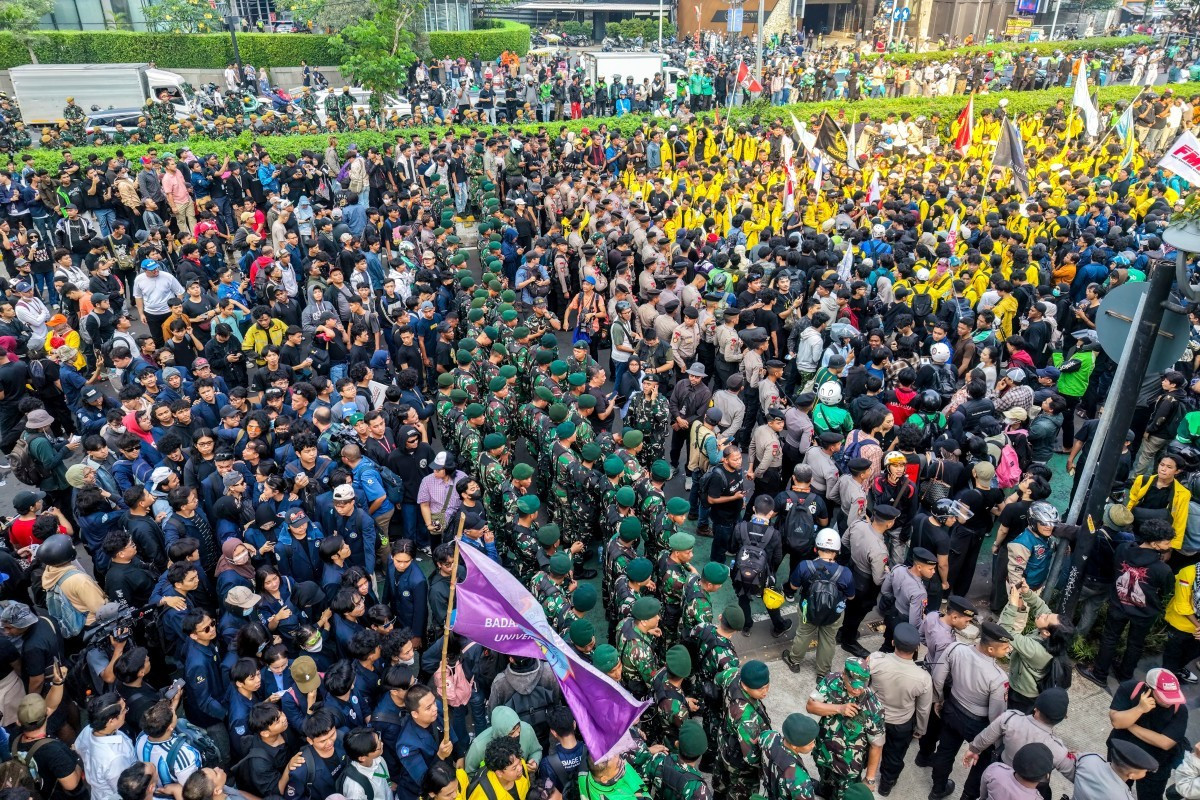 Indonesian Military (TNI) personnel (center) stand guard behind police personnel to block the path of students protesting demanding a reduction in fuel prices and the dissolution of President Prabowo Subianto's free nutritious meal program, which they consider to be a hotbed of corruption, on June 12 in Jakarta. (AFP/Bay Ismoyo)
S
tudents from Indonesia’s leading universities have once again taken to the streets in Jakarta and other major cities, about eight months after the last wave of mass protests turned violent. This time, they are specifically targeting President Prabowo Subianto’s leadership and governing style, which they blame for the country’s current economic difficulties.
Unlike in previous protests, however, the Indonesian Military (TNI) was deployed from the outset to help manage the situation amid growing calls from some government critics for political change. Despite a few minor scuffles, the demonstrations on June 12 remained largely peaceful, with both protesters and security forces exercising restraint.
Student leaders have vowed to return to the streets after giving Prabowo an opportunity to respond to their five-point list of demands. They also plan to reassess their strategy in light of the military’s involvement. The following Monday, additional student groups, joined by civil society organizations, staged demonstrations in Jakarta, suggesting that public dissatisfaction extends beyond university campuses.
The movement in Jakarta was led by the “Yellow Jackets,” a group of students from Universitas Indonesia, the country’s premier public university. They were joined by students from other public and private universities in the capital, as well as in several major cities across the country.
Under the banner “Toward a Bankrupt Indonesia,” the students are demanding that the government stop squandering state funds, reduce the prices of food and fuel and roll back the President’s flagship programs, including the free nutritious meal program and the establishment of the Red and White Rural Cooperatives program. They are also calling for an end to the military’s involvement in civilian affairs and for the President to acknowledge and take responsibility for policy mistakes.
The protests come amid an economic downturn marked by the rupiah’s decline to historic lows of more than Rp18,000 against the US dollar and a fall in the Jakarta stock market.

Analysts say that what began as a loss of confidence among foreign investors has spread to Indonesia’s middle class. The lower middle class, represented in part by the student movement, has expressed its frustration by taking to the streets. Analysts also point to an erosion of political confidence amid signs of shrinking civic space and the expanding role of the TNI in civilian affairs.