The Jakarta Post
Please Update your browser
Your browser is out of date, and may not be compatible with our website. A list of the most popular web browsers can be found below.
Just click on the icons to get to the download page.


Popular Reads
Top Results
No results found. Please check your search term and try again
Can't find what you're looking for?
View all search results
Popular Reads
Top Results
No results found. Please check your search term and try again
Can't find what you're looking for?
View all search resultsBombs and bombast fail to stop a multipolar world
While Western pressure aims to break Iran, the deep historical roots of Persian statecraft and the unstoppable shift toward a multipolar world ensure Tehran cannot be isolated.
Change text size
Gift Premium Articles
to Anyone
Share the best of The Jakarta Post with friends, family, or colleagues. As a subscriber, you can gift 3 to 5 articles each month that anyone can read—no subscription needed!
 Set as preferred source
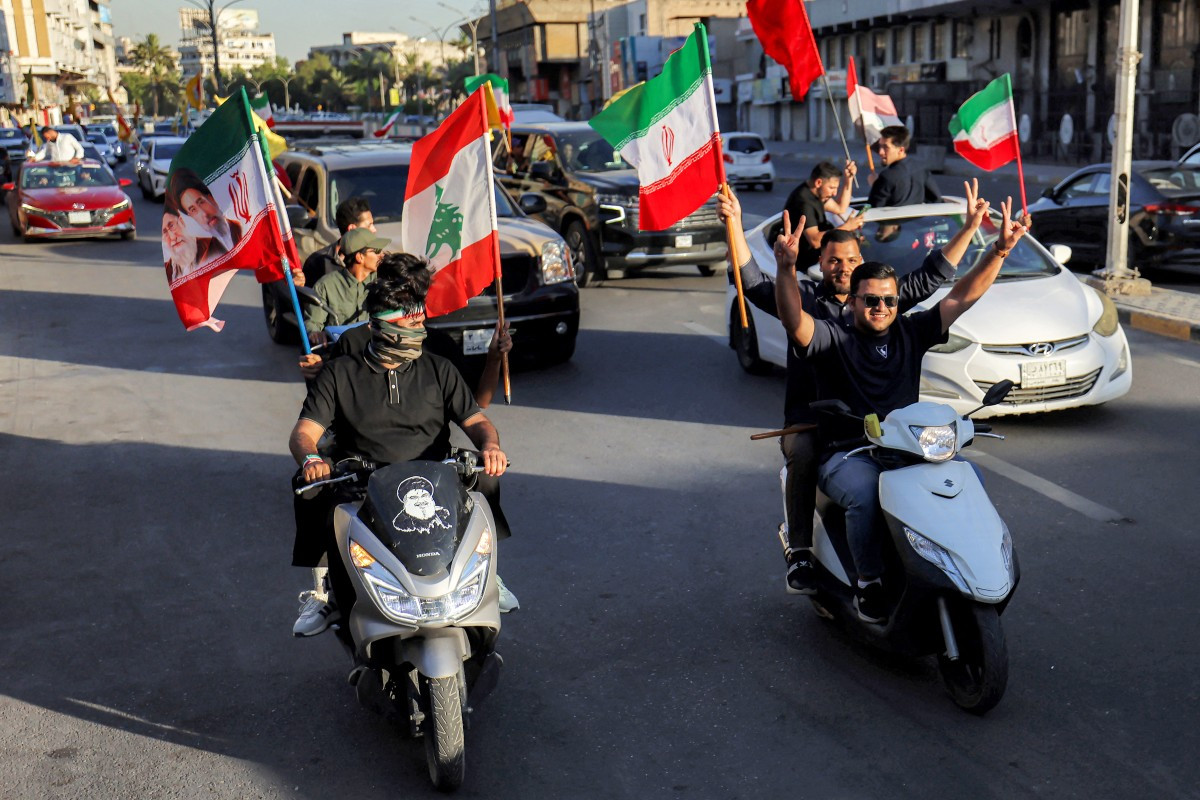 Youths ride scooters and vehicles while waving flags of Iraq, Iran, Lebanon and Hezbollah on June 15 in Baghdad, during celebrations following the announcement of a deal to end the war between Iran and the United States. (AFP/Ahmad Al-Rubaye)
T
he recent memorandum of understanding between the United States and Iran may have temporarily reduced the immediate risk of escalation in West Asia. However, it would be premature to interpret the agreement as either a comprehensive peace settlement or a strategic defeat for Iran. At most, the memorandum represents a temporary de-escalation rather than a lasting resolution of the longstanding issues that have driven tensions between the two countries.
While the document provides broad assurances regarding Iran's nuclear program, several critical issues remain unresolved. It lacks the robust inspection framework associated with the International Atomic Energy Agency's Additional Protocol, and there is no publicly disclosed mechanism for accounting for highly enriched uranium already within Iran.
Furthermore, the agreement does not impose significant restrictions on ballistic missile development, nor does it directly address Iran's extensive network of regional partners. The absence of these provisions underscores the fact that the memorandum is merely a 60-day pause—one that hardliners in both Iran and Israel could easily ruin. Rather than resolving the underlying strategic dispute, it effectively postpones it.
An equally significant misconception is gaining traction in certain policy circles: the assumption that military pressure alone can fundamentally reshape Iran's political trajectory or reverse the broader geopolitical transformation unfolding across Eurasia. Such assumptions warrant careful examination.
Persia has endured foreign invasions, dynastic upheavals, imperial occupations and revolutionary transformations over millennia. The modern Islamic Republic represents only one phase within a much longer civilizational continuum. To suggest that a limited military campaign or a temporary diplomatic arrangement has diminished Iran's strategic significance is to overlook both historical experience and geopolitical realities.
Iran remains positioned at the intersection of West Asia, Central Asia, South Asia and the Caucasus. It possesses one of the region's largest populations, substantial energy resources and extensive ties with neighboring states. More importantly, Iran has become increasingly integrated into a broader network of relationships that extends well beyond the Middle East.

China and Russia may not share all of Iran's ideological perspectives, nor are they likely to form formal military alliances comparable to those of the Cold War era. Nevertheless, both countries have compelling strategic reasons to prevent Tehran's complete isolation. For China, Iran remains an important component of regional connectivity and long-term energy security. For Russia, Iran serves as a valuable partner in balancing Western influence across Eurasia.