The Jakarta Post
Please Update your browser
Your browser is out of date, and may not be compatible with our website. A list of the most popular web browsers can be found below.
Just click on the icons to get to the download page.


Popular Reads
Top Results
No results found. Please check your search term and try again
Can't find what you're looking for?
View all search results
Popular Reads
Top Results
No results found. Please check your search term and try again
Can't find what you're looking for?
View all search resultsStudent protests as the last civilian check against militarism, fiscal populism
Widespread student protests serve as Indonesia's last functional civilian check against a coopted parliament and structural decay. By demanding accountability for flagship populist programs, this growing movement directly challenges the systematic infiltration of militarism into civic governance and the erosion of constitutional fiscal boundaries.
Change text size
Gift Premium Articles
to Anyone
Share the best of The Jakarta Post with friends, family, or colleagues. As a subscriber, you can gift 3 to 5 articles each month that anyone can read—no subscription needed!
 Set as preferred source
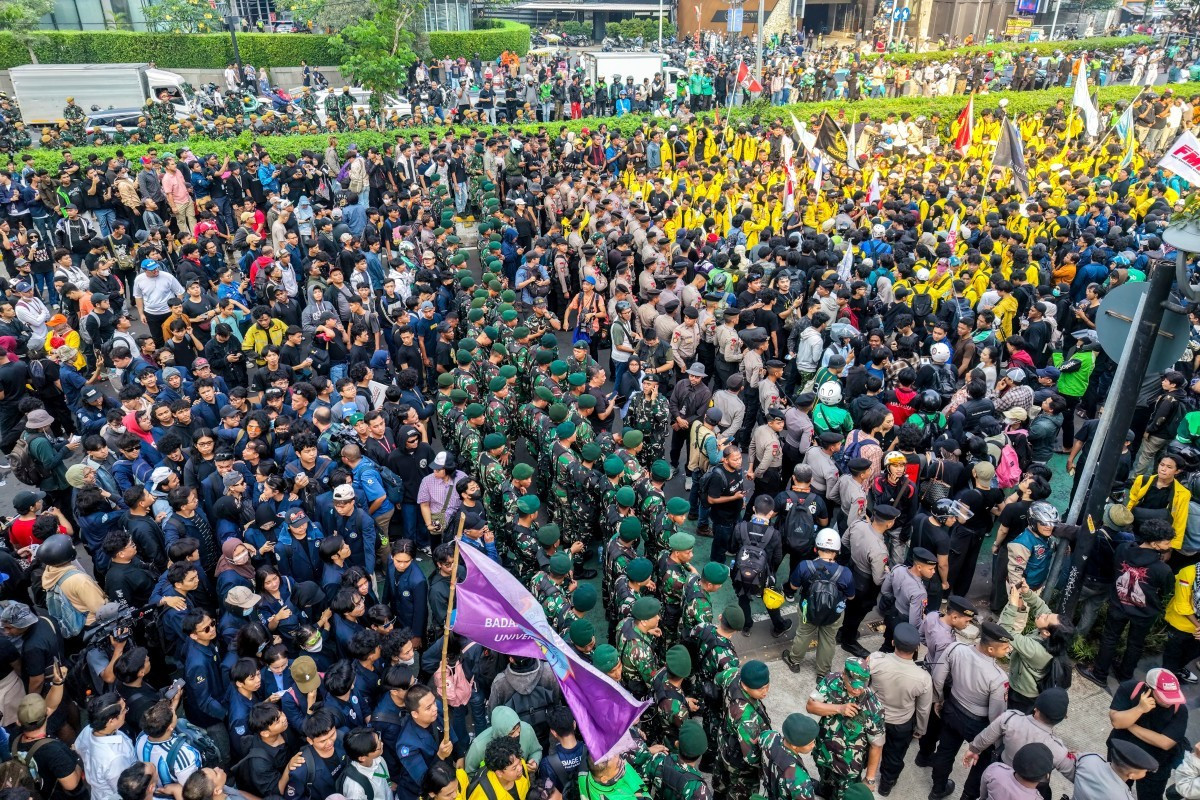 Indonesian Military (TNI) personnel (center) stand guard behind police personnel to block the path of students protesting demanding a reduction in fuel prices and the dissolution of President Prabowo Subianto's free nutritious meal program, which they consider to be a hotbed of corruption, on June 12 in Jakarta. (AFP/Bay Ismoyo)
W
idespread student demonstrations across Indonesia underscore growing public disillusionment with recent economic and structural policies. Ignited by a hike in nonsubsidized oil prices—framed by the administration as a necessary response to global crude fluctuations—the nationwide protests reflect deep concerns over fiscal mismanagement.
Thousands of students have demanded an immediate cessation of wasteful spending, focusing specifically on President Prabowo Subianto’s flagship populist initiatives: the free nutritious meal program and the Red and White Cooperatives (KDMP). Beyond fiscal worries, these demonstrations highlight resistance against the systematic infiltration of militarism into civic and economic institutions.
The mobilizations, which began on June 12, under the banner "Indonesia Toward Bankruptcy," issued an 18-day ultimatum for the government to stabilize the economy. This timeline aligns with the sharp depreciation of the rupiah, which breached the psychological threshold of Rp 18,000 per US dollar for the first time on June 4, and continued to fluctuate in the subsequent days.
Public skepticism regarding the MBG program is validated by severe governance failures. Just prior to the currency's decline, the Attorney General’s Office (AGO) detained Dadan Hindayana, the former head of the National Nutrition Agency (BGN), alongside two former deputy heads: retired police general Sony Sonjaya and retired Army general Lodewyk Pusung. The three were named suspects in a major corruption case involving the misappropriation of the 2025–2026 MBG budget.
Specific allegations include a mark-up scheme for 21,801 electric motorcycles, inflated procurements for items irrelevant to nutritional distribution, including 32,000 pairs of shoes, over 31,000 tablets and 5,400 72-inch televisions. Furthermore, billions of rupiah per day were allegedly channeled into daily incentives for private foundations affiliated with the suspects.
Civil society coalitions, such as MBG Watch, point out that the program lacks proper targeting; demographic data shows many recipients can already secure three meals a day independently. Instead of focusing resources on underdeveloped, frontier and outermost (3T) regions, this expansion represents a severe misallocation of funds, prompting demands for comprehensive structural audits.

The financial architecture of the MBG program, which commands a budget of Rp 268 trillion this year, directly threatens other essential sectors. Its funding relies on reallocating resources originally designated for public education, health, and social services. Out of the mandated 20 percent education allocation in the 2026 state budget (Rp 769.09 trillion), between Rp 223.5 trillion and Rp 268 trillion was diverted to the free meals initiative. Because the program is classified under social spending, this diversion circumvents the constitutional education quota.