The Jakarta Post
Please Update your browser
Your browser is out of date, and may not be compatible with our website. A list of the most popular web browsers can be found below.
Just click on the icons to get to the download page.


Popular Reads
Top Results
No results found. Please check your search term and try again
Can't find what you're looking for?
View all search results
Popular Reads
Top Results
No results found. Please check your search term and try again
Can't find what you're looking for?
View all search resultsThe myth of global chaos: Behind turmoil lies a hard political logic
Take a step back and you will see that all of today’s major conflicts are of a piece, and a powerful logic of adaptation and resilience is at work.
Change text size
Gift Premium Articles
to Anyone
Share the best of The Jakarta Post with friends, family, or colleagues. As a subscriber, you can gift 3 to 5 articles each month that anyone can read—no subscription needed!
 Set as preferred source
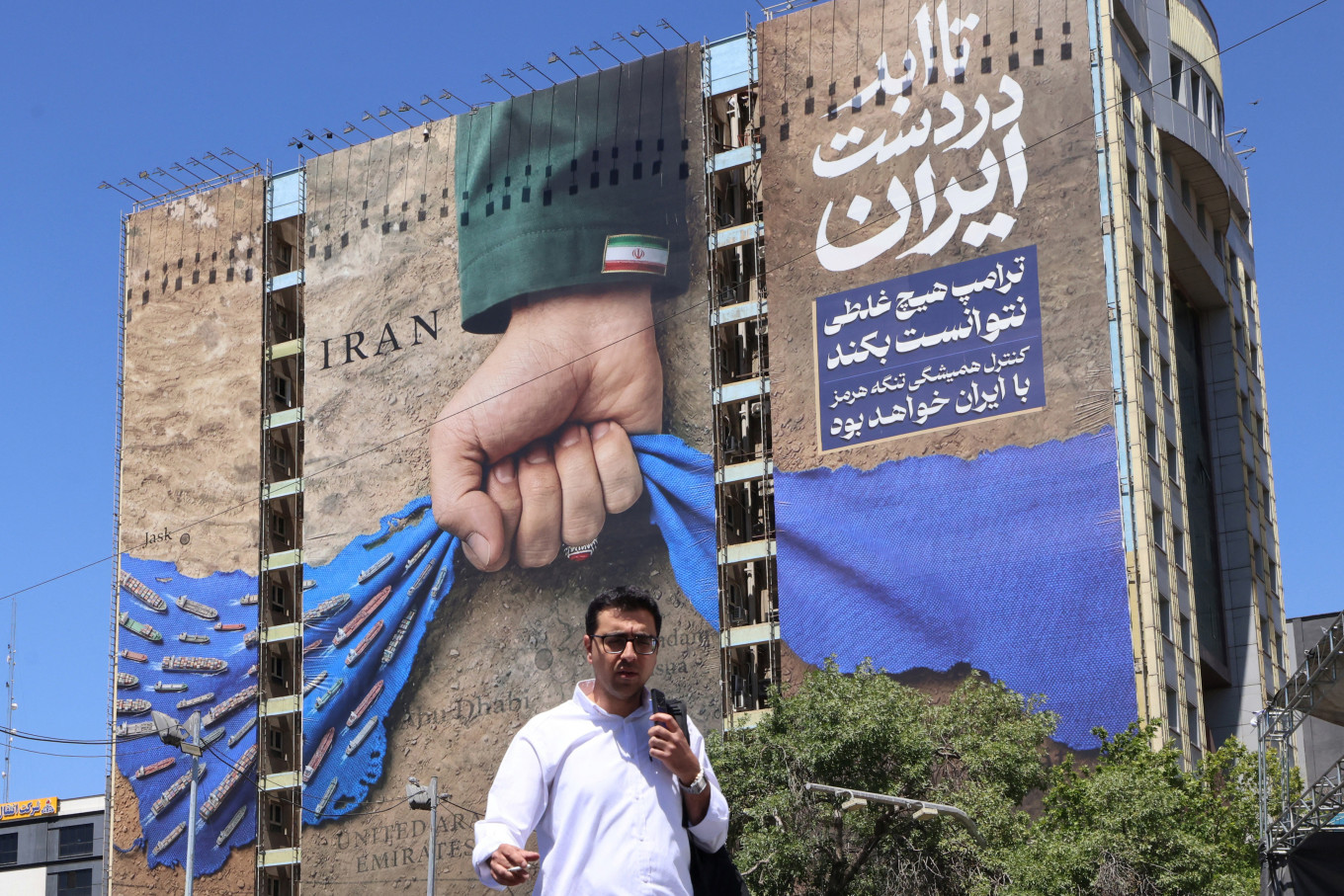 A man crosses a street past a billboard on the facade of a building depicting the Strait of Hormuz with a caption in Persian reading “Forever in Iran’s Hand”, on May 25, 2026, at Vanak Square in Tehran. (AFP/Atta Kenare)
T
he shambolic diplomacy between United States President Donald Trump’s administration and Iran provides further evidence that world affairs have become unintelligible. But take a step back and you will see that all of today’s major conflicts are of a piece, and that despite the apparent entropy, a powerful logic of adaptation and resilience is at work.
The four biggest flash points today stem from historical processes that made them largely predictable. The ferocity of Russia’s invasion of Ukraine may have shocked the world, but the war itself followed from the Kremlin’s well-known resentments and insecurities. President Vladimir Putin had long made clear that he abhorred the idea of Ukrainian independence or strategic alignment with the West. As former US National Security Adviser Zbigniew Brzezinski warned in the 1990s, “Without Ukraine, Russia ceases to be an empire.”
The implication was that, with Ukraine back under its control, Russia would be made great again. Everything that has ensued stems from this historical longing. There is no need for chaos theory or psychoanalysis. The war is simply the result of a Russian determination not to accept its status as a post-imperial power.
A second flash point, Taiwan, holds the potential for global devastation. But here, too, the stakes have not fundamentally changed since the Korean War. That is when the US brought both Taiwan and South Korea within its security perimeter. Mao himself hesitated to get involved, precisely because he feared that a war on the peninsula would divert him from the conquest of Taiwan he was planning. But it was too late. The Korean War, prolonged by the interposition of the US Seventh Fleet, froze the situation in place.
Three-quarters of a century later, the world is still dealing with the strategic ambiguity between the US and China over Taiwan. China wants the US to declare its formal opposition to the island’s independence, whereas the US will not say what it would do to defend the island. Admittedly, this ambiguity might not last. Trump may well renounce any US commitment to support Taiwan, or China may finally decide to blockade the island and force America’s hand.
But we are not there yet, and even if we were, the ensuing turmoil would not be incomprehensible to anyone who was paying attention. This is not to deny the danger of such a development, only to underscore its rationality. In a famous article published in the late 1990s, the historian and strategist Michael Mandelbaum wagered that a war between great powers was probably becoming obsolete. But he acknowledged two cases that could undercut his argument: Ukraine and Taiwan.

The same applies to the Middle East, where both the Israeli-Palestinian conflict and the US/Israeli-Iranian war have had grave consequences. What is most striking, yet again, is not their irrationality, but their persistence. It has long been obvious that only a compromise, trading some territory for the prospect of lasting peace can settle the dispute over the Holy Land. Yet we have moved further than ever from that outcome. The conflict has grown only more violent and terrible; but that does not make it irrational or unintelligible.