The Jakarta Post
Please Update your browser
Your browser is out of date, and may not be compatible with our website. A list of the most popular web browsers can be found below.
Just click on the icons to get to the download page.


Popular Reads
Top Results
No results found. Please check your search term and try again
Can't find what you're looking for?
View all search results
Popular Reads
Top Results
No results found. Please check your search term and try again
Can't find what you're looking for?
View all search resultsMaking democracies work for the betterment of youth
As the leaders of the world's largest and third-largest democracies meet in Jakarta, the ultimate success of the Prabowo-Modi summit hinges not on traditional diplomacy, but on how effectively they can unlock the economic powerhouse of their combined 485 million youth.
Change text size
Gift Premium Articles
to Anyone
Share the best of The Jakarta Post with friends, family, or colleagues. As a subscriber, you can gift 3 to 5 articles each month that anyone can read—no subscription needed!
 Set as preferred source
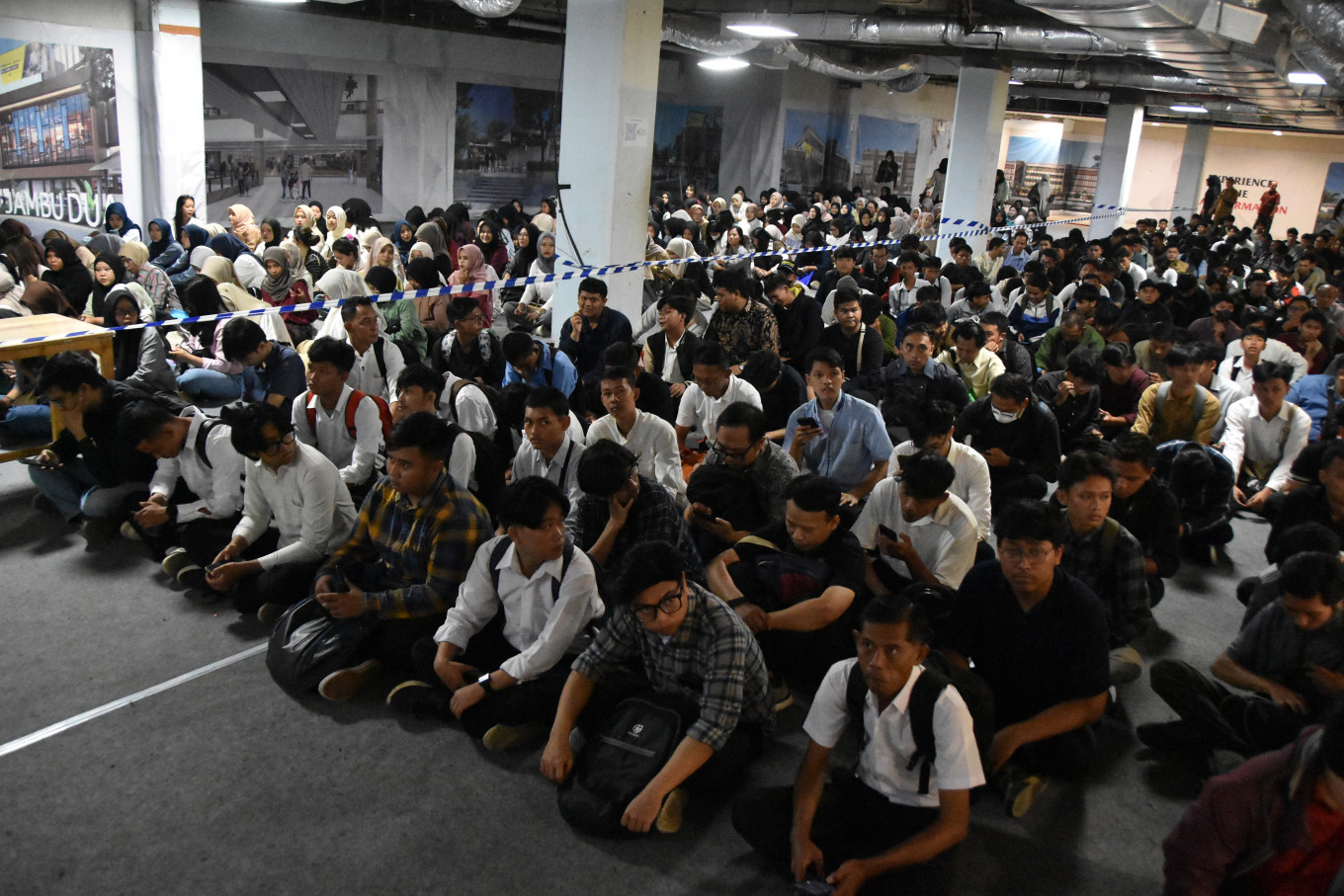 Jobseekers wait in line during the opening of the 2026 Bogor Job Fair at Plaza Jambu Dua in Bogor, West Java, on June 8, 2026. The job fair, organized by the Bogor Manpower Office and attended by 30 local and national companies offering 3,212 job vacancies, aims to connect jobseekers directly with employers and help reduce unemployment in West Java. (Antara/Arif Firmansyah)
A
head of the highly anticipated meeting between Indonesian President Prabowo Subianto and Indian Prime Minister Narendra Modi in Jakarta on Tuesday, public attention had focused on traditional pillars of diplomacy: strengthening civilizational ties, expanding trade and investment and enhancing maritime security cooperation in an increasingly volatile world.
Yet, the true geometric potential of this summit between the leaders of the world’s largest and third-largest democracies lies elsewhere. The significance of their bilateral engagement will multiply exponentially if both leaders explicitly prioritize and align strategies to support the aspirations of their vast youth populations.
Together, India and Indonesia possess a staggering demographic advantage. India is home to approximately 371 million young people between the ages of 15 and 30, while Indonesia counts 114 million within the same cohort. Combined, this represents a powerhouse of 485 million young people. How this massive population is nurtured, specifically in terms of healthcare, education, vocational skills, employment and entrepreneurship, will decisively shape the future economic and geopolitical trajectory of both nations, and Asia as a whole.
To effectively address this demographic opportunity, policymakers in Jakarta and New Delhi must adopt a more nuanced analytical framework for what constitutes "youth". The cohort is not monolithic; rather, it spans three distinct demographic segments with unique pressures.
First is the older wave of Millennials (Gen Y), who have graduated and are navigating the volatile early phases of their careers. Second is Gen Z, currently pursuing higher education or vocational training and preparing to enter the workforce in the near term. Finally, there is Gen Alpha, the rising generation of teenagers whose outlook and stability will be profoundly shaped by the success, or failure, of the two generations preceding them.
What, then, do young citizens expect from the democracies that govern them? The answer remains as timeless as it was when formulated by the authors of the American Declaration of Independence in 1776, a document whose upcoming 250th anniversary is recognized globally.

The text famously identifies the fundamental human pursuit as the securing of "Life, Liberty and the pursuit of Happiness", a philosophy deeply mirrored in the post-colonial constitutions of both India and Indonesia.
For the contemporary youth of both nations, these three principles translate into tangible modern necessities.
"Life" directly correlates to health, nutrition, and physical safety. While universal food security and school meal programs, signature initiatives for both Prabowo and Modi, are occasionally critiqued regarding implementation costs, the foundational premise is indisputable: robust public health infrastructure is non-negotiable for youth development.
Currently, both nations face systemic public health challenges, including high rates of anemia, stunting, wasting, and rising youth mental health crises. Furthermore, industrial pollution, microplastics and carbon emissions have exposed younger generations to the severe long-term consequences of degraded air and water quality, while illicit drug networks increasingly target vulnerable demographics.
Physical safety is further compromised by everyday hazards, notably the high rate of vehicular accidents involving two-wheelers, the primary mode of transport for young workers and students, often exacerbated by lax traffic enforcement. Addressing these foundational health and safety risks requires urgent policy synchronization and rigorous enforcement across both archipelagic Indonesia and continental India.
"Liberty" encompasses the constitutional freedoms of expression and political agency. While regular, orderly elections are a crowning achievement of both democracies, youth dissatisfaction often stems from a lack of everyday institutional avenues to influence policy. To deepen democratic engagement, both nations could explore progressive electoral mechanisms, such as structured recall procedures for non-performing officials or localized referendums on critical civic matters.
Furthermore, younger demographics remain starkly underrepresented in formal governance structures. In the House of Representatives, only 87 out of 580 members (15 percent) are under the age of 40. In India’s Lok Sabha, the figure is even lower: 60 out of 543 members (11 percent). While veteran statesmen bring vital institutional memory, expanding youth representation within legislative bodies is essential to ensure policies align with digital-age realities.
In this hyper-connected era, youth will inevitably find avenues for expression. When digital discourse turns polarizing, draconian crackdowns risk alienating the public and inciting unrest. Given that both Prabowo and Modi command substantial mandates and enjoy significant goodwill among young voters, their administrations are uniquely positioned to meet criticism with measured, tolerant, and sophisticated institutional responses.
Finally, life and liberty yield little return without the meaningful "pursuit of happiness." For today's youth, happiness is structural: access to affordable, high-quality education; viable pathways to employment; opportunities for leisure, sports, and travel; and the financial stability required to build families. The undercurrent of recent youth anxieties in both regions stems from economic friction.
Globally, traditional education costs have outpaced returns, economic growth has struggled to absorb new entrants, and underemployment persists. The rise of the gig economy has frequently translated into systemic vulnerability rather than flexibility.
In this context, targeted regulatory interventions—such as Indonesia's recent decision to cap ride-hailing and delivery commission rates at 8 percent, provide necessary protections to safeguard youth disposable income.
With approximately 10 million Indians and 2 million Indonesians entering the labor market annually, macroeconomic policy must pivot aggressively toward sustainable job creation. Both nations must prioritize structural reforms that foster low-tax, high-growth environments capable of attracting global capital, while continuing to cultivate domestic technology ecosystems and startup infrastructure, as seen in India's recent digital manufacturing pushes.
Indonesia's founding president, Sukarno, famously declared: "Give me 1,000 old men, and I will tear Mount Semeru from its roots. Give me 10 young men, and I will shake the world."
Presidents Prabowo and Modi are uniquely positioned to lead millions of them. The ultimate legacy of their leadership will be measured by how effectively they equip this massive generation to positively transform their own societies, the Global South, and the broader international order.
***
The writer is a Jakarta-based strategic advisor and international expert on sustainability, inclusive development, education and democratic governance. Follow him @amoltitus