The Jakarta Post
Please Update your browser
Your browser is out of date, and may not be compatible with our website. A list of the most popular web browsers can be found below.
Just click on the icons to get to the download page.


Popular Reads
Top Results
No results found. Please check your search term and try again
Can't find what you're looking for?
View all search results
Popular Reads
Top Results
No results found. Please check your search term and try again
Can't find what you're looking for?
View all search resultsBuilding an ASEAN that delivers: Why centrality requires capacity
ASEAN’s 60th anniversary next year offers an occasion for both reflecting on the progress it has made thus far and considering the transformative efforts it must undertake to fulfill one of its founder's visions: a Southeast Asia that stands on its own feet.
Change text size
Gift Premium Articles
to Anyone
Share the best of The Jakarta Post with friends, family, or colleagues. As a subscriber, you can gift 3 to 5 articles each month that anyone can read—no subscription needed!
 Set as preferred source
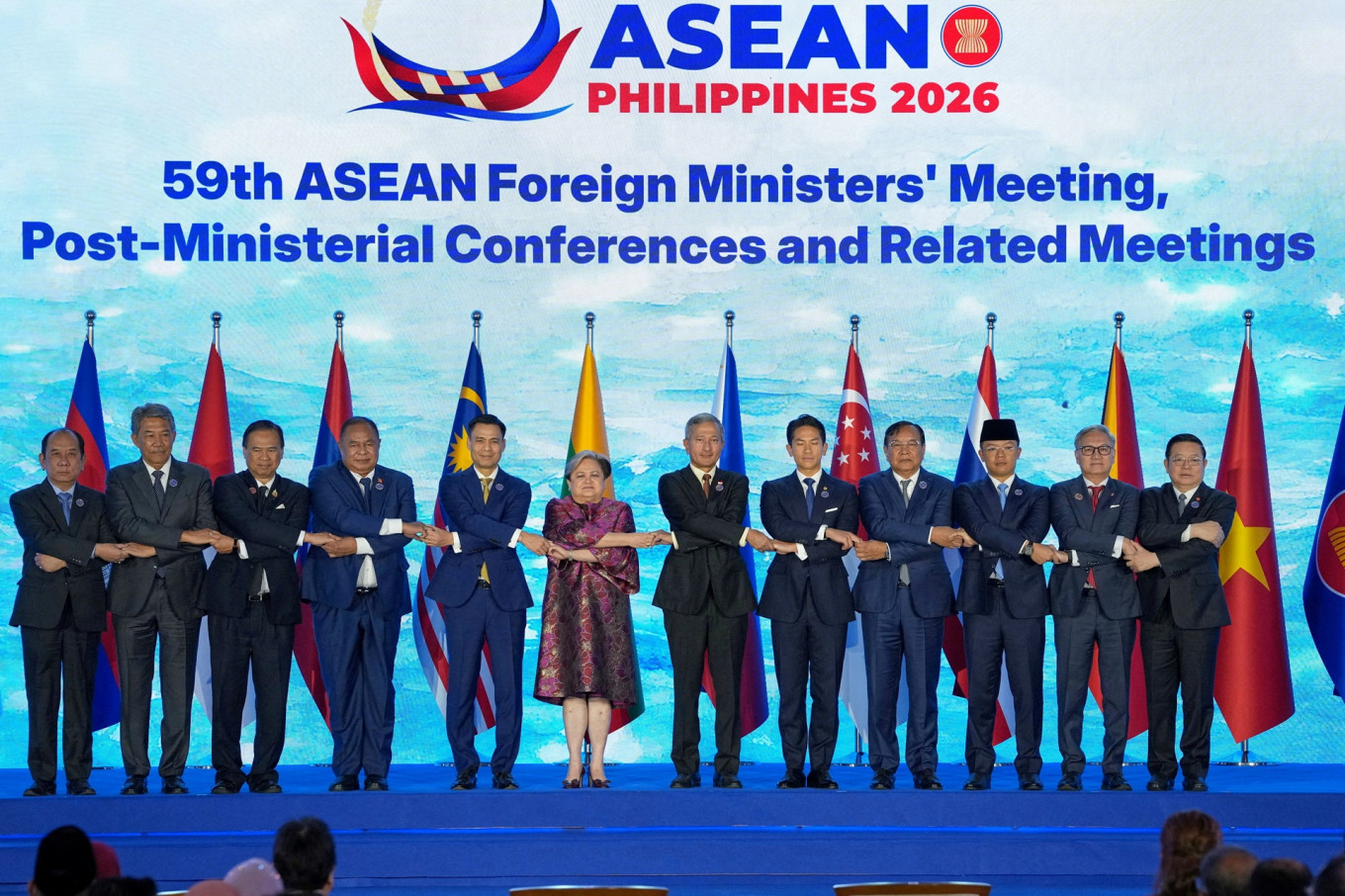 Foreign Minister Sugiono (third right) stands with his regional counterparts (from left) Myanmar's Hau Khan Sum, Malaysia’s Mohamad Hasan, Thailand's Vijavat Isarabhakdi, Timor-Leste's Bendito dos Santos Freitas, Vietnam's deputy minister Dang Hoang Giang, the Philippine’s Theresa Lazaro, Singapore's Vivian Balakrishnan, Brunei's Prince Abdul Mateen Bolkiah, Cambodia's Prak Sokhonn and Laos' Thongsavanh Phomvihane, along with ASEAN Secretary-General Kao Kim Hourn (right), for a “family photo” on July 21, 2026, during the opening ceremony of the 59th ASEAN Foreign Ministers' Meeting (AMM) in Manila. (Reuters/Pool/Aaron Favila)
N
early six decades ago, one of the founding fathers of ASEAN, Indonesia’s Foreign Minister Adam Malik, envisioned a Southeast Asia capable of standing on its own feet. At the height of the Cold War, he believed the region should be “strong enough to defend itself against any negative influence from outside the region”.
Today, his vision continues to resonate strongly.
The world is once again shaped by strategic rivalry, geopolitical fragmentation and growing uncertainty. Yet unlike in 1967, Southeast Asia is no longer a region defined by conflict and mistrust. Through decades of dialogue and cooperation, ASEAN has evolved into a trusted anchor of regional stability and an indispensable platform for diplomacy.
This was evident during the ASEAN Foreign Ministers’ Meeting and Post-Ministerial Conferences in Manila a few weeks ago. Every ASEAN Dialogue Partner was represented at the highest level. At a time when dialogue is becoming increasingly difficult in many parts of the world, leaders still choose ASEAN as a table worth coming to.
That convening power did not emerge overnight. It is the product of nearly six decades of trust building, dialogue and respect for international law. It is also anchored in principles that have guided ASEAN for generations: respect for sovereignty, noninterference, the nonuse of force and the peaceful settlement of disputes, as enshrined in the Treaty of Amity and Cooperation in Southeast Asia (TAC), which marks its 50th anniversary this year.
But anniversaries are not achievements in themselves. The true measure of the TAC lies not in the number of countries that have acceded to it but in whether its principles continue to shape state behavior.

Likewise, ASEAN’s convening power is not an end in itself. Its real value lies in what it enables ASEAN to deliver.