The Jakarta Post
Please Update your browser
Your browser is out of date, and may not be compatible with our website. A list of the most popular web browsers can be found below.
Just click on the icons to get to the download page.


Popular Reads
Top Results
No results found. Please check your search term and try again
Can't find what you're looking for?
View all search results
Popular Reads
Top Results
No results found. Please check your search term and try again
Can't find what you're looking for?
View all search resultsTearing down the currency wall
Most of the world seems to misunderstand why global capital is not financing the developing world’s climate transition.
Change text size
Gift Premium Articles
to Anyone
Share the best of The Jakarta Post with friends, family, or colleagues. As a subscriber, you can gift 3 to 5 articles each month that anyone can read—no subscription needed!
 Set as preferred source
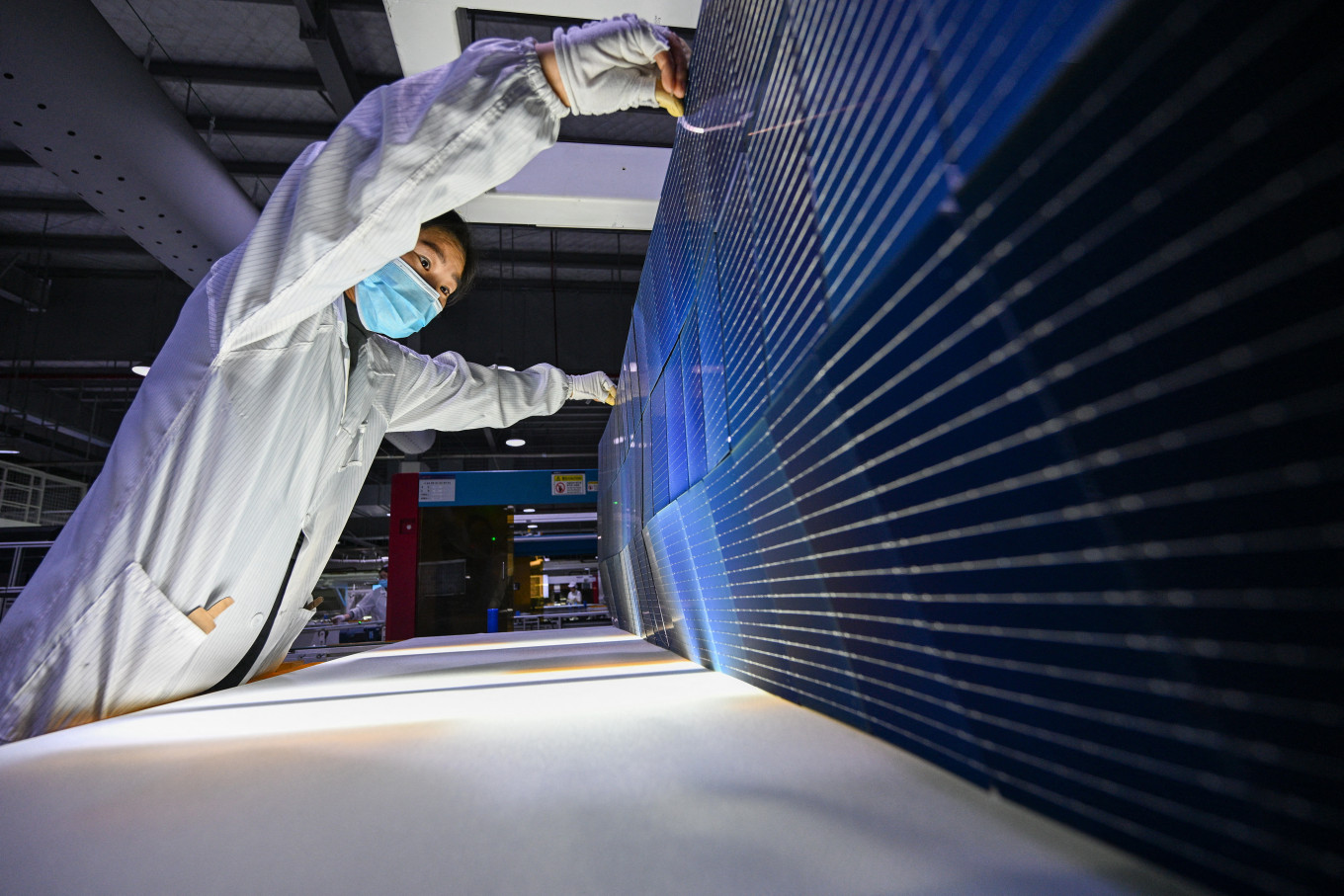 A worker produces photovoltaic (PV) modules for solar panels on Jan. 23, 2025, in a factory in Suqian, Jiangsu province, China. (AFP/-)
T
he world possesses an enormous stock of long-term savings, and the Global South boasts a robust pipeline of commercially sound climate projects. But the channel connecting them is blocked by what amounts to a currency wall.
Standard explanations for global capital’s failure to reach developing-economy climate projects emphasize poor project quality, weak institutions and political risk. But solar parks in India, wind programs in South Africa and electric-bus fleets in Latin America deploy proven technologies through competitive procurement and reward their domestic investors. The real barrier lies in the structure of price formation.
According to the Independent High-Level Expert Group on Climate Finance, emerging-market and developing economies (EMDEs, excluding China) will have to invest some US$2.4 trillion annually in climate action by 2030. Domestic savings cannot meet this target, given the need to finance other priorities, such as housing, factories, highways and data centers. This is as true for India, which saves about 32 percent of gross domestic product, as it is for countries with smaller savings pools, such as Mexico, Nigeria and South Africa. The same expert group estimates that roughly $1 trillion of the annual total must come from external finance.
Because climate infrastructure does not have a unified global market, prices are set on a project-by-project basis, through auctions, regulated tariffs and long-term concessions. In EMDEs like India, the domestic capital pool is deep enough to price the market, but too shallow to finance the transition. While the marginal investor is domestic, the missing investor is global.
This mismatch creates costs. In a solar auction, for example, the clearing tariff is set according to the cost of equity in the local currency — the same currency in which investors’ returns are denominated. An investor accountable in dollars must then convert their rupee, rand or rupiah cash flows. Expected depreciation and volatility, or hedging costs, can add 5-6 percentage points to the required equity return.
This wedge often outstrips the true risk: in many markets, hedging costs have persistently exceeded realized depreciation by some two percentage points annually. With a 2:1 debt-to-equity ratio, the weighted average cost of capital rises by 1-2 percentage points. Since financing and construction dominate the lifetime cost of renewables, hard-currency capital often cannot compete in auctions priced by locally funded investors. For global funds that have participated anyway, 15-18 percent gross rupee returns have been reduced to just 8-9 percent returns in dollars - well below what international investors require.

After a locally funded developer wins an auction, the discovered price hardens into a benchmark: no distribution company can pay more for power, and no municipality more for electric buses, than the last tender established. Regulators then face political pressure to match this price, and aggressive bids from thinly capitalized developers push the benchmark lower still.