The Jakarta Post
Please Update your browser
Your browser is out of date, and may not be compatible with our website. A list of the most popular web browsers can be found below.
Just click on the icons to get to the download page.


Popular Reads
Top Results
No results found. Please check your search term and try again
Can't find what you're looking for?
View all search results
Popular Reads
Top Results
No results found. Please check your search term and try again
Can't find what you're looking for?
View all search resultsIn the age of AI, we need ancient intelligence
As the country rushes headlong into AI, what is being left behind is the age-old wisdom that has been a cornerstone of human civilization for millennia: When entering someone's home, we knock first to obtain their permission, and we don't barge in anyway if they turn us down.
Change text size
Gift Premium Articles
to Anyone
Share the best of The Jakarta Post with friends, family, or colleagues. As a subscriber, you can gift 3 to 5 articles each month that anyone can read—no subscription needed!
 Set as preferred source
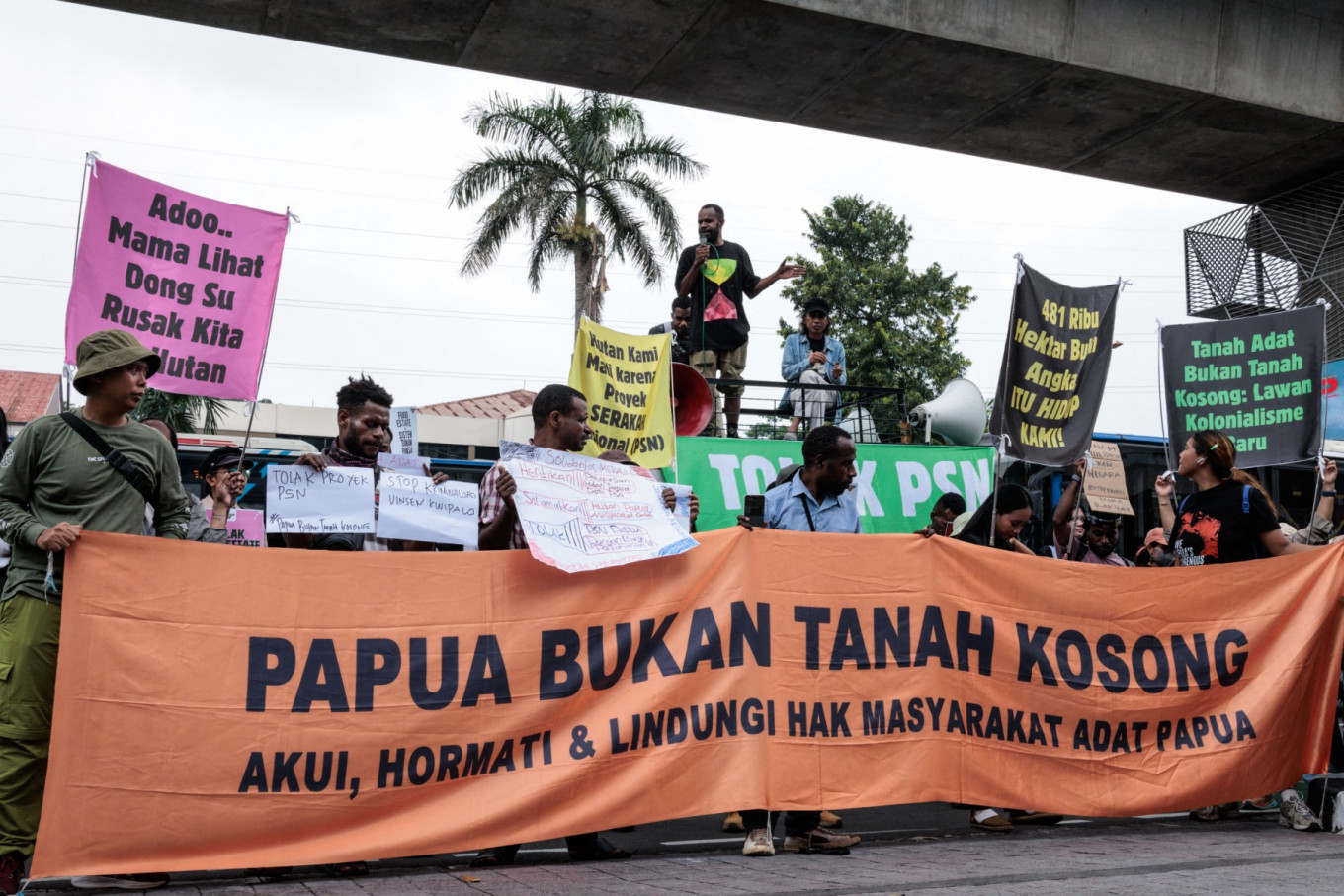 Demonstrators hold a banner that reads “Papua is not empty land” as they rally in front of the Agrarian and Spatial Planning Ministry in South Jakarta on Oct. 7, 2025, against a plan to release forest areas in South Papua for national strategic projects on food, energy and defense. (AFP/Yasuyoshi Chiba)
L
ast year, Agrarian and Spatial Planning Minister Nusron Wahid offered a striking description of land marked for a national strategic project in South Papua. It was a state-owned forest, with no residents and no settlements, he said, so there was no need to compensate anyone. Nusron later apologized for the statement, saying it was incorrect.
The Malind Anim, Yei, Wambon and Awyu peoples might have been surprised to learn that their customary territories, which cover much of that area, do not exist.
More than a careless remark, this revealed a worldview in which indigenous presence simply does not register. When a state can look at inhabited land and call it empty, dispossession stops looking like a crime and starts looking like paperwork.
The pattern repeats across the archipelago. In East Kalimantan, the Balik people have farmed and fished around Sepaku for generations. Then the new capital Nusantara arrived.
A dam and water intake on the Sepaku River, built to supply the future city, swallowed sacred sites and ancestral graves and now threatens to displace families who refuse to leave. For them, refusal is not stubbornness. As one community leader explained, even a move to the next village would turn them into strangers on their own land.
In Merauke, South Papua, the same logic is used in the language of food security. The government has released nearly half a million hectares of forest for sugarcane and bioethanol, then granted a single company the rights to 328,000 hectares of it, all under a national strategic project secured by a heavy military presence.

Indigenous leaders say the maps were drawn and the stakes were driven before anyone bothered to ask them.