The Jakarta Post
Please Update your browser
Your browser is out of date, and may not be compatible with our website. A list of the most popular web browsers can be found below.
Just click on the icons to get to the download page.


Popular Reads
Top Results
No results found. Please check your search term and try again
Can't find what you're looking for?
View all search results
Popular Reads
Top Results
No results found. Please check your search term and try again
Can't find what you're looking for?
View all search resultsWho should build the low-carbon economy?
The geographical diversification of technological innovation has remained more of a dream than a reality.
Change text size
Gift Premium Articles
to Anyone
Share the best of The Jakarta Post with friends, family, or colleagues. As a subscriber, you can gift 3 to 5 articles each month that anyone can read—no subscription needed!
 Set as preferred source
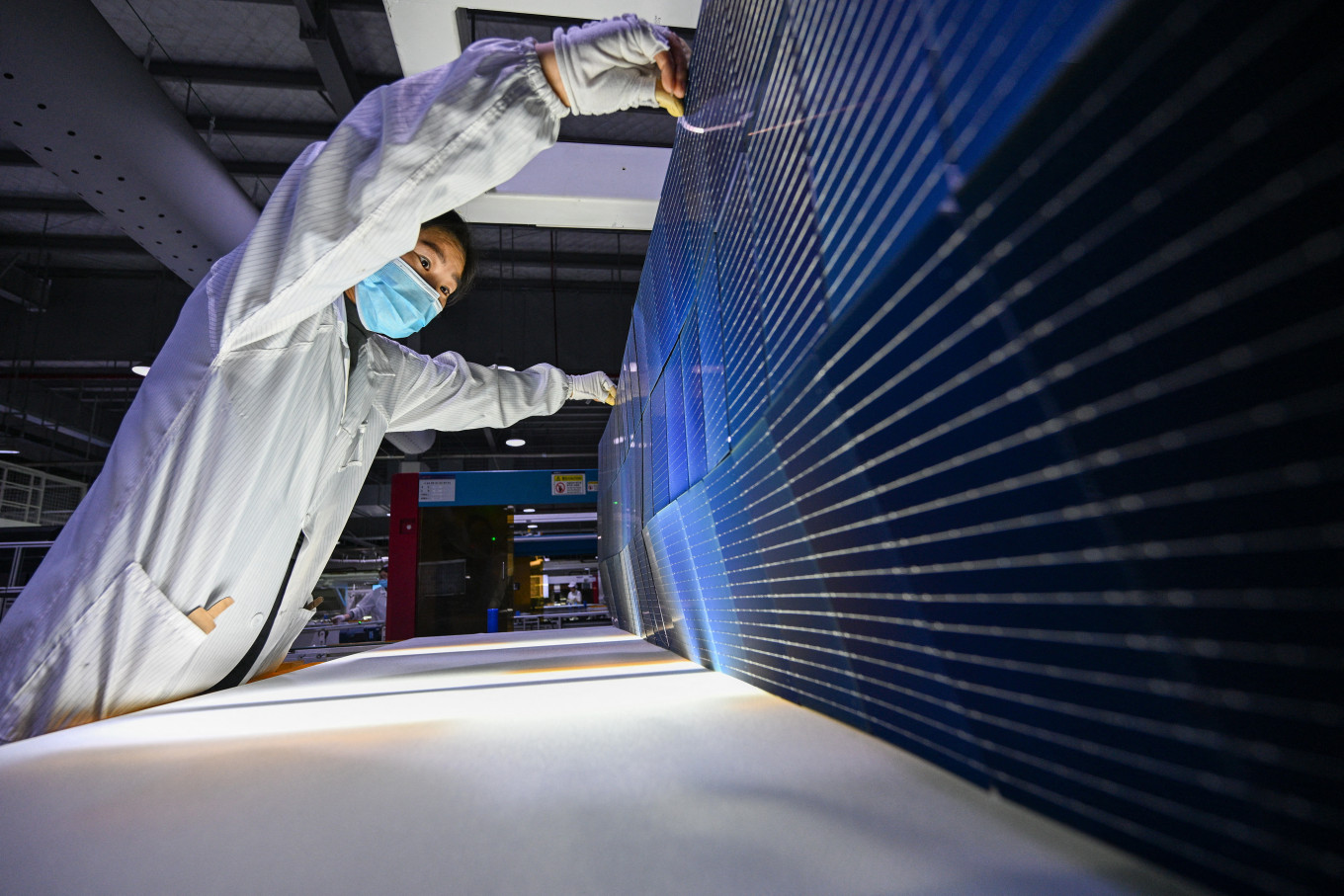 A worker produces photovoltaic (PV) modules for solar panels in a factory in Suqian, east China's Jiangsu province on Jan. 23, 2025 (AFP/-)
S
uppose the global economy comprised countries roughly equally equipped with research institutions, technology development labs and industrial production facilities. They might compete fiercely, build rival alliances and vie aggressively for raw materials and natural resources.
But one can also imagine a more optimistic scenario. Since each country would understand its own challenges best, it could devise solutions adapted to its own circumstances, building systems and equipment at precisely the scale required. And where competences complement one another, governments could engage in mutually beneficial collaborations, mobilizing scientists, technology and manufacturing toward common goals.
Unfortunately, humankind has tended in the opposite direction. Since the first Industrial Revolution and the emergence of a truly global economy around the turn of the 19th century, goods and technologies have reached the farthest corners of the world, but the ability to design, build, market and extract value from them has remained highly concentrated.
By the mid-1800s, steam locomotives were already operational in almost 60 countries or colonies, yet only Britain, the United States, and certain German states were fully capable of supplying them. Telegraphic lines followed a similarly uneven pattern, as did the auto industry, which emerged at the turn of the 20th century and became emblematic of globalization in the post-World War II era with the internationalization of manufacturing capabilities, especially in large developing countries in Asia and Latin America. But only two of these economies, Japan and South Korea, managed to join the exclusive club of so-called original equipment manufacturers.
With the end of the Cold War, the information-technology industry took this model, under the banner of “Designed in California, assembled in China”, to the next level, drawing a clear line between knowledge-intensive, well-remunerated activities and labor-intensive, low-paid operational ones.
Nonetheless, with the rise and spread of the clean-energy industry and other climate technologies, many thought that history could be written differently. When China started to gain global market share in the production of solar panels and wind turbines, some analysts suggested that “green windows of opportunity” could emerge across the rest of the developing world. Having successfully learned the inner workings of the new technologies through joint ventures and licensing agreements with advanced-economy providers, China seemed to have found a blueprint that others could follow.

But the geographical diversification of technological innovation has remained more of a dream than a reality. The International Energy Agency finds that while clean-energy technologies are spreading fast, with solar capacity having increased tenfold since 2015, manufacturing capabilities remain highly concentrated.