The Jakarta Post
Please Update your browser
Your browser is out of date, and may not be compatible with our website. A list of the most popular web browsers can be found below.
Just click on the icons to get to the download page.


Popular Reads
Top Results
No results found. Please check your search term and try again
Can't find what you're looking for?
View all search results
Popular Reads
Top Results
No results found. Please check your search term and try again
Can't find what you're looking for?
View all search resultsWhen diplomatic neutrality meets defense network warfare
As unmanned systems increasingly define the battlespace, they must plug directly into a shared digital web to serve as viable combat nodes.
Change text size
Gift Premium Articles
to Anyone
Share the best of The Jakarta Post with friends, family, or colleagues. As a subscriber, you can gift 3 to 5 articles each month that anyone can read—no subscription needed!
 Set as preferred source
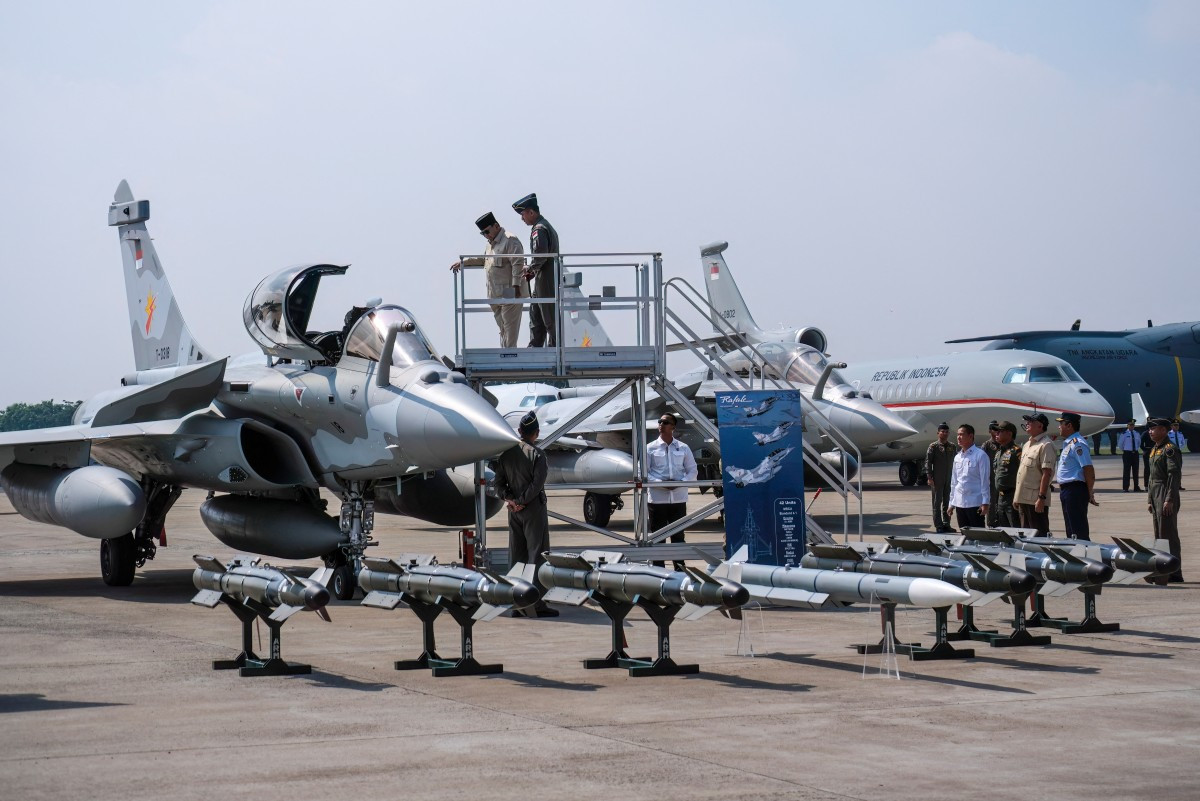 President Prabowo Subianto (left) looks inside the cockpit of a Rafale jet fighter during a ceremony to hand over six new Rafale jet fighters, four Dassault Falcon 8X aircrafts and one Airbus A400M Atlas aircraft to the Indonesian Air Force on May 18 at Halim Perdanakusuma Air Force Base in Jakarta. (AFP/Bay Ismoyo)
E
ver since the Cold War, strict neutrality has anchored Southeast Asian foreign policy. For most ASEAN member states, maintaining a non-aligned posture has never been merely a diplomatic posture—it is a fundamental survival strategy.
This non-alignment shaped defense procurement in concrete ways: buying fighter jets from the West, air defense batteries from Russia or Europe, and naval vessels or artillery from elsewhere. The approach served two vital purposes. Domestically, it prevented overreliance on any single power, ensuring national security was never held hostage to foreign arms embargoes. Internationally, it signaled unequivocally to competing superpowers that Southeast Asia would not be locked into anyone’s exclusive sphere of influence.
For decades, this "mix-and-match" procurement model was the region's ultimate geopolitical insurance policy.
Yet modern conflict has evolved radically. Ever since the first Gulf War, integrated sensor feeds, digital command links and electronic warfare have become the primary arbiters of combat. Today, the engineering complexity of multi-role platforms—trying to pack stealth, heavy payloads, long-range radar and electronic warfare suites into a single fifth-generation fighter—makes all-in-one platforms fiscally unsustainable for most nations, as the struggles of programs like Europe's Future Combat Air System (FCAS) demonstrate.
Instead, modern militaries are pivoting toward networked force design. Rather than relying on a single, exorbitant platform to do it all, capabilities are disaggregated: stealthy forward nodes handle tracking, cheaper standoff platforms serve as missile shooters and dedicated electronic-warfare suites suppress enemy command networks.
The war in Ukraine showcases this networked reality through the ubiquitous use of uncrewed aerial vehicles (UAVs). While drones are widely praised as cheap, asymmetric alternatives to crewed platforms, their lethality is an illusion without an integrated digital ecosystem. A low-cost drone cannot survive, navigate or strike on its own.

Behind every successful strike sits a demanding web of infrastructure: resilient satellite links, high-bandwidth datalinks, airborne early warning assets and real-time sensor-fusion engines. Strip away this digital backbone, and even the most advanced drone is rendered blind. Modern combat capability is no longer defined by standalone hardware, but by the unseen networks tying it all together.