The Jakarta Post
Please Update your browser
Your browser is out of date, and may not be compatible with our website. A list of the most popular web browsers can be found below.
Just click on the icons to get to the download page.


Popular Reads
Top Results
No results found. Please check your search term and try again
Can't find what you're looking for?
View all search results
Popular Reads
Top Results
No results found. Please check your search term and try again
Can't find what you're looking for?
View all search resultsWhy Aceh peace remains fragile 21 years after the Helsinki accord
Two decades after ending decades of civil war, Aceh’s fragile peace is unraveling as a disillusioned new generation turns against its own ruling ex-rebel elite and revives calls for independence.
Change text size
Gift Premium Articles
to Anyone
Share the best of The Jakarta Post with friends, family, or colleagues. As a subscriber, you can gift 3 to 5 articles each month that anyone can read—no subscription needed!
 Set as preferred source
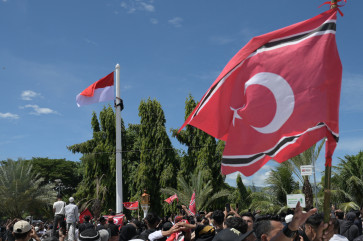
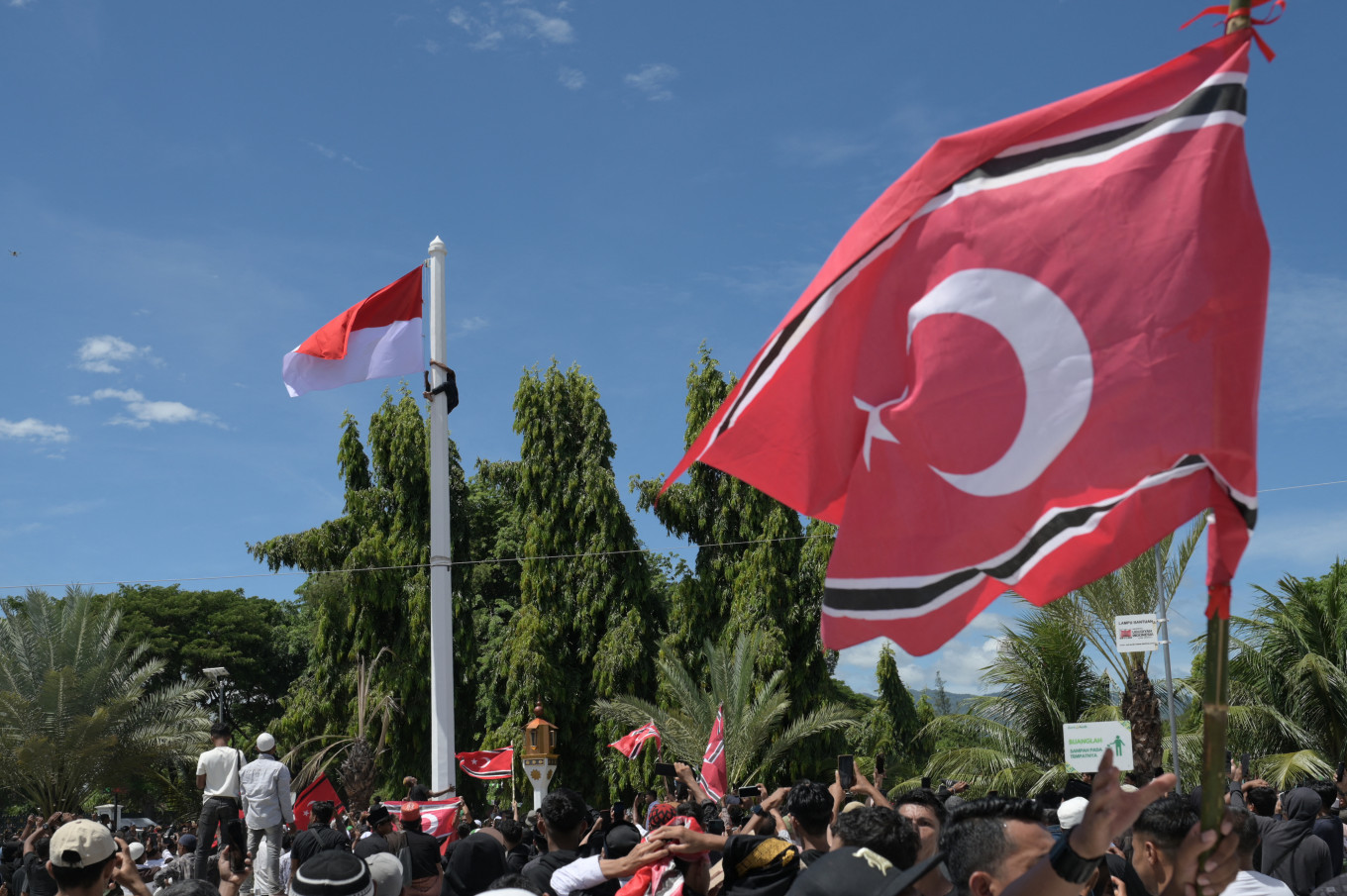 A man (top left) climbs a flagpole on Saturday as he attempts to raise a Free Aceh Movement flag alongside the Indonesian national flag during a rally outside the Baiturrahman Grand Mosque in Banda Aceh, Aceh province. Thousands of people gathered to mark the 21st anniversary of the Helsinki Memorandum of Understanding (MoU) peace agreement, which ended nearly three decades of conflict. The raising of the separatist-linked flag, although not explicitly banned by the 2005 peace deal, remains a highly controversial issue, with central government authorities often prohibiting its display. (AFP/Reza Saifullah)
P
eace in Aceh is fraying. For the first time since 2005, the anniversary of the Helsinki memorandum of understanding (MoU) was marked not by solemn prayer and joint dhikr, but by open unrest.
On Aug. 15, hundreds converged on the Baiturrahman Grand Mosque, openly defying the police and military to press a radical demand: full independence. Waving flags of the Aceh–Sumatra National Liberation Front (ASNLF) alongside the United Nations banner, protesters replaced the Indonesian national flag with Aceh’s regional standard, then stormed the Governor’s Pavilion to pull down and smash the national emblem of Pancasila.
Crucially, this was not orchestrated by former Free Aceh Movement (GAM) commanders, who have largely traded the battlefield for political office and lavish lifestyles. It signals an unpredictable shift in Aceh’s grassroots politics - one that could spiral rapidly if mishandled.
The 2005 peace agreement was codified into Law No. 11/2006 on the Governing of Aceh. It granted the province extensive self-governance: dedicated special autonomy (Otsus) funding, the right to form local political parties, the institutionalization of Sharia law and exclusive administrative privileges. Former GAM fighters leveraged this framework to establish local parties and capture the province's executive and legislative branches.
Yet, two decades on, these funds have done little to lift everyday livelihoods. Aceh remains the poorest province in Sumatra. The primary beneficiaries have been the ex-combatant elites themselves, who have amassed considerable personal wealth, luxury cars, real estate and multiple marriages - all while facing virtually no parliamentary opposition.
Rather than defending Aceh’s regional interests against Jakarta, these local leaders have largely been integrated into the national political establishment. During the 2024 presidential election, for instance, former GAM military commander and current Aceh Governor Muzakkir Manaf led Prabowo Subianto’s provincial campaign.

Disillusionment with this cooptation was evident at the recent rally, where protesters carried banners bearing Manaf’s face, punching and kicking his image while branding him an outright traitor.