The Jakarta Post
Please Update your browser
Your browser is out of date, and may not be compatible with our website. A list of the most popular web browsers can be found below.
Just click on the icons to get to the download page.


Popular Reads
Top Results
No results found. Please check your search term and try again
Can't find what you're looking for?
View all search results
Popular Reads
Top Results
No results found. Please check your search term and try again
Can't find what you're looking for?
View all search resultsHow a decoy court ruling shields Indonesia’s ruling elite
Rather than a genuine check, the Constitutional Court provides a strategic runway for legislative engineering, allowing the executive branch to bypass immediate fiscal discipline while public attention cools, over the education fund.
Change text size
Gift Premium Articles
to Anyone
Share the best of The Jakarta Post with friends, family, or colleagues. As a subscriber, you can gift 3 to 5 articles each month that anyone can read—no subscription needed!
 Set as preferred source
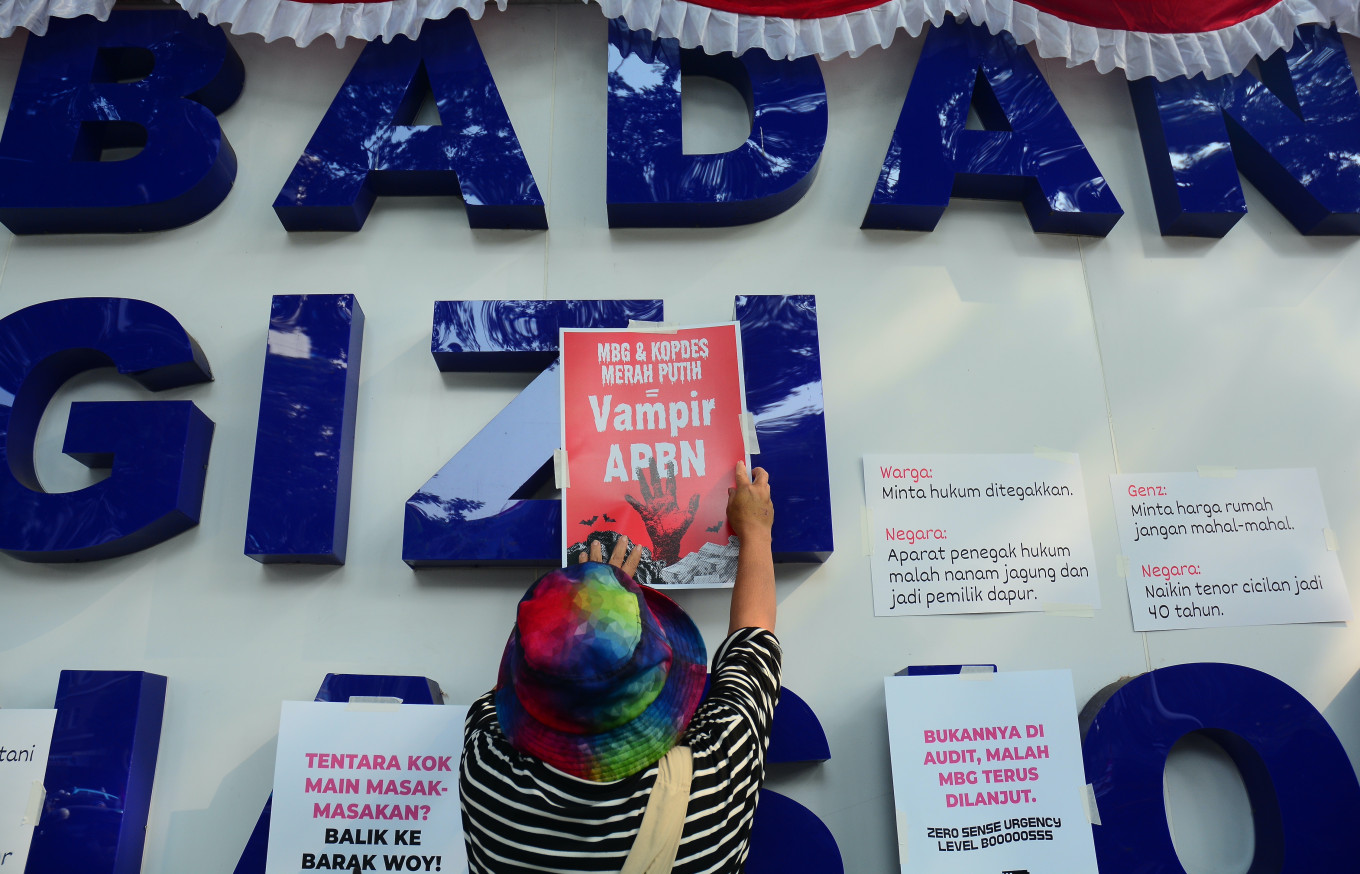 Participants in a protest by a civil society coalition known as MBG Watch display a poster reading “Free Nutritious Meals and Red-and-White Cooperatives = Vampires of the State Budget” outside the National Nutrition Agency (BGN) office in Central Jakarta on Aug. 14, 2026. (JP/Iqro Rinaldi)
W
hen the justices of the Constitutional Court delivered their ruling on July 30, the courtroom carried the brief, deceptive hum of a democracy correcting its course. The bench decreed that President Prabowo Subianto’s flagship free nutritious meal program could no longer siphon money from the country’s legally mandated 20 percent education budget.
To civil society advocates and exhausted public school teachers, it looked like a courageous stand for judicial independence. Yet, the real story lay in a tactical clause buried deeper in the paperwork, which quietly delayed the enforcement of the ruling until the 2028 fiscal year.
Rather than a genuine constitutional check, the delay provides a strategic runway for legislative engineering, allowing the executive branch to bypass immediate fiscal discipline while public attention cools.
More profoundly, it shields a staggering machinery of state patronage disguised as national welfare. The free meals program, alongside its sibling initiatives, including the Red and White Cooperatives, the sprawling food estates and the Danantara state asset fund, is not standard socio-economic policy. It is an existential toolkit built to consolidate elite networks, mobilize grassroots loyalists and secure military fealty before the 2029 re-election cycle begins.
Prabowo's state-centric projects are actually direct descendants of the New Order era under president Soeharto. During that period, the regime maintained stability by intertwining state resources with political survival, utilizing institutions like the State Logistics Agency (Bulog) to control basic food commodities and secure elite loyalty through lucrative distribution monopolies.
While Soeharto built his patronage network behind a wall of authoritarian decrees and personal cronyism, the current administration operates through democratic structures. By absorbing civilian programs into formal state-funded agencies, the regime adapts old-school elite cohesion into a modern legal framework.

Under the current 2026 state budget, total government spending is locked at a staggering Rp 3.79 quadrillion (US$$11.6 billion). The mandatory 20 percent education budget arrives at an unprecedented Rp 769 trillion. However, the state engineered a controversial structural shift by designating Rp 223.56 trillion, nearly 30 percent of the entire education envelope, specifically to the National Nutrition Body (BGN) to run the free meals rollout.