The Jakarta Post
Please Update your browser
Your browser is out of date, and may not be compatible with our website. A list of the most popular web browsers can be found below.
Just click on the icons to get to the download page.


Popular Reads
Top Results
No results found. Please check your search term and try again
Can't find what you're looking for?
View all search results
Popular Reads
Top Results
No results found. Please check your search term and try again
Can't find what you're looking for?
View all search resultsWhen intellectuals respond to the dictates of power
As fiscal strain, budget reallocations and state dominance deepen across Indonesia, students and intellectuals are stepping into the fray—reclaiming their historic duty to speak truth to power.
Change text size
Gift Premium Articles
to Anyone
Share the best of The Jakarta Post with friends, family, or colleagues. As a subscriber, you can gift 3 to 5 articles each month that anyone can read—no subscription needed!
 Set as preferred source
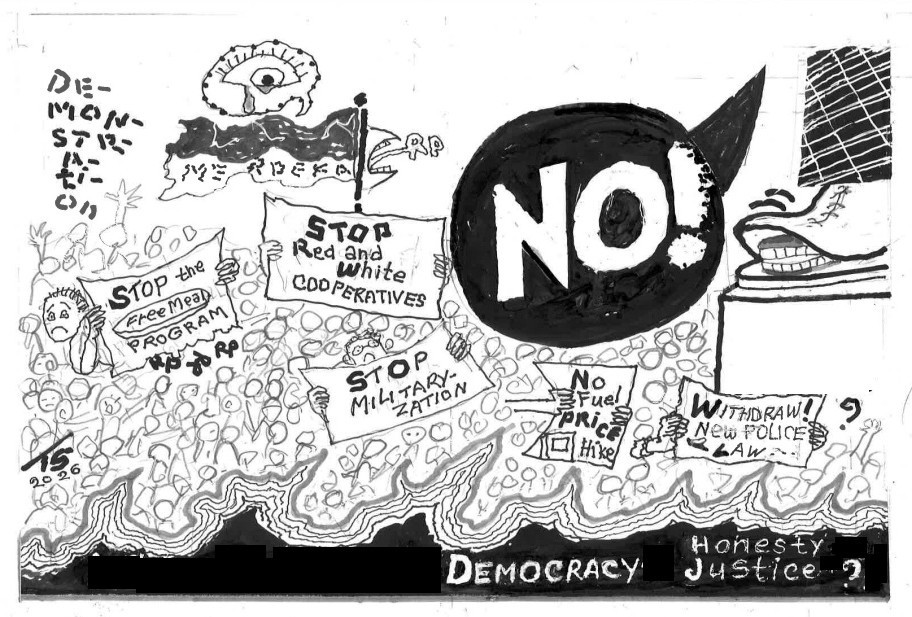 Student demonstration cartoon (JP/T. Sutanto)
T
he current wave of student and intellectual mobilization across Indonesia is far more than routine street protest. At its core, it is a battle over whether knowledge exists to serve truth or to serve power.
This tension was famously diagnosed a century ago by French philosopher Julien Benda in La Trahison des clercs (1927). Benda warned that the “treason of the intellectuals” happens when scholars abandon their vocation—the disinterested pursuit of justice and reason—to become functionaries of political passion, whether tied to nationalism, class interests or state power. When thinkers trade independence for proximity to power, Benda cautioned, they do not stabilize the state; they degrade both the state and thought itself.
Two major intellectual traditions reinforce Benda’s warning. United States critic Noam Chomsky framed intellectual responsibility as a moral duty: scholars must use their privileged platform to expose state deception and speak truth to power. French sociologist Pierre Bourdieu took this further, viewing academic knowledge as cultural capital that can—and must—be converted into symbolic authority to challenge political hegemony.
These three perspectives converge in contemporary Indonesia. Grassroots movements such as Indonesia Gelap (Dark Indonesia) and Indonesia Menuju Bangkrut (Indonesia on Brink of Bankruptcy), alongside the newly founded Interdisciplinary Intellectual Forum (FIAD), are working to reclaim that Bendaean role: speaking independently against the dictates of power. By turning university campuses into moral counterweights against institutional crisis under President Prabowo Subianto, they are putting these classic theories into practice.
Democratic backsliding in the country is increasingly visible in shrinking civic space, a hollowed-out political opposition, compromised legal institutions and a fiscally precarious brand of centralized populism. The student protests pushing back against these shifts underscore a breakdown in legislative checks on the executive branch.
The movement’s grievances are grounded in economic realities that clash with official rhetoric. Statistics Indonesia (BPS) data from May 2026 recorded over 1.1 million unemployed university graduates. Meanwhile, waves of layoffs across manufacturing, textiles and tech continue to erode household purchasing power.

At the same time, job creation has been channeled into high-profile national programs: the free nutritious meal program (MBG) and the Red and White Cooperatives (KDMP). Yet the promised economic multiplier effects have fallen short. The free meals program has produced weak supply-chain linkages: agricultural sector growth slowed to 1.5 percent–2.5 percent in early 2026, down sharply from roughly 5 percent in 2025. The cooperatives, meanwhile, locks the country into a state-led spending path that risks crowding out private investment—the true engine of sustainable employment. The result is populism without productivity: conspicuous spending paired with negligible returns.