The Jakarta Post
Please Update your browser
Your browser is out of date, and may not be compatible with our website. A list of the most popular web browsers can be found below.
Just click on the icons to get to the download page.


Popular Reads
Top Results
No results found. Please check your search term and try again
Can't find what you're looking for?
View all search results
Popular Reads
Top Results
No results found. Please check your search term and try again
Can't find what you're looking for?
View all search resultsBeneath choking skies
As toxic haze blankets Southeast Asia and millions of tonnes of CO2 enter the atmosphere, the country is running out of excuses to rein in corporate polluters and honor its climate promises.
Change text size
Gift Premium Articles
to Anyone
Share the best of The Jakarta Post with friends, family, or colleagues. As a subscriber, you can gift 3 to 5 articles each month that anyone can read—no subscription needed!
 Set as preferred source
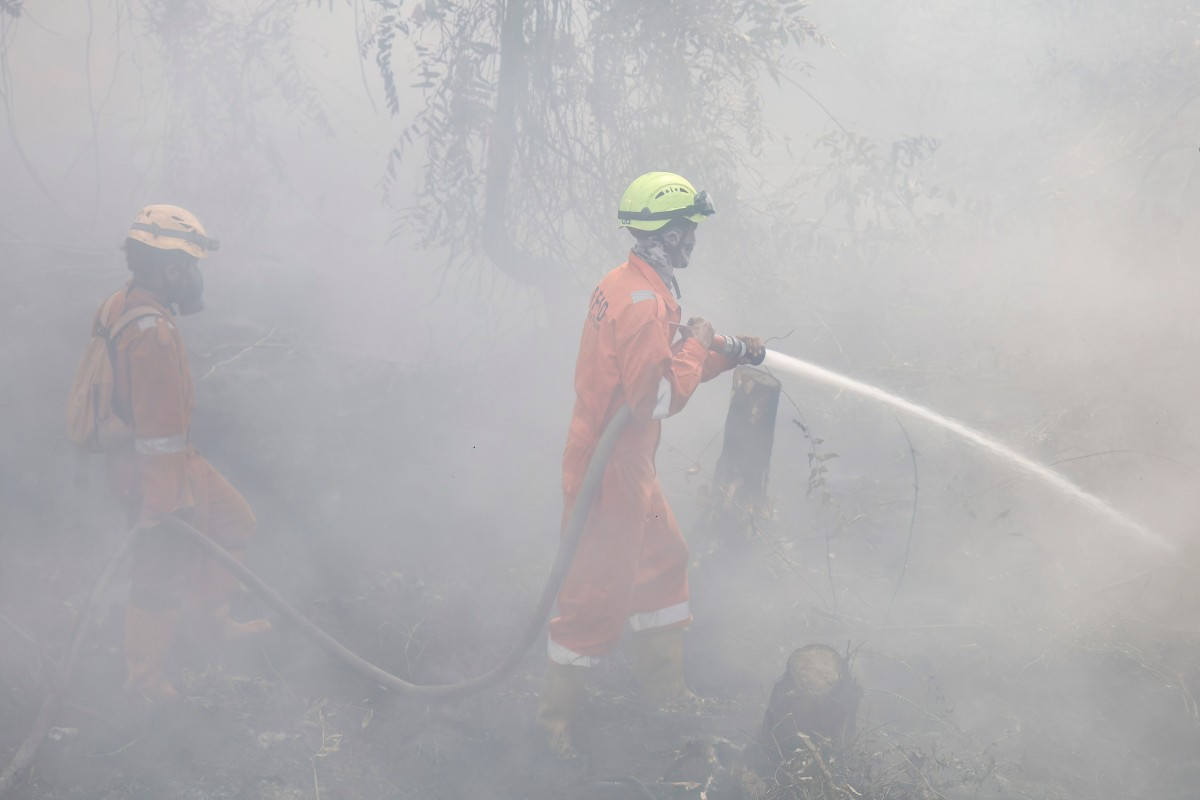 Firefighters battle a wildfire on Sept. 21, 2026, in Banjar, South Kalimantan, as the government struggles to extinguish blazes across Kalimantan and Sumatra as well as contain cross-border haze pollution. (AFP/Muda Sagala)
P
ressure continues to mount on Indonesia to contain its rapidly spreading forest and peatland fires. The ecological disaster now poses a threat to not only the health and livelihoods of millions at home but also populations across its Southeast Asian neighbors, and not least to global climate stability.
By late August, uncontrollable blazes had scorched nearly 900,000 hectares of land. Alarming satellite data compiled by independent forest monitor Nusantara Atlas showed this burned area has decisively outpaced the figures recorded during the catastrophic 2019 and 2023 fire seasons.
In the flames’ wake has come the suffocating, toxic haze that routinely chokes communities in Kalimantan, Sumatra and Papua, which has drifted across borders to trigger hazardous air quality alerts as far away as Vietnam.
Yet localized air pollution represents only one facet of this unfolding catastrophe. The rampant fires tearing through Indonesia’s major islands are simultaneously discharging astronomical quantities of greenhouse gases (GHG) that accelerate global heating.
Verified measurements from the European Union's Copernicus Atmosphere Monitoring Service indicate that the fires have belched an estimated 106 million tonnes of carbon dioxide (CO2) into the atmosphere. This single, seasonal pulse equals the combined annual CO2 output of roughly 103 coal-fired power plants running at full capacity.
This immense emissions surge threatens to derail Indonesia, which consistently ranks among the world’s top GHG emitters, from achieving crucial targets in its Nationally Determined Contribution (NDC) per the 2015 Paris Agreement.

In its second NDC, submitted last year, the country pledged to transform its Forestry and Other Land Use (FOLU) sector into a net carbon sink by 2030, an ambitious benchmark requiring natural carbon sequestration to consistently outstrip gross sector emissions.