The Jakarta Post
Please Update your browser
Your browser is out of date, and may not be compatible with our website. A list of the most popular web browsers can be found below.
Just click on the icons to get to the download page.


Popular Reads
Top Results
No results found. Please check your search term and try again
Can't find what you're looking for?
View all search results
Popular Reads
Top Results
No results found. Please check your search term and try again
Can't find what you're looking for?
View all search resultsImpunity for military ends, may justice for all begin
By dismantling the shield of military courts for ordinary crimes, the Constitutional Court's landmark ruling reclaims civilian supremacy and demands an end to institutional impunity in Indonesia.
Change text size
Gift Premium Articles
to Anyone
Share the best of The Jakarta Post with friends, family, or colleagues. As a subscriber, you can gift 3 to 5 articles each month that anyone can read—no subscription needed!
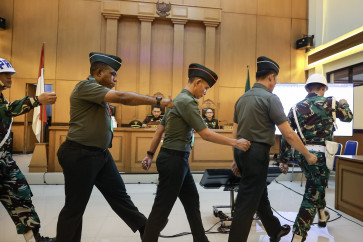
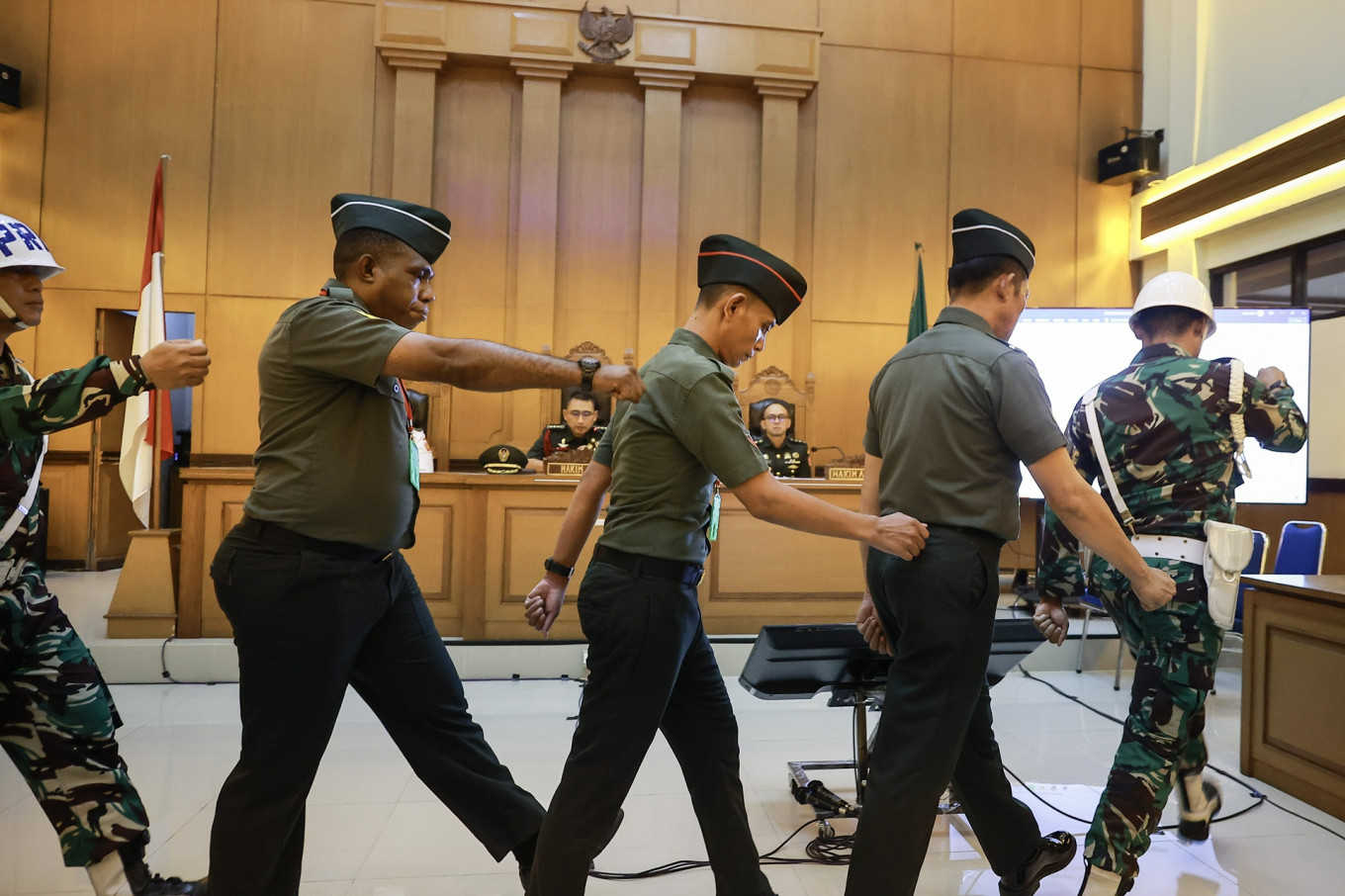 Defendants in a murder case of a bank branch head in Jakarta, namely Chief Sgt. Frengky Yaru (second left), Second Cpl. Feri Heriyanto and Chief Sgt. Mochamad Nasir (second right), are escorted out of the courtroom after their verdict hearing at the Jakarta Military Court in Jakarta on June 3, 2026. The judges sentenced Nasir to 13 years in prison, Feri to seven years and Frengky to a year after finding them guilty in the murder case. (Antara/Dhemas Reviyanto)
M
ilitary impunity for ordinary criminal offenses has been formally abrogated by the Constitutional Court through Decision No. 260/2025, which granted the judicial review of Law No. 31/1997 on military courts. Amid growing military outreach into the civilian sphere, the ruling, which is final and binding, marks a critical legal milestone, reorienting the judicial system toward a victim-centered paradigm rather than shielding perpetrators based on institutional status.
Furthermore, the Constitutional Court mandated a comprehensive revision of the Military Courts Law within a maximum timeframe of two years. This period must not be treated as a grace period for delay, but as a vital window for a structural overhaul across the entire justice sector, including relevant ministries, law enforcement and integrity bodies.
Such reform is essential to realign military justice with democratic principles that uphold civilian supremacy and fundamental human rights. Any hesitation to enact these reforms constitutes an evasion of the Constitution, flouting the court’s reaffirmation of equality before the law under Article 27(1) of the 1945 Constitution.
The judicial review stemmed from the resolve of two civilian women, Lenny Damanik and Eva Meliani Pasaribu, who sought accountability for killings involving military personnel. Lenny is the mother of 15-year-old Michael Histon Sitanggang, who died after being severely beaten by military personnel. Eva lost her family after her home was intentionally set ablaze, allegedly on the orders of a soldier, in retaliation for reporting by her late father, investigative journalist Rico Sempurna Pasaribu, on illegal gambling operations.
The petitioners challenged key provisions of the Military Courts Law that perpetuate structural legal disparities. Their direct experience during military proceedings exposed systemic barriers that severely curtailed access to justice, institutional transparency and victims' procedural rights.
At the core of this judicial review lies Article 9 of the Military Courts Law, which confers jurisdiction upon military courts based solely on the offender's status as an active service member, rather than on the objective nature of the crime committed. This jurisdictional distortion is reinforced by Article 43(3) and Article 127, which grant exclusive authority to the High Military Court to adjudicate jurisdictional disputes, including pre-trial determinations, between the officer empowered to hand over matters (Papera) and the military prosecutor. This insular consolidation of authority creates a closed judicial enclave, fostering institutional conflicts of interest and eroding the principle of equality before the law.

Grounding jurisdiction in subjective personal status generates legal uncertainty and arbitrary discretion. The boundary between general and military court jurisdiction must be determined objectively by the character of the offense.