The Jakarta Post
Please Update your browser
Your browser is out of date, and may not be compatible with our website. A list of the most popular web browsers can be found below.
Just click on the icons to get to the download page.


Popular Reads
Top Results
No results found. Please check your search term and try again
Can't find what you're looking for?
View all search results
Popular Reads
Top Results
No results found. Please check your search term and try again
Can't find what you're looking for?
View all search resultsThe illusion of customary rights protection in Indonesia
Behind the veneer of administrative procedure, Indonesia’s legal system continues to sacrifice ancestral lands to state-backed megaprojects, reducing constitutional rights for Indigenous peoples to little more than a paper tiger.
Change text size
Gift Premium Articles
to Anyone
Share the best of The Jakarta Post with friends, family, or colleagues. As a subscriber, you can gift 3 to 5 articles each month that anyone can read—no subscription needed!
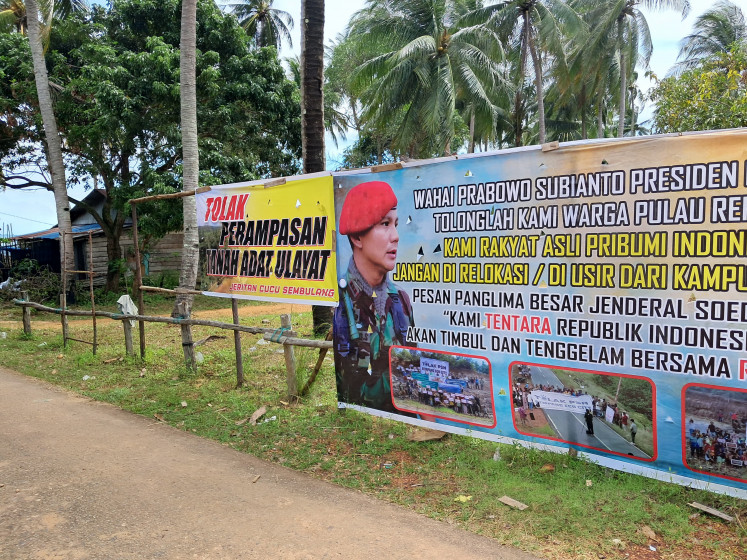
 Protest signs are pictured on Dec. 5, 2024, on the outskirts of Sembulang village on Rempang Island, where a glass and solar panel manufacturing site is to be constructed. Set up by a group of villagers resisting eviction for the industrial project, the signs reads: “To those who have accepted relocation: You are strictly prohibited from coming back to Sembulang!!!”. (JP/Fadli)
T
he struggle of Indigenous peoples to secure justice and safeguard their customary lands and forests (ulayat) consistently collides with the formidable wall of state legal policy and judicial institutions, neither of which has demonstrated a real commitment to recognizing and protecting these fundamental rights.
A stark symptom of this structural injustice emerged in mid-September, when the Jayapura State Administrative Court (PTUN) dismissed a lawsuit filed by five Malind Indigenous leaders. The plaintiffs had challenged the environmental feasibility approval granted for a 135-kilometer road project connecting Wanam and Muting in Merauke Regency.
The case originated six months prior, when the five leaders contested a decree signed by the Merauke Regent concerning environmental feasibility. Notably, this decree was issued a full year after excavators had already begun clearing customary forests in August 2024. The drafting of the Environmental Impact Assessment (AMDAL) systematically undermined the essential rights and participation of Indigenous communities, specifically the Malind clan, the sole customary landowners of the territory spanning Wanam, Nakias and Tagaepe villages, in shaping development roadmaps within their ancestral domain.
During proceedings, the regent went so far as to deny the plaintiffs' legal standing as Indigenous peoples, citing their lack of formal administrative recognition from the regency government. Ironically, this pretext of absent official recognition is routinely deployed as a state defense to deflect legal challenges and justify environmental exploitation across Papua.
Yet, both de facto and de jure, the existence of Papuan Indigenous peoples is explicitly recognized by the Papua Special Autonomy Law, Special Regional Regulations (Perdasus) and, within the local jurisdiction, Merauke Regency Regional Regulation No. 5/2013.
The regent’s denial exposes a profound institutional absurdity. In the context of advancing and fulfilling human rights, the state is obligated to guarantee the rights of Indigenous peoples by taking active measures to formally recognize and register their legal existence, rather than exploiting its own administrative inaction as a weapon against them.

Court proceedings also laid bare the total absence of Free, Prior and Informed Consent (FPIC) at both policy and operational levels. The plaintiffs were never meaningfully consulted before heavy machinery cleared their ancestral lands. Instead, the bureaucracy engineered a fait accompli, deliberately excluding dissenting community members from deliberations.