The Jakarta Post
Please Update your browser
Your browser is out of date, and may not be compatible with our website. A list of the most popular web browsers can be found below.
Just click on the icons to get to the download page.


Popular Reads
Top Results
No results found. Please check your search term and try again
Can't find what you're looking for?
View all search results
Popular Reads
Top Results
No results found. Please check your search term and try again
Can't find what you're looking for?
View all search resultsWho are really behind Indonesia’s forest fires?
Holding those behind Indonesia’s forest fires truly accountable means looking past the individuals striking the matches and following the corporate paper trail straight to the parent companies profiting from the burn.
Change text size
Gift Premium Articles
to Anyone
Share the best of The Jakarta Post with friends, family, or colleagues. As a subscriber, you can gift 3 to 5 articles each month that anyone can read—no subscription needed!
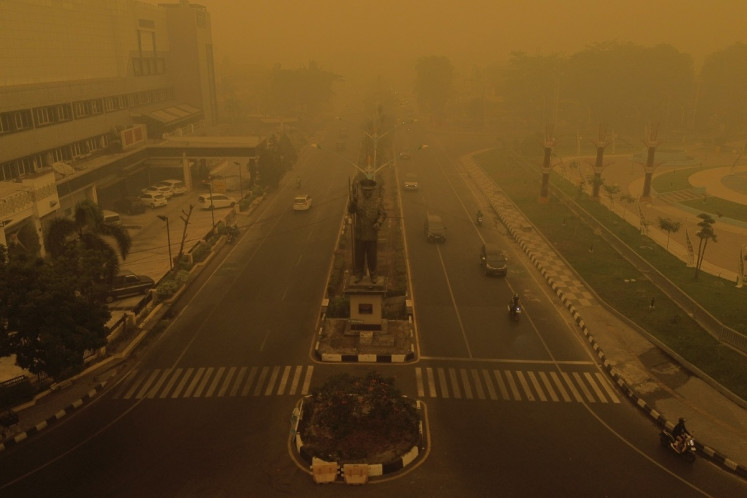
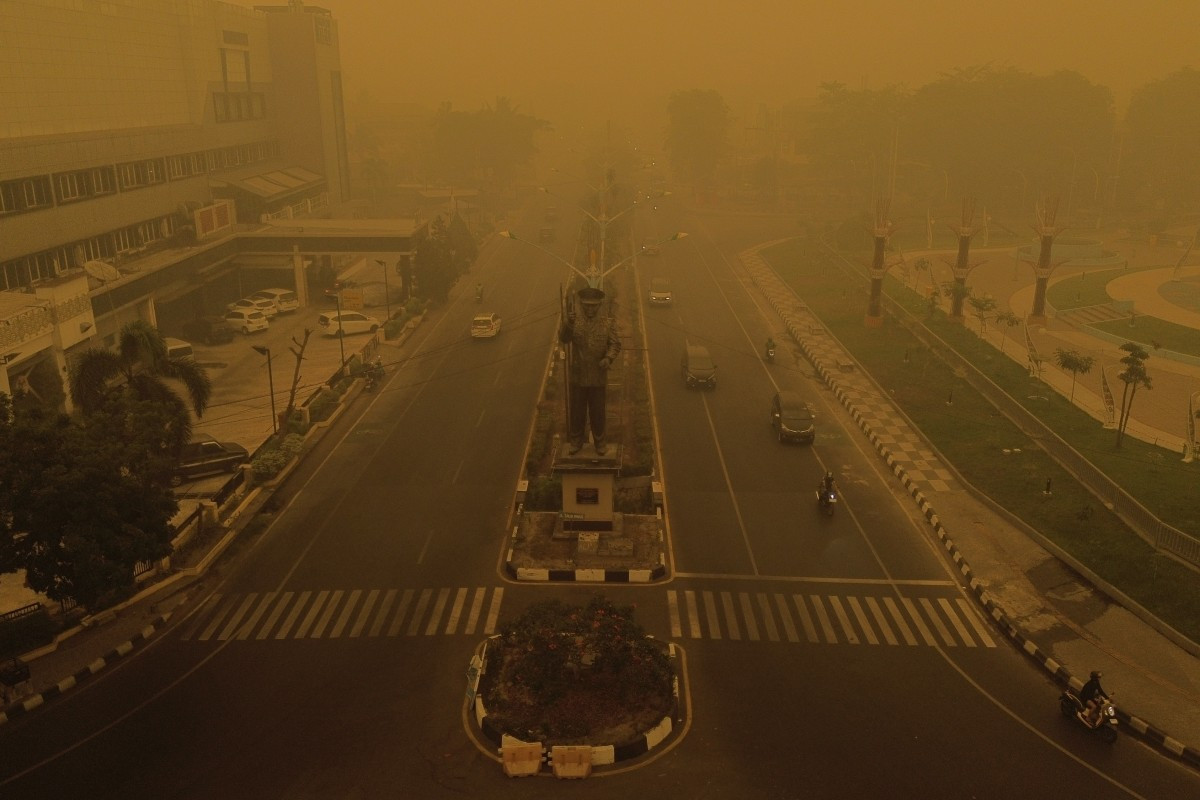 A street is choked by haze from forest fires on Oct. 15 in Palangkaraya, Central Kalimantan. Toxic haze has covered parts of Indonesia, Malaysia and Singapore for weeks as Jakarta struggles to contain fires that have scorched large tracts of Borneo and Sumatra, with smoke drifting across the region. (AFP/Afan Anugerah )
O
n Sept. 7, President Prabowo Subianto asked his ministers for the names of companies behind this year’s forest fires and wanted to know who owns them. It was the right question. More than a month later, however, the public still does not have a complete answer.
What we have seen is a growing list of individual suspects. By mid-September, police had named 162 people as suspects and said 95 companies were under investigation. Corporate cases have emerged, but enforcement still tends to focus on the entity whose name appears on the permit.
A new study by the Indonesian Forum for Environment (WALHI), Who are Behind the Fires? (Siapa di Balik Api), shows why the approach may be too narrow.
Between Jan. 1 and Sept. 7, WALHI identified 9,951 high-confidence hot spots across 561 oil-palm concession areas and 293 forestry concessions. Its analysis used NASA fire mapping systems (MODIS and VIIRS) and the government’s SiPongi data filtered for high-confidence detections and overlaid them against concession boundaries using GIS.
A hot spot inside a concession does not prove that a company started a fire. Satellite data cannot establish criminal intent or identify who held the match. But repeated fire patterns on land under the same corporate control should be treated as an investigative lead, not dismissed as coincidence.
WALHI’s more important findings concern ownership. The study traces companies with high hot spot concentrations through shareholders, directors, parent companies and beneficial owners. Many sit within larger corporate groups, sometimes through several layers of subsidiaries and cross-border ownership. WALHI argues that economic benefit, decision-making and business control may therefore lie beyond the operating company that formally holds the concession.

This matters because enforcement still largely stops at the bottom of the chain. If several subsidiaries belonging to the same group repeatedly appear in areas with high hot spot concentrations, regulators should ask whether there is a common failure of governance, supervision or risk management at group level.