The Jakarta Post
Please Update your browser
Your browser is out of date, and may not be compatible with our website. A list of the most popular web browsers can be found below.
Just click on the icons to get to the download page.


Popular Reads
Top Results
No results found. Please check your search term and try again
Can't find what you're looking for?
View all search results
Popular Reads
Top Results
No results found. Please check your search term and try again
Can't find what you're looking for?
View all search resultsAmid pandemic bike boom, invest in wheels of change
The Jakarta government should seize the bicycle madness as an opportunity to invest in the permanence of a hospitable biking environment.
Change text size
Gift Premium Articles
to Anyone
Share the best of The Jakarta Post with friends, family, or colleagues. As a subscriber, you can gift 3 to 5 articles each month that anyone can read—no subscription needed!
 Set as preferred source
H
ow to maintain your health when gyms and swimming pools are closed? How to reach your destination when you fear crowded public transport? What can benefit economic recovery from this pandemic? The answer is simple: ride a bicycle.
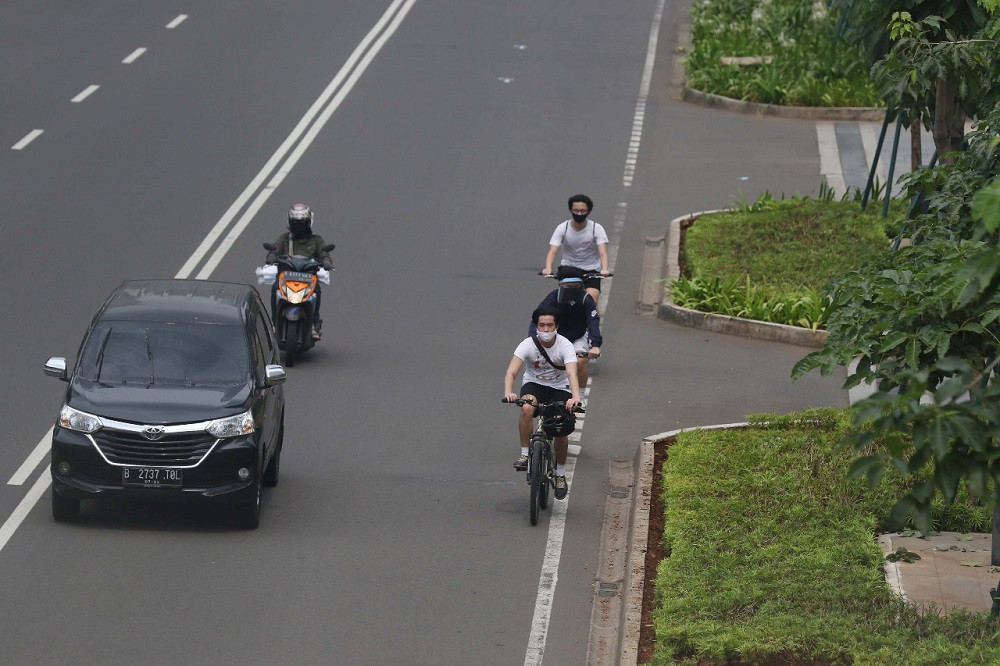
Jakarta has entered the “new normal”, so has the bicycle. The pandemic has created a massive bike craze. June saw a 500 percent increase of cycling activity in Jakarta, compared to October 2019. While COVID-19 has battered most of the economy, the bicycle industry has seen a huge boom. The Jakarta government should seize the bicycle madness as an opportunity to invest in the permanence of a hospitable biking environment, to turn the bicycle into the preferred mode of transportation in the new normal era. Subsequently, many other large Indonesian cities could imitate the bicycle revolution.
For residents of a city hard hit by COVID-19 such as Jakarta, maintaining physical and mental health has become crucial. As an alternative to canceled sport events and reduced opening hours of public sport areas, cycling proves effective to maintain health while keeping social distance. People who hop in the saddle on a regular basis reduce stress and anxiety and are less likely to have chronic diseases, which would otherwise put extra burden on already overwhelmed health workers.
Recent research by Harvard University has revealed the relation between air pollution and increased vulnerability to the most severe COVID-19 outcomes, including more hospitalization and higher death rates. Considering Jakarta’s bad air quality, it is thus more crucial then ever to invest in alternatives to air polluting motor-based mobility. Cycling as a mode of transportation will increase the city’s accessibility, which is essential for economic growth. Contrariwise, congestion costs Jakarta some Rp 65 trillion (US$4.5 billion) per year.
Many other cities around the world have long embraced cycling as one of the main modes of transport to accommodate challenges coinciding with urbanization. An example is Amsterdam. The Dutch capital has around 2 million bicycles, and all of Amsterdam’s cyclists together cycle around 2 million kilometers per day. To improve and maintain the city’s accessibility and livability, the Amsterdam authority has invested in, among other things, multilevel bike parks next to the central station, development of bike lanes and bicycle safety campaigns.
The bike boom could have a lasting, positive impact on Jakarta as well – even well beyond the pandemic – but only with ample political will to invest in a durable biking infrastructure. A lack of safety among cyclists is a huge challenge to keep the popularity of cycling alive. As long as bike lanes are only separated by stripes or traffic cones instead of permanent and physical separators, it will be no surprise that the bike craze coincides with a rising number of traffic accidents that will be a blow to cycling popularity. Motorized vehicles often drive or even park on bicycle lanes. From January 2020 to June 2020, 29 bicycle accidents were registered on Jakarta’s highways, of which 58 percent were fatal to cyclists.
It would be an illusion to think that reallocating road space from cars to bicycles will come without resistance, considering Indonesia’s powerful and active car lobby. Motor-based mobility has dominated Jakarta’s street view for many years, and this will not suddenly change with the bike craze and the reopening of offices, malls and other public places.