The Jakarta Post
Please Update your browser
Your browser is out of date, and may not be compatible with our website. A list of the most popular web browsers can be found below.
Just click on the icons to get to the download page.


Popular Reads
Top Results
No results found. Please check your search term and try again
Can't find what you're looking for?
View all search results
Popular Reads
Top Results
No results found. Please check your search term and try again
Can't find what you're looking for?
View all search resultsIndonesia's sea transportation suffers Rp 12.2t losses in H1
A Transportation Ministry webinar on Tuesday presented the findings of a study on the economic impacts of the travel ban during this year's Idul Fitri holiday season on the sea transportation sector.
Change text size
Gift Premium Articles
to Anyone
Share the best of The Jakarta Post with friends, family, or colleagues. As a subscriber, you can gift 3 to 5 articles each month that anyone can read—no subscription needed!
 Set as preferred source
A
study by the 10 November Institute of Technology (ITS) in Surabaya shows that Indonesia's sea transportation sector has recorded Rp 12.2 trillion (US$821.9 million) in output losses in the first half of the year, due primarily to the drop in passenger demand as a result of government restrictions imposed to contain COVID-19 transmission.
The ITS study evaluated the impacts on the sector from the Transportation Ministry’s ban on mudik (exodus) from April 24 to June 1 during the Idul Fitri holiday season. The ministry imposed the travel ban as part of the government's coronavirus response in an attempt to halt the disease's spread.
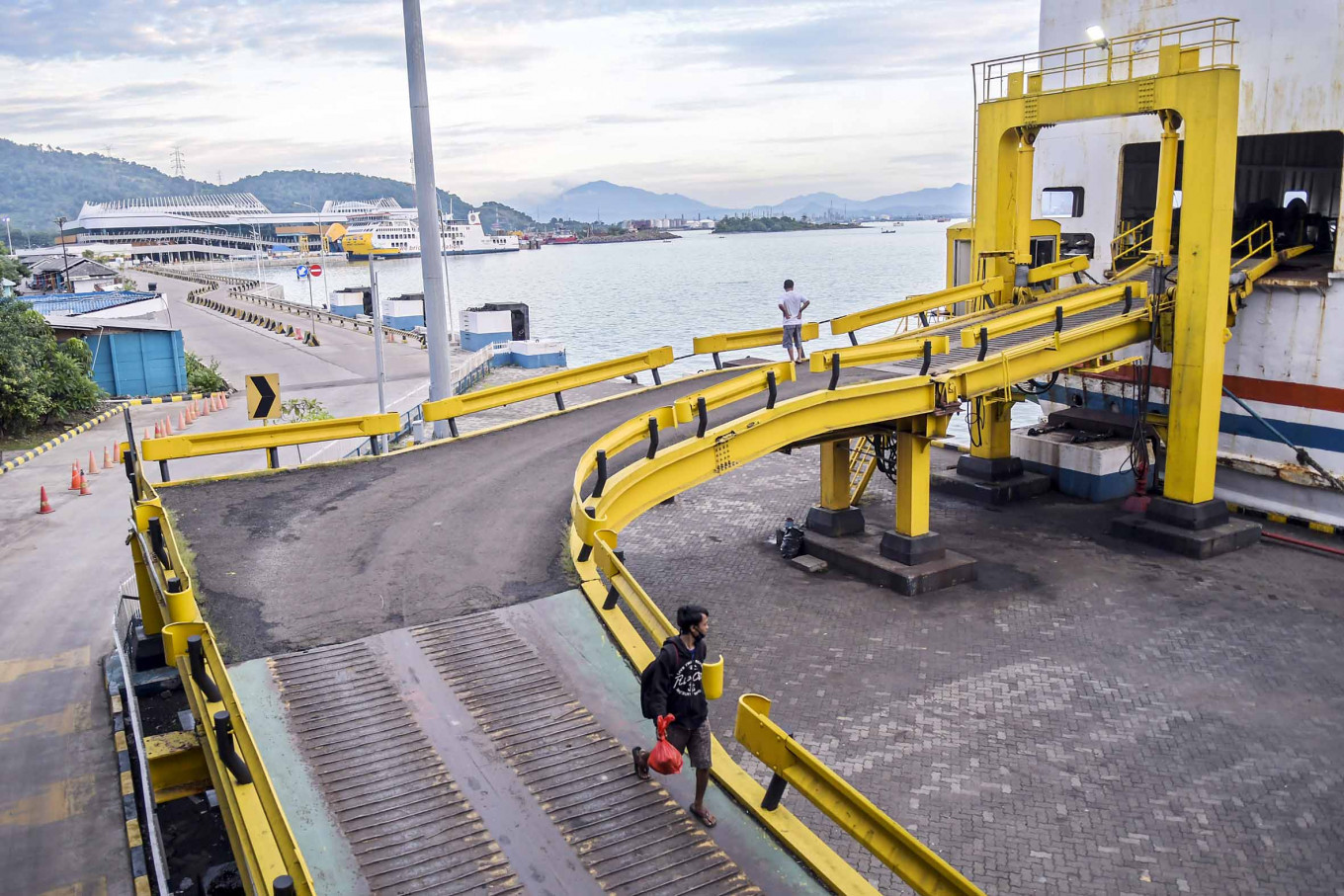
Among the losses to the sector that the study attributed to the mudik ban are an estimated loss of Rp 862 billion for state-owned shipping company PT Pelni and combined losses of Rp 44 billion for inter-island ferry companies. These include ferries operating the Merak-Bakauheni route between the provinces of Banten and Lampung, as well as those operating the Ketapang-Gilimanuk route between East Java and Bali.
“We’ve seen a huge decline in passengers during the pandemic, especially at three main ferry ports and routes. On the Merak-Bakauheni route, the number of passengers dropped around 80 to 95 percent,” ITS rector Mochamad Ashari said on Tuesday, during a webinar held by the ministry.
The decline in economic activities in the transportation industry had contributed to the 5.32 percent year-on-year (yoy) contraction in gross domestic product (GDP), according to Statistics Indonesia (BPS).
BPS data for the second quarter also show that the transportation and warehousing sector contracted 30.84 percent yoy, with the sea transportation sector suffering a 17.48 percent yoy decline.
During the webinar, ITS researcher Ardi Adji said that the contraction in the sea transportation sector in turn caused a ripple effect in local economies, with the provincial economy of Bali suffering the worst blow.