TheJakartaPost
Please Update your browser
Your browser is out of date, and may not be compatible with our website. A list of the most popular web browsers can be found below.
Just click on the icons to get to the download page.


Popular Reads
Top Results
No results found. Please check your search term and try again
Can't find what you're looking for?
View all search results
Popular Reads
Top Results
No results found. Please check your search term and try again
Can't find what you're looking for?
View all search resultsIndonesia’s needs holistic approach to sustainable bioenergy
The government needs to take an integrated, multi-sectoral approach to sustainable biofuel production in its efforts to fulfill its NDC commitments.
Change text size
Gift Premium Articles
to Anyone
Share the best of The Jakarta Post with friends, family, or colleagues. As a subscriber, you can gift 3 to 5 articles each month that anyone can read—no subscription needed!

F
ollowing the Paris Agreement in 2015, Indonesia has committed to reducing greenhouse gas (GHG) emissions by 29 percent under a business-as-usual scenario by 2030 in its Nationally Determined Contribution (NDC). It has also committed to achieving 23 percent of renewable energy (RE) in its primary energy supply by 2025.
A critical part of both efforts is biofuel, with the government targeting production of a 30 percent biodiesel blend (B30) by 2020 through to 2050, and a 20 percent bioethanol blend by 2025, to be increased to 50 percent by 2050. By 2020, however, Indonesia had achieved just 11.5 percent of its RE share, of which 35 percent came from biodiesel.
Meeting the emission and renewables targets is not just about mitigating climate change, but also about ensuring energy security. Although Indonesia is known for its rich oil resources with proven reserves of 2.44 billion barrels as of 2021, it has been a net importer since 2008.
Along with the gradual decline in crude oil production, demand has been steadily increasing, particularly in the transportation sector. As of 2018, the transportation sector’s energy demand has been dominated by oil (96 percent), of which 35 percent is imported.
Indonesia has been pushing to develop biofuel production as an answer to environmental concerns and energy security issues, especially palm oil production. Indonesia is the largest palm oil producer in the world with a production output of 40.57 million tons as of 2018. The figure accounted for more than 50 percent of the world’s palm oil output and is projected to grow 25 percent by 2029.
Further, Indonesia views palm oil as a promising export commodity. The Indonesian Oil Palm Association (GAPKI) predicts exports could reach 67 percent of total production this year. In short, Indonesia is highly confident in the sustainability of its palm oil as a sustainable feedstock oil.
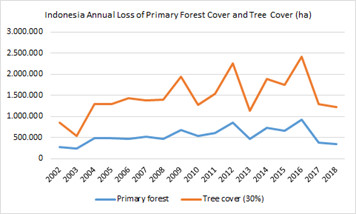
However, palm oil plantation expansion is the primary driver of deforestation and land-use change (CIFOR) and contributes significantly to Indonesia’s GHG emissions. Indonesia is the fifth-largest global emitter, with emissions reaching 1,866,552 Gg of carbon dioxide equivalent (CO2e) in 2019 according to the Environment and Forestry Ministry. Of this figure, 50 percent comes from forestry and peat fires. In 2000-2018, Indonesia lost more than 9 million hectares of primary forest and almost 25 million ha of tree cover, according to environmental news site Mongabay (see graph). Nevertheless, Indonesia has continued to issue licenses that provided an additional 891,902 ha of peatland and 3.9 million ha of forests for oil palm plantation companies.