The Jakarta Post
Please Update your browser
Your browser is out of date, and may not be compatible with our website. A list of the most popular web browsers can be found below.
Just click on the icons to get to the download page.


Popular Reads
Top Results
No results found. Please check your search term and try again
Can't find what you're looking for?
View all search results
Popular Reads
Top Results
No results found. Please check your search term and try again
Can't find what you're looking for?
View all search resultsAustralia, EU seal long-awaited trade deal amid global trade tensions
Previous talks collapsed in 2023 largely over disagreements on EU quotas for meat imports and protections for the agricultural sector.
Change text size
Gift Premium Articles
to Anyone
Share the best of The Jakarta Post with friends, family, or colleagues. As a subscriber, you can gift 3 to 5 articles each month that anyone can read—no subscription needed!
 Set as preferred source
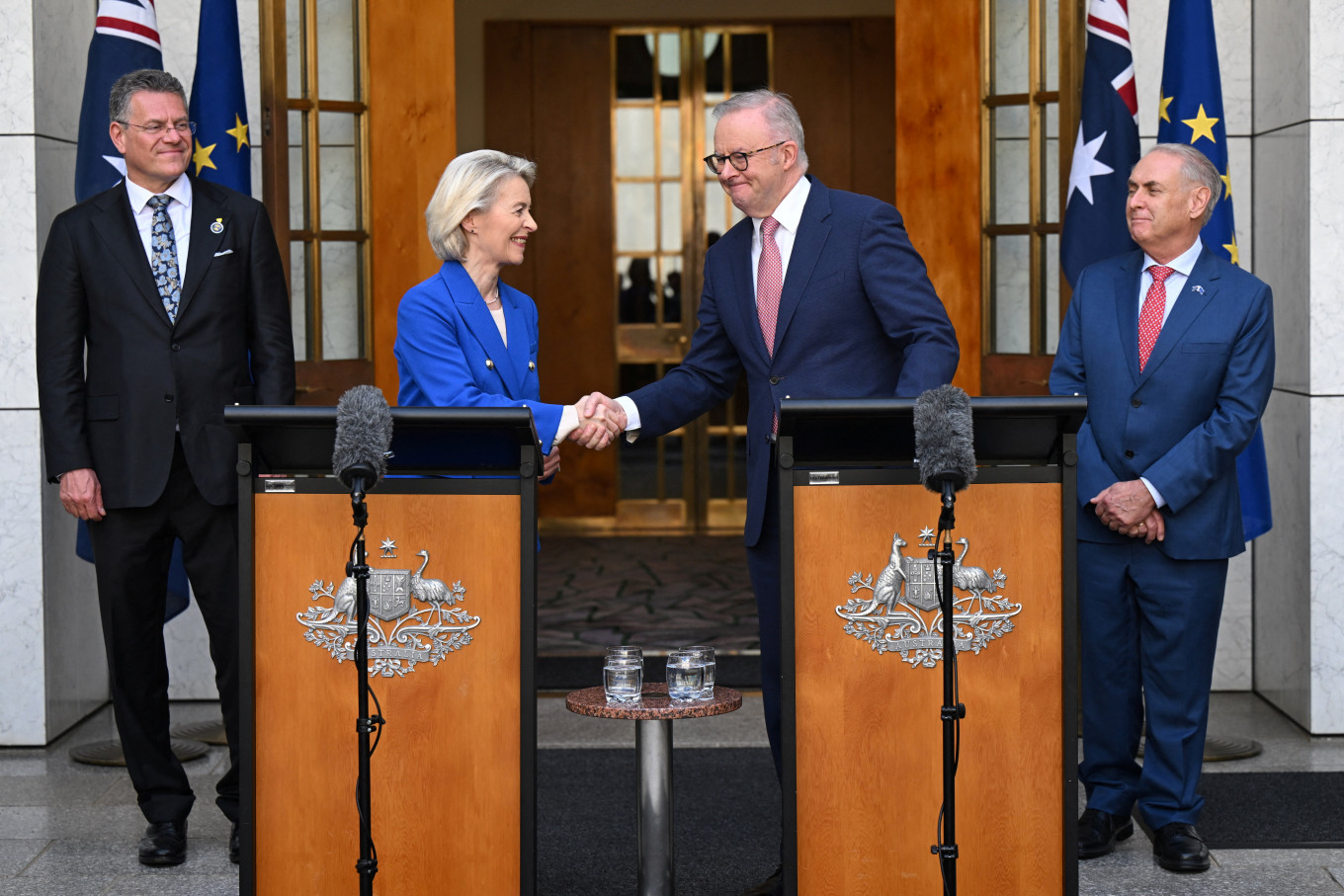 Australian Prime Minister Anthony Albanese and President of the European Commission Ursula von der Leyen shake hands during a press conference at Parliament House in Canberra, Australia, on March 24, 2026. (AAP via Reuters/Lukas Coch)
A
ustralia and the European Union on Tuesday signed a trade deal marking the culmination of years of negotiations, as Europe seeks to diversify its export markets and expand ties beyond its traditional partners.
Talks between Australia and the EU began in 2018 but progress had been gradual before gaining momentum amid rising global trade tensions, partly driven by United States tariffs.
The deal also reflects the EU's push to reduce dependency on China, particularly in critical minerals where Beijing has imposed export controls on some key resources and signals Europe's growing engagement in the Indo-Pacific, after striking trade accords with Indonesia in September and India in January.
The agreement will remove over 99 percent of tariffs on EU goods exports to Australia, cutting one billion euros (US$1.16 billion) a year in duties for companies. It will also lower tariffs on imports of critical minerals, the EU said.
'Moving closer together'
"The EU and Australia may be geographically far apart but we couldn't be closer in terms of how we see the world," European Commission President Ursula von der Leyen said after meeting Prime Minister Anthony Albanese in Canberra.
"With these dynamic new partnerships on security and defense, as well as trade, we are moving even closer together."
The European Commission, which oversees trade policy for the 27-nation bloc, expects the deal to help increase its total exports to Australia by up to 33 percent over the next 10 years.
In services, the EU will gain more access for telecoms and financial services, while in agriculture, Australian tariffs will drop to zero for wine, sparkling wine, fruit and vegetables and chocolates from day one and for cheeses over three years.
For beef, the EU will open two tariff rate quotas of a total of 30,600 tons, with about 55 percent of the volume to enter duty-free.
Previous talks collapsed in 2023 largely over disagreements on EU quotas for meat imports and protections for the agricultural sector.
Trade between the two sides is substantial, with EU firms exporting to Australia 37 billion euros of goods in 2025 and 28 billion euros of services in 2023.
As a bloc, the EU was Australia's third-largest two-way trading partner in 2024 as well as the sixth-largest export destination, official data showed. The bloc was Australia's second-largest source of foreign investment in 2024.